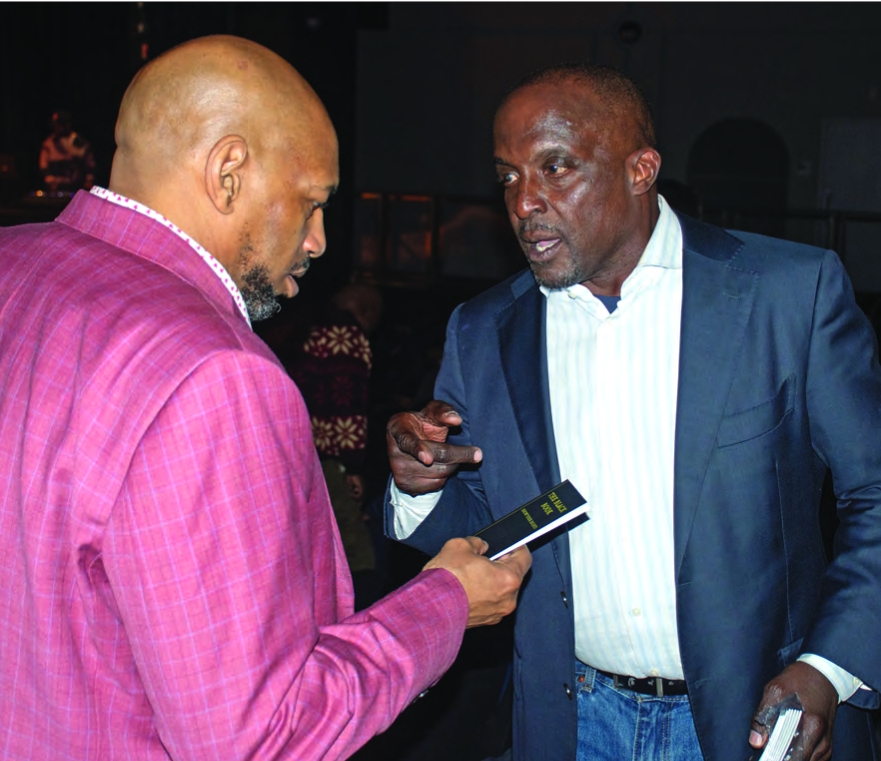
Ron
Bell (right), founder of Dunk the Vote, hands out copies of the
organization’s “Black Book” at the Boston Office of Black Male
Advancement Empowerment Summit, March 7. The book explains civil rights
broadly, as well as specifically in reference to areas like voting
access, immigration and racial profiling.
Thirty-three years ago, as the city of Boston grappled with a wave of racial profiling in the wake of the murder of Carol Stuart, Ron Bell, founder of Dunk the Vote, was busy handing out pamphlets about civil rights and driving while Black.
Now, Bell is returning to those roots, passing out a civil rights booklet that Dunk the Vote developed called “The Black Book: Know Your Rights.”
The booklet comes amid a changing landscape of rhetoric on the national political stage, as the administration of President Donald Trump takes aim at things like diversity, equity and inclusion. That shift and community concerns have raised fears that Bell is aiming to help address with the effort.
“There’s a great deal of fear — not just in the immigrant community, but also a great deal of fear, which has been going on for years, in the Black community,” Bell said.
The booklet is also intended to close gaps in civil rights knowledge.
“Civil rights violations happen every day and many of them go unreported,” Bell said.
By sharing the book, Bell said he wants to equip people with the necessary tools to protect their rights.
To that end, the Black Book details a range of civil rights information, including racial profiling, police brutality and voting rights. One page of the 20-page booklet is devoted to how to handle interactions with the United States Immigration Customs and Enforcement.
The booklet is available online at the Dunk the Vote website, but Bell is also making an effort to pass out physical copies in community locations like barber shops, hair salons and churches.
“I think it’s important that people have something they can put in their pocket,” he said.
And it can build new connections. At the Boston Office of Black Male Advancement’s Empowerment Summit on March 7, Bell passed out 100 of the booklets — all that he had brought with him. One of them ended up in the hands of Maurice Baynard, chair of
Philadelphia’s Mayor’s Commission on African American Males, who was
attending the event and is now interested in recreating the resource in
his city.
“With
all the changes in the federal government and responding to things like
a slew of executive orders, people need information,” Baynard said.
“Seeing it in that form just seemed perfect.”
And
having it in a physical form might help bring it to more people,
Baynard said, reaching community members through “different modalities
for different audiences.”
“Not
everybody has an internet connection, not everybody has a smartphone,”
he said. “I think this is a way to kind of democratize information.”
Often,
Bell said, individuals might face civil rights violations and not even
know it, or a community may face so many violations that they start to
become normalized. His booklet aims to take steps to change that.
“It’s
not just a matter of saying, ‘Okay, here it goes again. It’s being
normalized. They do this all the time,’” Bell said. “You have a right.”
But
even if they don’t know why, there might be a gut feeling where an
individual can tell something is wrong, even if the individual can’t
point to the specific reason, said Javier Luengo-Garrido, organizing
strategist at the American Civil Liberties Union of Massachusetts.
“You
might not be able to cite a specific law, the specific right that is
being violated, but you feel it,” he said, paraphrasing a talk from Carl
Williams, an attorney who previously worked with the ACLU of
Massachusetts.
Part of addressing those gaps in knowledge, Baynard said, should be more education broadly, across age ranges.
“This
is kind of the basics of being a citizen, and so we should start early,
right?” he said. “We should start in middle school. We should reinforce
it in high school to get people civically engaged as adults. Any right
that you don’t exercise is a right you don’t have.”
Bell’s
distribution of the booklet is reminiscent of early activities
conducted by his organization in the wake of Charles Stuart’s murder of
his pregnant wife on Mission Hill in 1989, and the wave of racial
profiling that followed when Stuart blamed the attack on a Black man.
That
event led to the start of Dunk the Vote, and in its early days, Bell
passed out “Driving While Black” packets, that had been put together by
the ACLU. He said feeling the need to hand out similar materials again
is “really sad” and feels like going back in history.
“It’s come full circle,” he said.
“We’re tired of people violating our civil rights.”
Efforts to ensure community
members know what rights they have recently have been especially
salient, particularly among immigrant communities that have been
grappling with a slew of executive orders and actions from the Trump
administration’s targeting undocumented immigrants and using rhetoric
that critics say pulls away from the civil rights of other Black and
brown communities.
“We’re
living in a time where being able to know your rights and being able to
exercise your constitutional rights — independently, or if you’re a
citizen or not — is really important,” said Luengo-Garrido, whose work
with the ACLU of Massachusetts has included putting together over 40
“know your rights” sessions in January and February.
Those sessions, run with community organizations and
generally run in-person, have offered immigrant communities hands-on
experiences to learn about their rights and how to react in a situation
where they feel like their civil rights are being violated.
The
programming includes role-playing opportunities and a curriculum that
is targeted toward the concerns faced by specific immigrant communities —
for example, growing concern among Haitian immigrants about the impacts
of Trump’s decision in January to roll back Temporary Protected Status
for Haitian immigrants, which could mean the loss of work authorization
and Social Security numbers. That move faces a lawsuit filed by
Boston-based Lawyers for Civil Rights.
For
those immigrant communities grappling with federal actions like
increased deportation efforts and an executive order attempting to end
birthright citizenship, learning about and knowing one’s rights can be a
step they can take to pull back a little control, Luengo-Garrido said.
“One
of the ways that we’re hearing the immigrant community talking is that
even though they don’t have a lot of things that they can take control
over, knowing their rights is something that is really proactive, that
they can actually do to protect themselves,” he said.
At
least among immigrant communities, “know your rights” efforts seem to
be complicating federal efforts to increase deportations. In January,
Trump’s “border czar,” Tom Homan, said Chicago residents were too
“well-educated” about how to resist immigration agents.
That
kind of autonomy is something Bell hopes to achieve with his Black Book
too, and so far, he said, the reception has been positive.
“People
are really happy that this is happening because people have become
numb,” Bell said. “They’re walking around in fear, and so, therefore,
this is a little piece of what needs to get done.”


