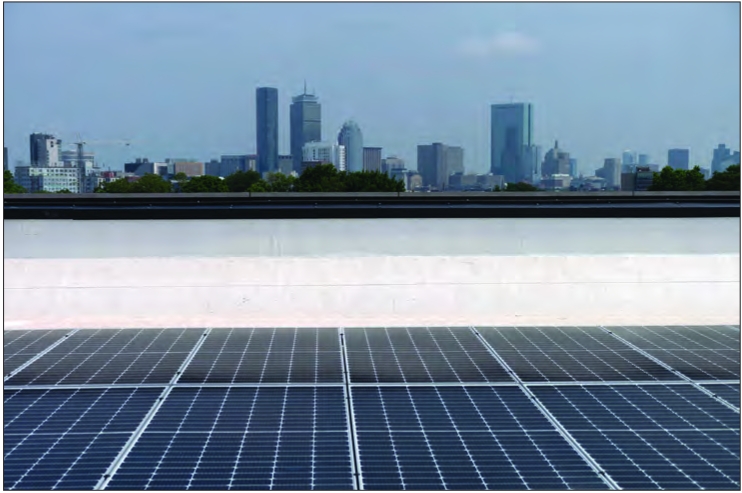
The
Boston skyline is shown rising above solar panels on the roof of the
Kenzi, an all-electric affordable housing development in Roxbury in July
2024. The Massachusetts Clean Energy Center, a quasi-public state
agency focused on economic development and climate, released a plan last
month with the goal of strengthening the state’s climate-focused
technology industry.
A new state plan aims to capitalize on funding from an economic development bond bill to grow and strengthen the state’s support for companies developing climate-focused technologies.
The Massachusetts Clean Energy Center, which developed and released the plan in collaboration with the state’s Executive Office of Economic Development, said the plan aims to solidify Massachusetts as a global leader in the space, drive equitable economic growth and advance the state’s goal to reach net-zero carbon emissions by 2050.
“This plan will solidify the Commonwealth as a leader in tackling the world’s most pressing climate challenges through innovation. Together, we’re building the foundation for sustained growth and impactful change across Massachusetts,” said Emily Reichert, CEO of MassCEC, in a statement.
She called the plan, released by the quasi-public state agency on Feb. 25, a “pivotal moment” for the state’s sector focused on climate tech — or technology aimed at mitigating the impacts of climate change and increasing resilience.
The plan set out nine goals across three broad categories: to invest in climate tech companies and infrastructure, to improve the way things operate so Massachusetts is the “best place for climate tech companies to do business,” and to better connect that ecosystem across the state and beyond.
Steps taken, the plan said, will leverage regional strengths in different parts of the state.
It
includes actions like trying to support companies that have already
started developing new technologies as well as those that are
progressing toward commercialization — the report identified the latter
as a gap in the state’s current ecosystem. The plan outlines steps like
increasing direct funding and introducing new tax incentives towards
that goal.
It aims to
drive more equitable workforce development efforts in a growing industry
that will need more workers and a variety of workers.
In
recent years, bringing more residents from the state’s communities of
color has been a priority for groups across Massachusetts, with
developing programs like a youth training course run by the Boston
professionals’ chapter of the National Society of Black Engineers, or
The American City Coalition’s Roxbury Worx initiative.
The plan outlines goals around scaling career awareness and workforce
development initiatives as well as building on opportunities like the
state’s push for free community college and equity-focused workforce
development funding.
Joseph
Curtatone, president of The Alliance for Climate Transition, spoke
positively of the state’s choice to develop a plan that doesn’t focus on
just one element of the clean energy industries. Instead, he said it
makes a “broad but very strategic” approach to change across the whole
ecosystem.
That broad
lens is something he said he thinks will help support technology get
from early ideas to being deployed and on the market.
“It
is a long journey from an innovative idea — coming up with an
innovative idea idea, developing it, refining it, developing a proof of
concept, piloting, testing, bringing it to market — but it’s happening,”
Curtatone said.
Experts said bringing new technologies onto the market will be important to meet climate goals across the globe.
According
to a September 2023 report from the International Energy Agency, to
reach global net-zero goals by 2050, about 34% of the emissions
reductions needed will have to come from technology that is not yet
commercialized. 64% of
emissions will be covered by technology already on the market and the
other 2% will be non-technology measures, that report found.
The
number of on-themarket solutions grew by almost 15% in that report from
a previous edition published by the group two years before.
The
plan also aims to fill gaps left by receding federal support. Within
the first days of his new administration, President Donald Trump took
steps to roll back clean energy generation and increase fossil fuel
production, as well as eliminating a Biden-era rule that would have
boosted the development of electric vehicles.
That
need for states to take charge was highlighted by Rebecca Tepper,
secretary of energy and environmental affairs, in a statement alongside
the release of the document. She said when it comes to the climate,
state leadership is “more important than ever.”
“This
is a forward-thinking approach that will set Massachusetts apart as a
leader in climate innovation and economic growth,” Tepper said. “By
taking bold steps now, we can ensure a future where our communities are
resilient, our economy thrives, and we continue to lead in climate
solutions.”
Curtatone
said he thinks the plan shows “incredible leadership” by the state,
especially given a federal administration led by President Donald Trump,
who has pulled away from green initiatives implemented by the Biden
administration over the last four years.
“This has proven that states can be the driving force behind a resilient, really future-focused economy,” Curtatone said.
State officials also highlighted the projected economic impact of the plan.
Gov. Maura Healey, in a statement, said the plan will generate billions of dollars and thousands of new jobs.
An
estimate released in the plan suggests the changes it proposes will
support over 1,000 companies and train 25,000 individuals.
“MassCEC’s
climate tech economic development plan is our roadmap to achieve this
goal by investing in cutting-edge technologies, tapping into regional
strengths and attracting world-class talent,” Healey said in a
statement.


