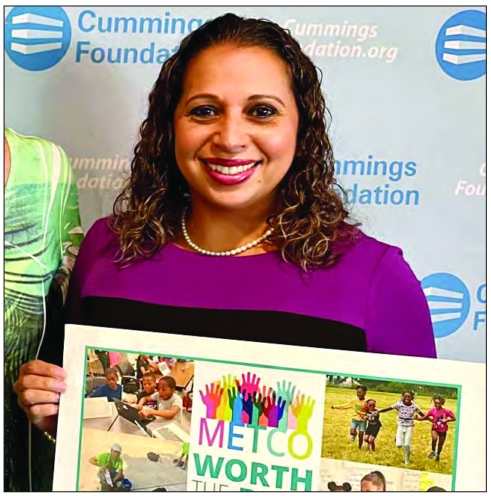
Milly Arbaje-Thomas “We need more money,” says Milly Arbaje-Thomas about Massachusetts’s only school desegregation program. She’ll visit Beacon Hill this week to ask the legislature to appropriate $33 million for the Metropolitan Council for Educational Opportunity.
Hired as the fifth leader in 2018, Arbaje-Thomas plans to step down at the end of June. As her youngest daughter starts college next year, she has not yet identified “professional next steps.” She said in a statement, “Wherever I land, it will be in support of mission-driven work.”
First things first, she’s finalizing her vision for METCO’s future.
Called METCO 2.0, it’s an antiracist roadmap for “higher accountability” of the districts voluntarily integrating their classrooms. Followed by a blueprint for changes district-wide, it will include measurable performance indicators by summer.
Board Chair Darnell Billings praised the contributions of Arbaje-Thomas and wished her “the very best in the future.” A search committee is in the works, aiming to hire a new leader by September 2025.
Every school day, 3,200 students board buses in Boston, traveling to 33 municipal and regional school districts and attending 190 schools. In Springfield, about a hundred kids do the same.
“We have nothing to do with Springfield,” she said, outside of their shared funding. “They are run by the school system over there.”
Dating to the end of separate and unequal public education, METCO is “the largest voluntary school integration program in the United States,” according to the vision.
METCO was started in 1966 by Ruth Batson, “the mother of school desegregation here in Boston,” Arbaje-Thomas said. Originally 220 students in seven school districts, it grew in the ’60s. She said the number of districts doubled “in 1968 after Dr. Martin Luther King was killed.”
Arbaje-Thomas, a former administrator with ABCD, said, “We haven’t had any other new districts since the ’70s.”
Also, once an organizer for Mattapan United, Arbaje-Thomas is a METCO
parent. She wants to raise the per-pupil rate of compensation above
$8,088. “When I got here, per-pupil [funding] was like $6,000.”
“It
goes to pay staffing and busing,” she said, and “in some cases, there’s
money available for additional programming.” Raising the rate could
fund more bus trips, since “we have some districts who can’t afford a
late bus.”
“Almost all our districts are top performing,” she said, and “in wealthy neighborhoods.”
Arbaje-Thomas
is focused on harnessing the potential of the METCO communities. The
2.0 roadmap calls for training parents, hiring organizers and
legislative advocacy.
The
Massachusetts Racial Imbalance Advisory Council documented the
“stubborn persistence” of school segregation last year. Its
recommendations include METCO expansion.
If
the legislature wants desegregation, Arbaje-Thomas said, “they have to
invest in something that has already been proven to work.”
“After George Floyd was killed, similarly, just like Martin Luther King, 11 districts reached out,” she said.
In those post-pandemic years, “we didn’t have a mechanism to onboard them” and the conversations quieted.
Arbaje-Thomas is crafting minimum commitments, a METCO pledge, for new districts joining.
Starting
out might mean “a year of preparation with the METCO blueprint” and
adopting “the METCO pledge,” she said. “If they can’t do that, then they
shouldn’t be part of the METCO program.”
“Before
we go expand to brand new communities, we have discussed internally how
to take care of our existing communities,” she said. “They already have
the staffing” and, in some cases, “available seats in their bus.”
“Bedford wants an expansion to their program,” she said. And Wayland “wanted to expand to Pre-K.”
One avenue to reduce racial segregation is increasing enrollment in the current districts.
Reading,
Westwood and Lynnfield “added 118 seats” after the pandemic. “I
basically got their numbers and got the school committee approval,”
Arbaje-Thomas recalled, “and I went to the legislators and asked them
for additional money.”
Otherwise,
budget language would have to set aside additional money for new
districts. Regardless of the funding level, enrollment for this year is
already set.
Arbaje-Thomas
is expecting a warm reception on Beacon Hill. “The legislators really
love that: having more programming,” she said. “They love 2.0.” Since
2018, the METCO line item has increased from $20.6 million to $29.9
million. H. 1 level funds the racial balancing programs.
Rep. Chris Worrell, a METCO alum, is anticipating the budget debate.
He
said, “When something works as well as METCO does, it is necessary to
ensure that it has the funding it needs to succeed and replicate where
possible.”
“As a proud
METCO graduate and parent,” said the 5th Suffolk State Representative,
“I look forward to working with parents, teachers, school districts, and
other policymakers to give METCO the resources it needs to continue to
thrive and change lives.”
Rep. Worrell is a member of the Education Committee and secured a vice chairmanship on Public Safety this session.
In recent years, the General Court has included money
for Milly’s vision. “We were able to use $500,000 last year and
$500,000 the year before,” she said. METCO funds training and district
grants for Blueprint commitments, she said, and “we hired a research
firm out of Washington, D.C.”
Ideally,
other urban districts, where racial minorities are concentrated, could
send students to their suburbs, she said. Lawrence’s students could
attend school in Andover, while Randolph’s and Brockton’s students have
the whole South Shore. Currently, Lynn’s suburbs receive students from
Boston.
If sending districts were added, she said METCO HQ could open new offices, in place of independent operations.
In
2024, a researcher found academic and economic benefits among
participants through a regression analysis. Value for suburban students
was inconclusive.
While voluntary desegregation is best, Arbaje-Thomas said, “I hope that’s not the only option.”
She
cited “white flight” from Boston “after the Judge Garrity decision of
1974” to illustrate the issue with mandates. “All the white people left
went to the suburbs, and then we ended up with more segregated schools.”
“People
that don’t get into programs like this deserve to have a quality
education,” she said, and “right in their neighborhood.”
One
source for increasing METCO funding is Fair Share tax revenue, she
said. Her ask is relatively modest, compared to the billions involved.
Plus,
Arbaje-Thomas said, a lot of the Fair Share money is coming from “the
METCO communities, from those suburbs that are wealthy.”


