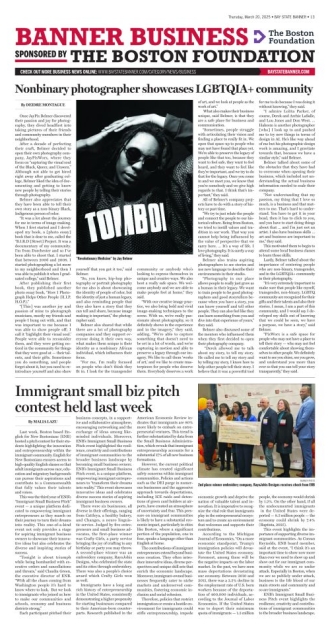
“Revolutionary Medicine” by Jay BelmerOnce JayPix Belmer discovered their passion and joy for photography, they dived headfirst into taking pictures of their friends and community members in their neighborhood.
After a decade of perfecting their craft, Belmer decided to open their own photography company, JayPixWorx, where they focus on “capturing the visual soul of the Black, Queer, and Unseen.” Although not able to get hired right away after graduating college, Belmer liked the idea of documenting and getting to know new people by telling their stories through photography.
Belmer also appreciates that they have been able to tell their own story as a non-binary Black, Indigenous person of color.
“It was a lot about the journey for me in terms of image making. When I first started and I developed my book, a [photo essay] book that is dear to me, called the “B.I.R.D [Street] Project. It was a documentary of my community. I’m from Dorchester and so I’ve been able to shoot that. I started that between 2006 and 2008. I started photographing a lot more in my neighborhood and then I was able to publish it when I graduated college,” said Belmer.
After publishing their first book, they published another photo essay book, “How I Photograph Helps Other People (H.I.P.H.O.P.).”
“[This] was another joy and passion of mine to photograph musicians, mostly my friends and people I hung out with, and that was important to me because I was able to show people off; I call it ‘highlight their visual soul.’ People were able to reconsider them, and they were getting noticed in the community for things that they were good at — their talents, and their gifts. Sometimes you do something, and people forget about it, but you need to reintroduce yourself and also show yourself that you got it too,” said Belmer.
“So,
you know, hip-hop photography or portrait photography for me also is
about showcasing the identity of people of color, but the identity of
just a human legacy, and also reminding people that they also have a
story that they can tell and share, because image making is important,”
the photographer said.
Belmer
also shared that while there are a lot of photography companies and
they support everyone doing it their own way, what makes them unique is
their identity as a nonbinary African individual, which influences their
focus.
“For me, I’m
really focused on people who don’t think they fit in. I look for the
transgender community or anybody who’s looking to express themselves in
unique and creative ways. We also host a really safe space. We welcome
anybody and we are able to make people feel at home,” they said.
“With
our creative image practice, we also bring bold and vivid image-making
techniques to the scene. With us, we’re really passionate about
photography, so it definitely shows in the experience and in the
imagery,” they said, adding, “We’re able to capture something that
doesn’t need to be set in a lot of words, and we’re capturing in motion
and able to preserve a legacy through our imagery. We like to call them
‘works of art,’ and we like to create masterpieces for people who
deserve them. Everybody deserves a work of art, and we look at people as
the work of art.”
What also makes their business unique, said Belmer, is that they are a safe place for business and communication.
“Sometimes,
people struggle with articulating their vision and finding a place to
really fit in. We open that space up to people who may not have found
that place yet. We’re able to preserve the legacy of people like that
too, because they want to feel safe, they want to feel heard, and they
want to feel like they’re important, and we try to do that for the
legacy. Once you come in and we meet you, we know that you’re somebody
and we give high regards to that. I think that’s important,” they said.
All of Belmer’s company projects have to do with a story of history or past time.
“We
try to just relate the people and connect the people to our historical
culture. Being from Boston, we tried to instill values and tradition in
our work. That way you cannot help being influenced by the value of
perspective that we carry here. … It’s a way of life. I love
photography. It is surely a way of living,” they said.
Belmer also trains aspiring photographers to see stories and use new language to describe their environments in their studio.
“Photography
in our place allows people to really just grow as a human in their
legacy. We want to train people to be good photographers and good
storytellers because when you have a story, you can know yourself and
tell other people. They can also feel like they can learn something from
you and dive into that experience of yours,” they said.
Belmer also discussed some of the mentors who influenced them when they first decided to open their photography company.
“Derek
allowed me to talk about my story, to tell my story. He called me to
tell my story and by telling my story, I know how to help other people
tell their story. I believe that it was a powerful tool for me to do
because I was doing it without knowing,” they said.
“I
admire Lolita Parker, of course, Derek and Archie LaSalle, and Lou
Jones and Don West. … Hakeem is another photographer [who] I look up to
and pushed me to try new things in terms of design in AI. He’s like way
ahead of me but his photographic design work is amazing, and I gravitate
towards that, because we have a similar style,” said Belmer.
Belmer
talked about some of the obstacles that they have had to overcome when
opening their business, which included not understanding the actual
business information needed to scale their company.
“Not
understanding that my passion, my thing that I love so much, is a
business and that matters to me. That’s hard to understand. You have to
get it in your head, then it has to click to you, and you have to start
doing things about that … and I’m just not an artist. I also have
business skills … art and business are important to me,” they said.
This motivated them to begin to attend some local business classes to learn those skills.
Lastly,
Belmer talked about the importance of centering people who are
non-binary, transgender, and in the LGBTQIA+ community in their
photography.
“It’s
very extremely important to make sure that people like myself,
transgender, non-binary, LGBTQ community are recognized for their gifts
and their talents and also their stories. I mean, I am a part of this
community, and I would say I developed my skills out of knowing that we
could be seen, we have a purpose, we have a story,” said Belmer.
“PixWorx
is a safe space for people who may not have a place to tell their story
— who may not feel comfortable about showing themselves to other
people. We definitely want to see you shine, see you grow, and
understand you more than ever so that you can tell your story
transparently,” they said.