A wooded path meanders through Franklin Park. 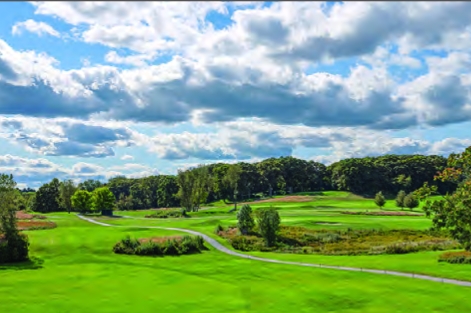
The
William J. Devine Memorial Golf Course in Franklin Park, established in
1896, is the second oldest public golf course in the nation.
When Boston was young, after our revolutionary era, the Shawmut Peninsula looked onto a forested hillscape. Nearly everywhere in sight was Roxbury.
The hills held a secluded sylvan valley nearby: Franklin Park. Then, as now, Bostonians escaped to nature there.
In 1871, speaking in Boston, Frederick Law Olmsted outlined his vision. He called for a “depth of wood” for both “comfort in hot weather” and to “completely shut out the city from our landscapes.”
Unlike the rest of the emerald necklace, where water features prominently, Franklin Park is cloaked in woodlands. The only water, Scarborough Pond, is manmade. Its attractions are not obvious to passersby. They must be discovered.
For Rickie Thompson, president of the Franklin Park Coalition, such discovery was the story of his childhood in Boston.
“When I was a kid, my mother used to take me on the streetcar,” he recalled. They’d disembark near Peabody Circle and visit the zoo.
“Living in Grove Hall,” Thompson believed “it was our park.”
He said, “We could run, we could play sports, we could go to a concert.” He remembers kite festivals and cook-outs too. As a teenager, he watched productions put on by Elma Lewis in The Playhouse “every night during the summertime.” The performances took place in “the ruins, the foundation” of “an old field house that burned down in the ’40s.” In high school, as a cross-country runner, he explored the park. “I realized it was a lot more than just a zoo,” he said.
Franklin Park has hosted a New England cross country championship routinely since 1914.
Now,
like other retirees, Thompson gets daily exercise walking in the park.
At times in the wilderness, “you don’t realize you’re in the city
anymore,” he said.
“It
was a hidden jewel, a hidden secret,” recalled Charlie Titus. As a
teenager living on Columbia Road, Franklin Park was a walk away. Then,
it was a place for youthful mischief. In recent years, he developed a
love for golf at Franklin Park. Now, his family hosts the Paula Titus
Golf Outing there.
Titus
described the golf course as “beautiful” and “marvelous.” With “fescue
and sand traps,” its challenges are “just different.”
“New Boston,” he said, is “playing at Franklin Park.” Especially “a lot of young professionals living in South Boston.”
For the “condition of the course and the price to play,” he said, “you’re just not going to get that value anywhere else.”
“Old-timers”
too, said Titus, have “been playing the course for years.” He credits
Rudy Cabral, of the Boston Parks and Recreation Department, with the
interclub’s vitality.
In 2022, “for the first time ever,” he said, Franklin Park held a “lottery for memberships.”
Set in The Country Park, golf is played between puddingstone ledges and old growth trees.
The
course is embedded in the city. With mirth, Titus mentioned playing
past cookouts and pedestrians walking through fairways. “People in the
immediate neighborhoods and community feel like it’s their park,” said
the long-time UMass Boston athletics director. “They own it.”
Franklin
Park, for UMass Amherst’s Olmsted scholar Ethan Carr, is “the shrine of
Black golf in Boston.” Perhaps, beyond. An editor of Olmsted’s papers,
Carr consulted on the Franklin Park Action Plan. He acknowledged the
“interface” between golfers and pedestrians could improve. “There are
places where the golf course could be more open to people.”
Overall,
golf minimally intervenes. Golf, he said, “has never been as big an
imposition on people enjoying the park” as commonly thought. Course
construction barely altered what Olmsted preserved. “Franklin Park is
still there,” Carr said.
Before
Olmsted, the land was dotted with country estates. After the civil war,
the surrounding neighborhoods were built out. Boston’s dense urban core
was sprawling through Roxbury.
Balancing between separatist and annexationists, Roxbury was sundered at Seaver Street, then wholly
enveloped. An urban-suburban edge of parkland — the Arnold Arboretum and
the Emerald Necklace — ensued.
Still
one of America’s largest cities, Boston outgrew Jamaica Pond’s water
supply. The capital procured water from Lake Cochituate. Nearby towns,
also straining natural sources, turned to Boston.
Roxbury
Historian Byron Rushing explained “what drew the towns into annexation
was the plans to have indoor plumbing.” Until then, Bostonians “rich or
poor,” the retired lawmaker said, “went to the bathroom outside.”
South
of the Charles River, only Brookline resisted the land grab. It had its
own reservoir. When the legislature established the nation’s first
regional wastewater system, the annexation movement abated.
Old
streets and landmarks memorialize the residents who lived in these
fringe areas. The first street to Blue Hill Avenue after Seaver bore the
name of the Williams family. They “owned tons of Roxbury between Seaver
Street and down to Walnut Avenue,” Rushing said. “The art museum, Barry
Gaither’s museum,” he explained, “those are descendants of the
Williamses who built that.”
Rushing said they built the building where Citizens Bank operates in Dudley Station, now Nubian Station.
Olmsted’s
designs changed little. In his lifetime, one of the park’s few
structures was Ellicott Arch. Its rough-boulder exterior carries circuit
drive over a walkway into the Country Park. Its mason, John Watson,
with Olmsted and horticulturalist William Fischer, were the “most
important designers of Franklin Park,” Carr said.
Named
to honor Benjamin Franklin’s bequest to the city of Boston, Franklin
Park “was mostly built between 1885 and, say, 1895,” Carr said. The
revolutionary diplomat’s fortune matured after 100-and 200-years.
“The zoo was added in 1912. They started playing golf in 1896,” Carr said.
Generation
to generation, things change. “Landscapes aren’t like other works of
design,” said the historian, “you don’t just have one person design it.”
Franklin Park is “constantly changing” depending on “who uses it and
who loves it.”
The 20th century saw demographic change in the
surrounding neighborhoods. Richard Heath’s 1985 history of Franklin Park
chronicles the ad hoc polity. “By the end of the 1960s, Roxbury and
North Dorchester were almost exclusively Black communities,” Heath
wrote. Elma Lewis, he recalled, began devoting her efforts to Franklin
Park in 1969. Her timing was critical.
“In
the 1960s and ’70s, Boston stopped maintaining Franklin Park,” said
Carr. Mostly, “white Boston stopped using Franklin Park.”
In 1971, the Franklin Park Coalition was founded.
Rickie Thompson said FPC’s work echoed prior neighborhood action. The
“predominantly Jewish” neighbors in Grove Hall “brought their own lawn
mowers out and cut the lawn on the golf course.”
Through the coalition, Black residents were doing “kind of the same thing.”
For Richard Heath, Franklin Park was “Black turf.”
The
busing era strife was cruel to the landscape. In 1974, Louise Day Hicks
held up nearly $1 million, destined in part to the golf course.
Formally part of an investigation, she
questioned whether the money “would benefit all the people of our city.”
She said, “our people can’t even go into” Franklin Park.
“It was abandoned by white Boston and officially by the city of Boston,” said Carr.
“In
those days, ’75, ’76, ’77, ’78, there were only nine holes open because
the rest of it was just in a total state of disrepair,” Titus
remembered. And yet, the park survived to flourish today. Largely,
thanks to the community that embraced it.
For Thompson, the mission remains “to make Franklin Park a destination for people from across the city.”
Forty-five
years ago last week, the Boston Landmarks Commission approved a report
to designate Franklin Park as an official landmark.