The
Edward Davis Company, led by former BPD commissioner Ed Davis, won the
contract to manage civilian flaggers working construction sites that
involve street traffic.
Some say bid process was rigged to favor ex-police officers
It was a years-long effort to persuade city officials and police unions to allow civilians to take on the paid construction details that have long been the exclusive domain of police officers. When the administration of Mayor Michelle Wu in 2023 inked a contract with the patrolmen’s union that allowed civilians to work details, many activists were encouraged.
But now that the city has awarded the contract to a firm to manage civilian flaggers, as those whose work details are referred to, some say the process was rigged. The Edward Davis Company, led by the former Boston Police Department commissioner, was announced as the successful bidder on the contract Friday.
Larry Ellison, former head of the Massachusetts Association of Minority Law Enforcement Officers, said the language in the city’s 2023 contract with the Boston Police Patrolmen’s Association (BPPA) all but assured Davis would get the contract, containing stipulations that the firm managing civilian flaggers be “a Massachusetts organization with law enforcement experience that
has knowledge of how the paid detail system operates in the City of
Boston,” and that the entity has “a minimum of three years experience
providing staffing for outside traffic control.”
The
Edward Davis Company, which has a contract to manage civilian flaggers
at Logan International Airport for MassPort, is the only firm in the
state that has such experience.
“When
you put in language like that, you’ve pretty much written it for Ed
Davis,” Ellison said. “It was written to exclude everyone but Ed Davis.”
While
there are two security companies owned by Black ex-police officers,
both of whom have had experience working with the police detail system,
neither firm has managed civilian contractors.
“This was Michelle Wu doing a favor for a friend,” Ellison said.
Davis
advised Wu during the search for a new police commissioner, which
resulted in the hiring of current Commissioner Michael Cox.
During
Davis’ tenure as BPD commissioner, from 2006 to 2013, MAMLEO issued a
vote of no confidence, citing what members said were policies that
undercut the recruitment and promotion of officers of color in the
department.
The
Mayor’s Press Office did not respond directly to questions from a
reporter on the awarding of the contract to Davis, instead issuing a
statement.
“Reforming
the detail system is a historic step taken by the City to ensure better
coverage of details and create more job opportunities for residents
across Boston’s neighborhoods,” the statement reads. “The City is
grateful to our Boston Police officers for their hard work and
commitment to our residents and look forward to continuing our work to
make Boston the safest major city in the country.”
Typically,
when city or state officials seek to make a large contract available to
small minority-owned firms, the work is broken down into pieces. Yet
the city’s RFP for flaggers extends exacting requirements to any
potential subcontractors — a move that would exclude any firm not run by
an ex-police officer from winning a bid.
“If
partnering with subcontractors for aspects of the work, all
organizations have at least 3 years experience with paid detail system
in Massachusetts,” the RFP reads.
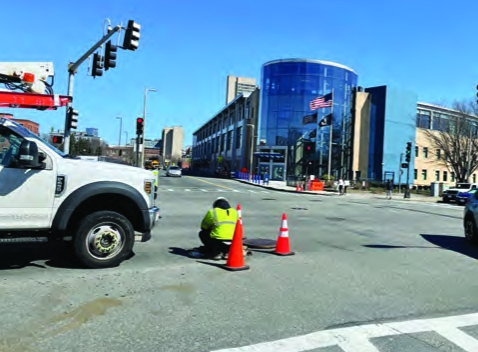
Under
city law, construction firms must hire police details any time
construction work takes place on a street or when it in any way blocks
traffic. The construction and utility firms that perform such work pay
for the detail.
The city’s decision to allow civilians to work
paid details comes after years of advocacy from criminal justice reform
activists. Although the details pay more than $40 an hour, they have
until now remained exclusively under the control of the Boston Police
Department, even though there are often not enough officers to fill in
all the needed details. In 2023, 52,462 details went unfilled — 43% of
the total number requested by construction firms, according to the
city’s records.
In the
city’s 2023 contract with the BPPA, Boston police officers have
priority in the assignment of construction details. Any details that go
unfilled by BPD officers are made available to a hierarchy of other
workers, including university police officers and retired BPD officers.
Civilians with no law enforcement experience have the lowest priority.
Activists who pushed the city to open details to civilians say the city’s
request for proposals for the project unfairly eliminated competition
from anyone not in law enforcement beginning with the stipulation that
firms competing for the contract be “a Massachusetts business
organization with law enforcement experience that has knowledge of how
the paid detail system operates in the City of Boston.”
“These
qualifications — in-depth knowledge of the paid detail system — they’re
going to exclude everyone but police officers,” said Fatema Ahmed of
the Muslim Justice League. “How is this actually opening the jobs up to
civilians?”
Paul
Joseph, a retired police officer who administered paid details while
working for the department, questioned why the city’s RFP called for law
enforcement experience.
“This
is a clerk’s job,” Joseph said. “It’s not rocket science. You don’t
have to be the head of a large corporation to manage this.”
The city’s RFP requires the selected firm to be prepared to train up to 600 people.
Ahmad
noted that most other states do not require a law enforcement
background for flaggers to direct traffic around construction projects.
“We’re
making it unnecessarily complicated, compared to the rest of the
country,” she said. “These are really well-paying jobs that should go to
folks who need them.”
Flipside News