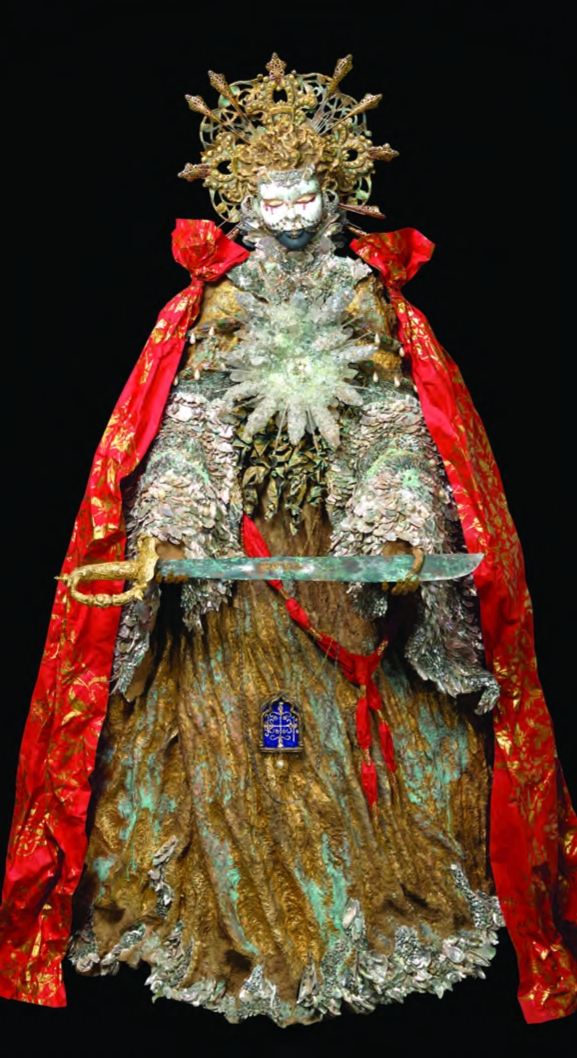
“Lwa,”
2021-2022. Papier-mâché with painted surfaces and applied abalone
shells, glass, crystal, metal and other mixed media. ©2024 Fabiola
Jean-Louis. 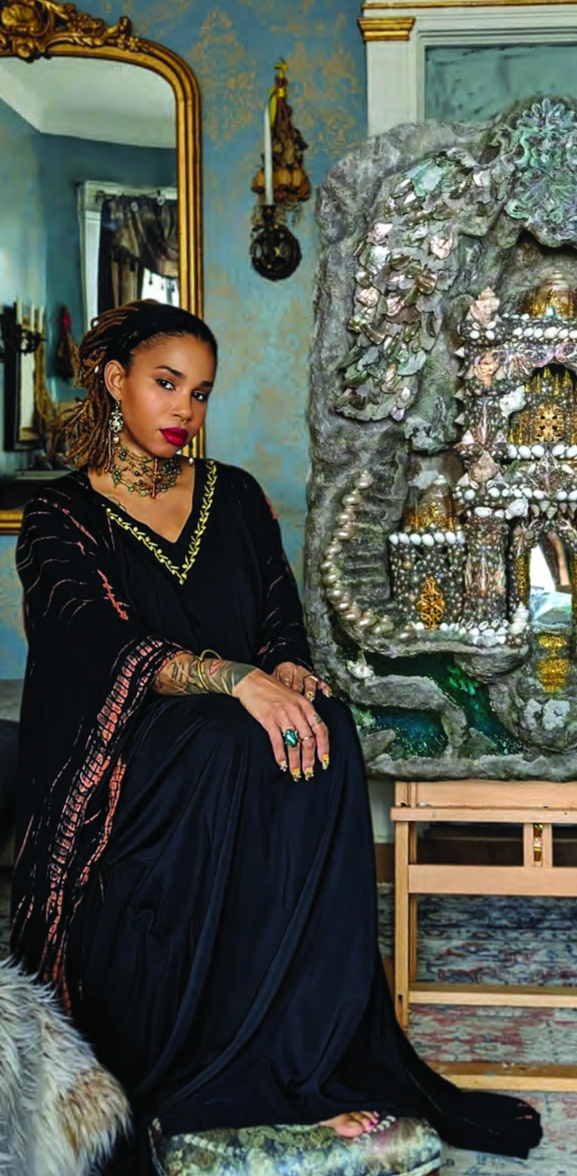
Artist Fabiola Jean-Louis © Fabiola Jean-Louis

Haitian artist Fabiola Jean-Louis teased her power during her 2023 exhibition at the Isabella Stewart Gardner Museum “Rewriting History.” Now, back in full force, she’s taken over three gallery spaces in the museum for a masterpiece exhibition, “Waters Of The Abyss: An Intersection of Spirit and Freedom.”
The experience begins with “Ayiti-Tomè,” a public art piece hanging on the façade of the museum. Ayiti was the original Taíno name of Haiti. Jean-Louis has a background in photography but has become known for her tactile paper sculptures and dresses, very physical handcrafted objects. “Ayiti-Tomè,” on the opposite end of the creative spectrum, is an exploration of AI.
Jean-Louis fed an AI platform photographs of her work and of Haiti and ultimately guided it to produce the image shown on the façade. This is a new way of working for her, which is precisely the point.
“Afrofuturism is looking to the past, looking at the present, looking to the future, but then that also includes being a part of technology,” says Jean- Louis. “It’s really important to use what we have access to, to imagine a future or to imagine a present that is not what it currently is.”
Pieranna Cavalchini, the Tom and Lisa Blumenthal Curator of Contemporary Art at the Gardner, recommends viewers then move to the Fenway Gallery, a small space tucked into the heart of the museum, just off the famous flowering courtyard. Here, Jean-Louis gets personal.
Two paintings with ornate, sculpted paper frames depict Jean-Louis. In one, a fantasy landscape, perhaps an alternative Afro-futuristic reality, includes her children as well as mermaids, deities, loved ones and pieces of the Haitian landscape.
“This part is more personal,” said Cavalchini. “And I think it’s based on who she was and who she became after all the research she did and the thinking about her origins.”
Jean-Louis was born in Haiti in 1978 and immigrated to Brooklyn, New York, as a young child. She was entrenched in vodou roots and tradition but also went to Catholic school in the United States.
In some ways, her work is a way of rediscovering the pieces of herself that were left on the island.
Between the self-portraits, two of her spellbinding 18th-century paper dresses are staged alongside depictions of those garments in an illuminated manuscript style.
The manuscript is another allusion to the future.
Jean-Louis’s next big project is a series of illuminated manuscript
books depicting different vodou spirits called lwa and the visual
markings, called veves, that are associated with them.
The
final stage of the experience is the largest exhibition in the
Hostetter Gallery. If the sheer scale and number of objects feels
stunning, it should. Jean-Louis made almost all of the objects on
display in the museum in the last two years, specifically for this
exhibition. In many cases, this is the first time the objects have been
on public view.
Everything
in this room is made of paper, from the larger-than-life sculptures of
figures and mermaid tails to the framed portals to the spirit world
hanging on the walls. To create these kinds of objects, Jean-Louis makes
a paper pulp paste that she uses to sculpt physical forms. Jean-Louis
uses paper very specifically. Paper represents power.
“Paper
is very sacred to Jean- Louis, because it’s also connected to identity
and who we are,” said Cavalchini. “For instance, if you don’t have a
birth certificate, you don’t exist. And in some countries, it’s very
hard to have one, like in Haiti.”
This use of paper as a formidable tool to reshape and even remove identity, legitimacy and resources is particularly timely.
“Waters Of The Abyss: An Intersection of Spirit and Freedom” is on view at the Gardner Museum through May 25.
In
this exhibition many of the sculptures include shells and stones from
Haiti and lots of gold and reflective material. According to the vodou
tradition, bright, reflective light attracts spirits.
The
spiritual is heavily present in the exhibition. Jean-Louis mixes
Christian symbols with Haitian vodou lwa and veve representations. This
tension ties into Haitian history. Christianity was used to control and
isolate enslaved Africans and vodou was used during the revolution that
established Haiti as the first free Black republic in the world. Jean-
Louis explores here how spirituality is tied to liberation and freedom.
She says Haitians, and other folks of the diaspora, are still trying to
reconnect to the spirituality and cultural connections that they were
separated from by oppressors.
The
exhibition serves many purposes. It’s a love letter to Haiti, it’s a
call to connect to ancestors and ancestral spirituality and, Jean-Louis
hopes, it’s a template for how to move forward in a complicated time.
“I
see myself as a spiritual being having human experiences, and that’s
how I try to lead every day my life,” said Jean-Louis. “And this work
reflects that hope that others can do the same.”
“Waters Of The Abyss: An Intersection of Spirit and Freedom” is on view at the Isabella Stewart Gardner Museum through May 25.
Learn more at gardnermuseum.org/calendar/fabiola-jean-louis-water-of-the-abyss.


