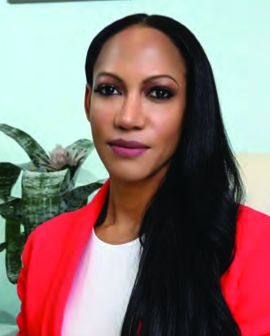
Dr. Judith Joseph Black women are disproportionately at risk
WORD IN BLACK
Judith Joseph has spent years watching highly successful people unravel behind closed doors. They run companies, excel in their fields, and keep their social lives intact — until they don’t.
As one of the leading psychiatrists in the country and social media health influencer — nearly 700,000 people follow her across Instagram and TikTok — and soon-to-be published author, Joseph believes in the power of healing. In her upcoming book, “High Functioning: Overcome Your Hidden Depression and Reclaim Your Joy,” (out April 8,) she unpacks the quiet crisis of high-functioning depression and the ways to heal.
Joseph, who holds an MBA, M.D., B.S., and is a board-certified psychiatrist, shares in the book how her own personal traumas led her to realize she was living with high-functioning depression. Instead of stopping there, she embarked on a journey to understand just how often successful and highly educated people deal with the same thing.
Joseph defines high-functioning depression as “a mental health disorder triggered by trauma that can lead to a lack of pleasure in life and masochistic behaviors.” In her book she details just how sneaky this mental health disorder is, why Black women are particularly at risk and how high-functioning depression differs from other forms of depression.
To some, high-functioning depression doesn’t seem all that bad. On the one hand, those who are living with it can be very successful in their careers or educational pursuits. But, on the other hand, Joseph says, it’s a
ticking time bomb before a person breaks. That can look like
low-functioning depression, suicidal ideation or suicide.
But
at the core of her book is the possibility and the belief that anyone
living with high-functioning depression can work towards healing. In the
conversation below, Joseph tells what inspired her book and why more
healthcare providers need to be paying attention to high-functioning
depression. Here’s what she shared.
Word In Black: Why did you decide to write this book?
Judith
Joseph: In April 2020, I was giving a talk to healthcare workers who
were stressed about COVID-19. I was supposed to calm their nerves and
worries and provide coping skills for them. Halfway through the talk, I
realized I was depressed, and I didn’t even realize it. I thought, if
this can sneak up on someone like me who’s a board-certified
psychiatrist and researchers depression for a living, how many other
people are out there just like me pushing through the pain?
I
started to test my theory out in my clinical research practice. I
wanted to see how many people didn’t meet the criteria for major
depressive disorder because they had all the symptoms of depression but
were still functioning. It turned out, a lot of people were presenting
that way. Trauma was one of the differentiating factors that I found.
Particularly
in marginalized groups, you have to be the one to represent your whole
community — you don’t have time to slow down. You don’t have time to
admit struggles. I decided to write a book for those of us who struggle
silently but still show up. A lot of mental health resources are geared
towards people who have already shown that they can’t function anymore
or are in a low-functioning state.
But there’s not a lot of resources for people who are fully functioning and still pushing through pain.
It’s
a part of this broken healthcare model where we are very reactive
instead of proactive. Why wait for people to break down? We should try
to prevent this from happening.
How
has your personal experience dealing with high-functioning depression
influenced your research and approach as a psychiatrist?
It’s
changed the way I ask about depression. Most mental health experts ask,
are you sad, do you have a low mood, or are you depressed? People with
high-functioning depression may not necessarily identify with that. So, I
wanted to shake things up, so that we identify those people who are
basically getting missed and going under the radar.
I
started asking about anhedonia, which is a medical term that most
people have never heard of. It’s a lack of pleasure or interest in
things. If you’re not getting the most out of these simple joys of life,
that’s a red flag that you may be developing depression. I wanted
people to identify it in themselves, and that’s my whole mission of
democratizing mental health.
For
someone living with highfunctioning depression, they can work and
accomplish things — to some it seems like they are thriving. Why is
highfunctioning depression an issue?
It’s
an issue because eventually something is going to give, the mind-body
connection is very real. After a while, what ends up happening is that
you keep pushing down your trauma, so you can’t feel the pain and you
can’t feel the joy. Eventually, people either develop low-functioning
depression or develop coping mechanisms that are unhealthy.
Or your body breaks down.
Stress
is toxic. So that stress does wear on the body, someone may never end
up in a therapist’s office saying they have high-functioning depression,
but they may end up in a doctor’s office with a heart attack or
worsened asthma or back pain.
You’re
the first psychiatrist to research high-functioning depression. It’s
also not included in the DSM-5. Do you know if other clinicians are
doing more research or taking the time to learn about high-functioning
depression?
To my
knowledge, no one else is doing the research. My book is in peer review,
right now, which means it’s at the last stages of possibly getting
published. So, if published, it will be the first study in the world on
high-functioning depression. We need to think about depression
differently.
Are there certain communities that are more likely to struggle with or deal with high-functioning depression?
This
research is so new, but my theory is that marginalized groups,
including Black and African American or Afro-Caribbean heritage are
going to have higher rates, because we have the highest rates of
post-traumatic stress disorder, we have the highest rates of trauma.
Cheslie
Kryst, it appears, struggled with high-functioning depression prior to
ending her life. Can you talk about the link between high-functioning
depression and suicidality?
Suicide is a symptom of high-functioning depression, and of all depression.
Cheslie’s
mom is a good friend of mine. She wrote a blurb for the book. When
Cheslie was in the limelight, she had a lot of pressure being the Black
woman who had to be smiling and bubbly all the time. That was a lot of
pressure for her.
I
used to think that only people who are in high-powered positions like
doctors, nurses, teachers and single moms were at a higher risk. But
then I started looking at people who were in the performing arts.
They’re at high risk for high functioning depression because they have
to mask their pain all the time.
To
your point, there’s not enough mental healthcare providers treating
people with high-functioning depression. What kind of problem does this
present for folks who are trying to seek care?
It’s
a twofold problem. There aren’t enough mental health providers, period.
But the resources are saved for those who are struggling. If you have
someone who’s depressed and suicidal, chances are they will get into
treatment first, before someone who’s struggling but not in crisis.
So,
I truly believe we can’t leave it up to clinicians. We have to provide
resources to people so they can work on their mental health and prevent
these negative outcomes. In a similar way to cancer.
We
shifted the focus from treating cancer to preventing it. Now we tell
people to decrease alcohol, stop smoking and get screenings.
It’s
the same for mental health issues. Why be reactive? By the time it
takes one psychiatrist to enter medical school and finish training,
that’s like 10 years. So, you’re gonna wait 10 years to get treatment
vs. giving people the tools to prevent these mental breakdowns or these
negative outcomes.
The article originally appeared on Word in Black.