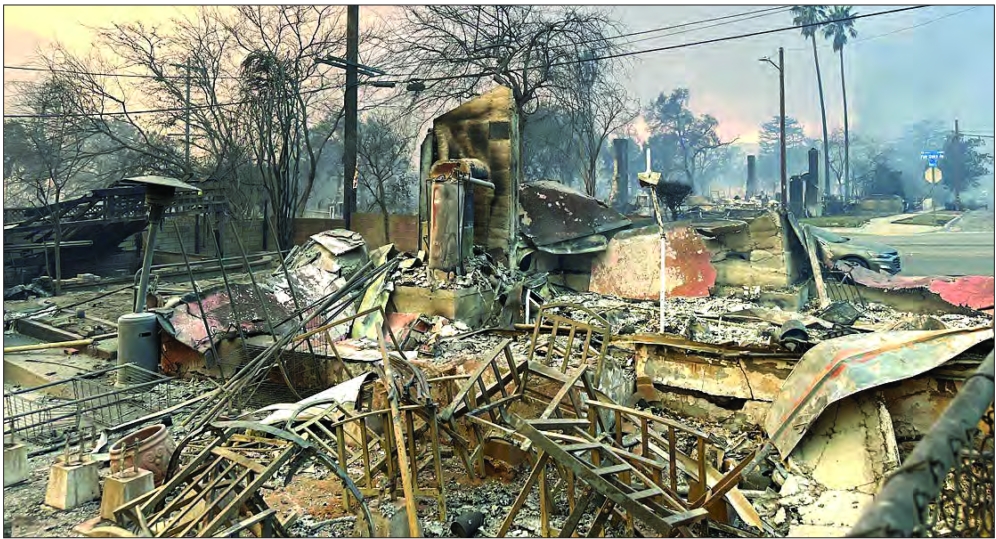
The remnants of Cynthia and Ibarionex Perello’s home after the Eaton Fire in CaliforniaOn Jan. 7, the day the Eaton fire began to burn in Southern California, 42-year-old Shai McCall did not think much of it, at first. She’s lived in her family’s Altadena home all her life, and it’s not unusual to see fires burning in the San Gabriel Mountains.
“We’ve had several wildfires, but they’ve never come down,” said McCall. “You pack a bag for one day and put some clothes in it. Then you come home. Nothing major.”
She wishes she took it more seriously this time.
The Eaton fire obliterated more than 9,000 structures and damaged nearly 1,100 others.
One of those structures was McCall’s family home where she lived with her aging parents, younger sister and nieces. All that’s left are the remains of a front porch, entryway and chimney.
The neighbor to the right of her has a chimney and a mailbox. The neighbor to the left has nothing.
“Every day, it’s ‘don’t cry,’” said McCall. “That’s the goal, just don’t cry.”
McCall discovered her home was lost after being sent a video from another neighbor who attempted to put the fire out with a hose. Unfortunately, no water came out.
“In the four-minute video, you hear at the end, ‘I’m so sorry we couldn’t save your home,’” said McCall. “To this day, I haven’t had the courage to show my parents the video, which shows the home that they raised their kids in burning down from beginning to end.”
McCall can’t remember who first informed her
parents that their home was decimated by the fires, but she does recall
their reactions. They were staying at her brother’s house in West
Covina.
“You could
just hear the awkward silence until my mother screamed. My dad took her
outside to talk with her,” said McCall. “I just sat there for a second.
It felt like a bad dream that you can’t wake up from.”
When
Shai McCall and her family evacuated on Jan. 7, her 64-year-old father
left with two outfits and her 74-year-old mother left with three. Her
mother also made sure to grab the deed to the house, birth certificates
and social security cards. Fortunately, her younger sister and nieces
were not at the home at the time of the wildfires.
Everything
else was lost. McCall had started school the day before the fires
started. The thousands of dollars she spent on textbooks and a new
laptop was wasted.
“You
have to smile and fight tears every day,” said McCall. “I tell people I
have a father who happened to have insurance on the home and he’s
handling the business aspects, but I also have a mother who has 44 years
of memories and is questioning whether she has another 44 years left.
Every day she wakes up in tears and cries on the bathroom floor for
hours.”
McCall recounted the fateful night while standing in line for resources.
Some
days she spends upwards of six hours waiting for clothing, toiletries
and gift cards to buy groceries. She’s started a GoFundMe to help them
in their pursuit of starting over.
“It
doesn’t matter the amount, just try to help as many people as you can,”
said McCall. “Appreciate life every day. Don’t take for granted that
you wake up in your own home because in the blink of an eye it can all
be gone.”
Husband and wife Ibarionex and Cynthia Perello’s Altadena home also perished as a result of the wildfires.
“Our
home wasn’t just a structure. It was a place of peace, love,
forgiveness, celebration and a testament to years of hard work,
dedication and resilience,” said Cynthia Perello. “The heartbreak of
seeing it reduced to ashes is a crisis no one should ever have to
endure.”
Like McCall
and so many others, Cynthia Perello said it was pretty standard to see
fires burning nearby. But, when she and her husband noticed the high
winds blowing embers and smoke in their direction, they knew they needed
to evacuate.
In the
face of a power outage, the Perellos used their phone flashlights to
gather essential items, like medications, a hard drive and the ashes of a
deceased family member. They fled their home in pajamas with their dog,
Gracie, in tow.
Ibarionex Perello, an award-winning photographer and podcast host, lost all the gear he uses to earn a living.
“We have lost everything, including his podcasting and photography equipment,” said Cynthia Perello.
“We are starting from scratch. There is a long road ahead of us to recovery.”
The Perellos have also started a GoFundMe to help reestablish their lives.
“Your
support will assist us to address the many aspects of recovery and
support our family needs regarding this crisis,” said Cynthia Perello.
“Any support you can provide to help Ibarionex and I rebuild our lives
would be greatly appreciated.”
Aside
from individual fundraisers, the California Black Freedom Fund, led by
Marc Philpart, has launched the Black LA Relief and Recovery Fund to
support African American
communities in Pasadena and Altadena on their path of restoring
normalcy. The fund is being run in collaboration with the California
Community Foundation.
Philpart
explained that it’s critical to support Black families at this time, as
communities of color tend to experience longer recovery times after
disasters. Some studies have even suggested that Black disaster
survivors receive less Federal Emergency Management Agency (FEMA) relief
than their white counterparts.
“There’s
inequity throughout the relief and recovery process both in terms of
who gets FEMA dollars and who ends up better off after a crisis like
this,” said Philpart. “We wanted to shine a spotlight on those
inequities and resource Black community organizations to address those
gaps.”
So far, the
Black LA Relief and Recovery Fund has raised over $3.5 million, which
will be distributed to service delivery organizations in Black
communities, like churches, senior centers and case management entities.
Philpart
recalled that in the 1980s Altadena was 45% African American. Just
before the wildfires, the share of Black residents was about 20%.
“There’s
very little economic opportunity for Black folks in California these
days. Many people are moving away and are unable to make a living the
same way their grandparents may have,” said Philpart. “We know that it
will only be worse as a result of this crisis, and we want to stave that
off as much as we can. We want Black people to feel like they have a
right to return, and we want them to be welcomed to return in a way that
allows them to rebuild in bigger and better ways.”
This article appeared first on AFRO American Newspapers.