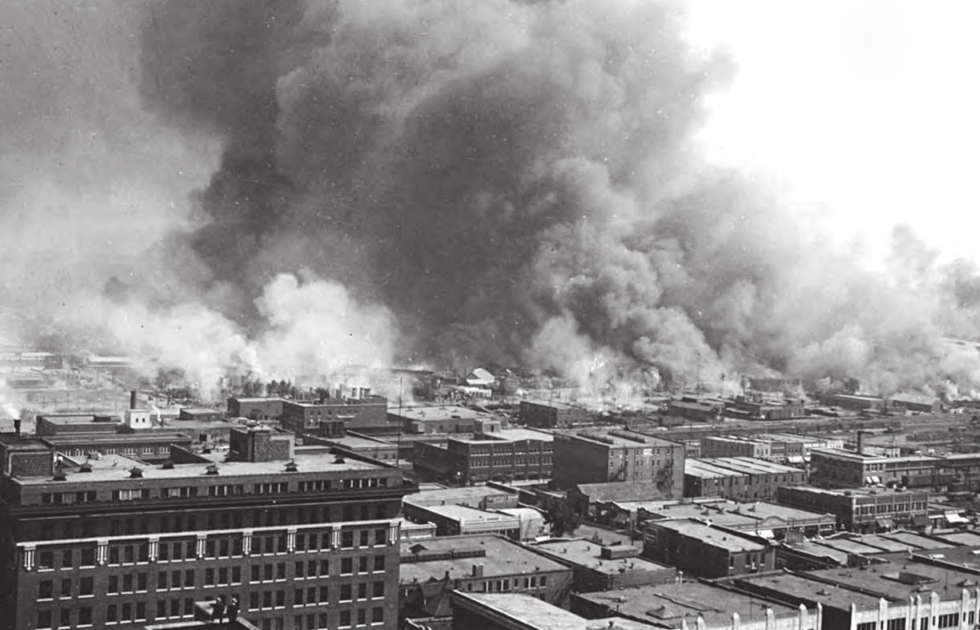
Destruction from the 1921 Tulsa Race Massacre 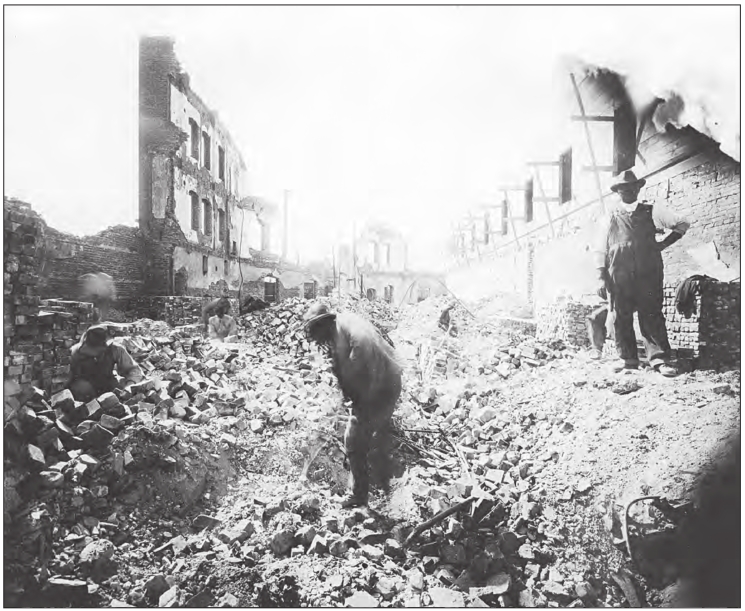
Greenwood’s Gurley Hotel after the 1921 Tulsa Race Massacre.

Panoramic view from the roof of Booker T. Washington High School showing the damage in the aftermath of the riot.
“Beautiful, bustling, and Black”—that was how author, attorney and activist Hannibal B. Johnson described the Greenwood District of Tulsa, Oklahoma, in his book “Black Wall Street: From Riot to Renaissance in Tulsa’s Historic Greenwood District.”
In the early 1900s, the Greenwood District flourished with over 100 Blackowned businesses, from restaurants and grocery stores to hotels and hospitals. Brick office buildings lined the streets with Black doctors, lawyers, and dentists ready to serve their communities. Visitors to the area included agricultural scientist George Washington Carver, famed contralto Marian Anderson and popular jazz and blues singer and pianist Dinah Washington. The district’s success represented more than just commerce; it embodied Black Americans’ resilience and ingenuity in creating economic opportunities despite the crushing restrictions of Jim Crow laws.
Greenwood’s prosperity came to a violent end in 1921 when a white mob destroyed the district in what is now known as the Tulsa Race Massacre. In just two days, their ensuing violence left 35 city blocks decimated, over 800 people injured, potentially 100 to 300 people killed (though exact figures can never be determined) and generations of accumulated wealth erased.
Unfortunately, the tragedy at Greenwood wasn’t an isolated event. The
years leading up to 1921 were marked by race-related violence. As
Johnson noted in his book, the United States saw 61 recorded lynchings
of Black Americans in 1920; the year prior, more than 25 major race
riots erupted throughout the nation in what was dubbed the Red Summer.
The devastation and its lasting impact
Today,
the country continues to grapple with the aftermath of such vehement
destruction. Evanston, Illinois, and Asheville, North Carolina, are
among the few cities carrying out reparations projects despite
opposition from the 6% and 13% of respondents who argued that such
programs would be too expensive or too difficult to administer,
respectively, according to a poll of 1,000 people by the University of
Massachusetts Amherst and Boston TV station WCVB.
Though
Greenwood residents reconstructed with astonishing speed after the
massacre, their efforts were continually stymied—not just by violence
but by policies that deprived these areas of further opportunities. “The
1921 Tulsa Race Massacre temporarily stilled the economic engines that
revved on Black Wall Street. That said, the community quickly rebounded
and rebuilt, peaking economically in the 1940s,” Johnson told Stacker in
an email. “In the 1960s and subsequent decades, structural factors like
integration and urban renewal precipitated a second decline.”
The
2024 ruling denying reparations to the last survivors of the massacre
serves as a sobering reminder that the consequences of this destruction
continue to reverberate through time, contributing to today’s racial
wealth gap.
The legacy of Black business districts across America
Though perhaps the most widely known, Tulsa’s story was not unique.
“Wherever
you had large Black populations concentrated because of segregation,
you had these enterprising African Americans who sprouted up to provide
every need possible,” Dr. Shennette Garrett-Scott, author of “Banking on
Freedom: Black Women in U.S. Finance Before the New Deal” and associate
professor of history and Africana studies at Tulane University, told
Stacker.
Across
America, Black entrepreneurs established thriving business districts
that faced similar threats from racial violence and discriminatory
policies.
From Richmond’s Jackson
Ward—known as “the cradle of Black capitalism”— to Detroit’s Paradise
Valley, Chicago’s Bronzeville, and Atlanta’s Sweet Auburn, across
America, Black entrepreneurs established communities with flourishing
enterprises that stood as beacons of economic promise and prosperity.
Stacker
used Census data and other sources to explore the untold history of
lesser-known Black Wall Streets across the United States and how
present-day Black business districts strive to rebuild wealth and
opportunity in the current economic landscape.
You may also like: AI art is facing a copyright problem. Here’s what it means for creators.
The winding path to economic freedom
The
roots of Black entrepreneurship run deep in American soil. The
entrepreneurial spirit of Black Americans can be traced to as early as
the 17th century, according to the Federal Reserve Bank of Richmond.
Even
while enslaved, Black Americans would barter and trade their surplus
production with other people who were enslaved—though most profits went
to their enslavers. Some with managerial duties even sold their skills
and services to others. Once freed, Black Americans continued this
tradition of engaging in businesses that used the skills valued by white
enslavers, including catering and personal services such as tailoring
and hair care.
In the
decades following the Civil War, Black Americans faced a paradox: newly
freed but systematically excluded from mainstream economic
opportunities.
“These
were enterprising, ambitious people who were trying to get their part,
their piece of the American dream, who were just as enthralled with
American free enterprise as their white counterparts,” Garrett-Scott
said. “Through their enterprise, they were able to carve out a space
within the limitations—the limited options that they were given.”
Overcoming systemic barriers
This
exclusion, though devastating, sparked a wave of Black entrepreneurship
across the country. According to the 1914-1915 “Negro Year Book: An
Annual Encyclopedia of the Negro,” Black business ownership grew from
virtually zero in 1863 to over 40,000 enterprises by 1913, while Black
homeownership rose from near zero to over 500,000 properties in the same
period. This growth occurred despite the implementation of restrictive
“Black codes” that required white sponsors for Black business licenses
and Jim Crow laws that systematically segregated commerce.
These
communities developed sophisticated financial networks, with Blackowned
banks providing crucial capital to entrepreneurs routinely denied loans
by white-owned institutions. “What made these Black business districts
thrive wasn’t just Black people supporting Black businesses; it was also
Blackowned financial networks, Black banks and Black insurance
companies that provided the capital when white institutions refused,”
said Garrett-Scott.
One
of the most significant developments was the creation of Black
financial institutions. Exemplifying this trend was the Grand Fountain
United Order of True Reformers, founded by Rev. William Washington
Browne in 1881 in Jackson Ward, a Black section of Richmond, Virginia.
Beyond providing insurance and banking services, the True Reformers
operated department stores, published a newspaper, maintained a home for
older people and invested in real estate across 10 Virginia cities,
Washington state, Baltimore, and other locations.
Backlash and lasting impact
However,
alongside these success stories came the backlash. Beyond Tulsa, Black
Americans who engaged in economic activity fell victim to racial
violence and intentional economic disruption. The 1917 East St. Louis
Massacre in Illinois, caused by white workers targeting their Black
peers hired by the Aluminum Ore Company or the Elaine Massacre in
Arkansas of Black sharecroppers seeking to unionize in 1919, marked
systematic attempts to suppress Black economic independence.
“Violence
plays a role in both creating Black Wall Streets and their decline,”
Garrett-Scott emphasized. “There are different, varying levels and kinds
of violence.” Beyond direct racial violence, Black businesses faced
what Garrett-Scott calls “bureaucratic violence”—systematic exclusion
from professional organizations, denial of licenses and permits and
restricted access to capital.
Discriminatory
policies compounded the damage. Redlining prevented Black businesses
from accessing loans and insurance, while urban renewal projects of the
1950s and 1960s often targeted Black business districts for demolition,
displacing established enterprises and fragmenting communities.
“Urban
renewal—ostensibly intended to eliminate urban blight—devastated Black
Wall Street by displacing individuals and enterprises and gobbling up
land,” said Johnson. “Wealth disparities are in large part attributable
to the ability to transfer property intergenerationally.
Urban renewal adversely affected that dynamic for Black folks.”
The ongoing wealth gap
The
dismantling of these Black business districts has had lasting effects
on economic progress for Black Americans spanning generations. According
to the American Civil Liberties Union’s 2023 Visualizing the Racial
Wealth Gap report, the gap in wealth between Black and white families
has grown since the 1970s. In 2018, the median white family of three
earned $33,000 more than a Black family of the same size. Black
homeownership rates have also stagnated, lagging behind Hispanic
homeownership rates and never reaching the 50% mark in the last 10
years.
“We
haven’t matched the level of economic destruction that came through
those forms of violence and policy violence with the requisite level of
economic investment into those communities. Each new generation can fall
farther and far farther behind,” Anthony Barr, director of research and
impact at the National Bankers Association, told Stacker. Barr’s
research specializes in the racial wealth gap, financial wellness and
digitization.
Where Black Americans found success across the U.S.
Different
cities developed distinct patterns of Black business growth. Due to
segregation, Richmond’s Jackson Ward transformed from a mixed
neighborhood that hosted German, Italian, and Jewish immigrants to a
Black business hub.
During
this time, “the Deuce,” known as 2nd Street, became a cultural and
economic powerhouse and the home of Hippodrome Theater, attracting
performers like Nat King Cole and Cab Calloway. The district was also
home to St. Luke Penny Savings Bank, founded in 1903 by the first Black
American woman to charter a bank in the United States, Maggie Lena
Walker, and the Southern Aid and Insurance Company, the country’s first
Black-owned life insurance company.
Durham,
North Carolina, presented a unique case. Unlike older Southern cities,
Durham’s rapid growth as a tobacco town created unexpected
opportunities. “My hunch is that the growth was so rapid that anybody
could come here to get a job,” Perry Pike of the Historic Preservation
Society of Durham told the Federal Reserve Bank of Richmond. “They
couldn’t afford to discriminate in the way that other southern cities
did.” Durham was also believed to be more progressive than other
communities.
“White
allyship helped facilitate Black business success in Durham, both in
terms of relative racial progressivism and capital investment,” said
Johnson.
Education and economic growth
This relative openness enabled the rise of North
Carolina Mutual Life Insurance Company—the nation’s largest Black-owned
insurer at the time—and Mechanics and Farmers Bank. Andre Vann, a North
Carolina Central University historian, also noted that Durham fostered
unusually progressive Black-white business relationships, with white
capitalists often working through Blackowned banks to invest in Black
communities.
Washington,
D.C.’s evolution tells yet another story. The city’s Shaw neighborhood,
particularly along U Street, emerged as a crucial hub after Black
businessmen were forced out of downtown. By 1910, Shaw hosted over 200
Black-owned businesses, with the True Reformers’ five-story building on
12th and U streets symbolizing the community’s ambitions. The
neighborhood’s growth was closely tied to Howard University, reinforcing
the power of education in economic mobility. The area’s growth
paralleled the expansion of Howard University, creating a symbiotic
relationship between education and enterprise that became a model for
other cities.
Barr
notes modern Black business hubs can learn from these historical
examples. “It’s not just about creating new wealth; it’s about
supporting jobs, which is about supporting families,” he said. “It’s
about increasing tax revenue, which is about being able to have more
money available for public services and quality schools and
infrastructure maintenance.”