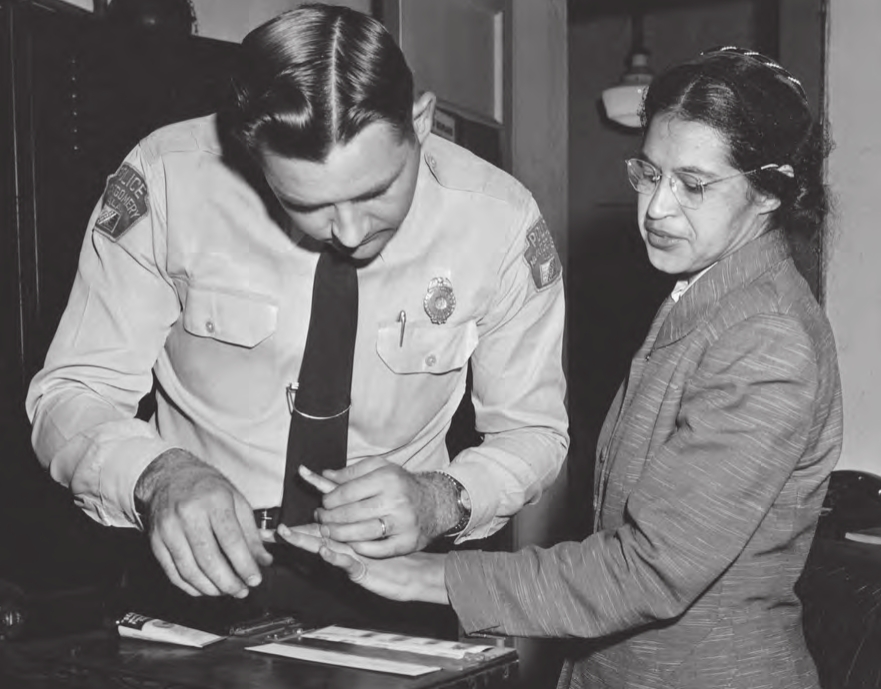
Rosa Parks is fingerprinted in Montgomery, Alabama, on December 1, 1955. She was arrested for refusing to give up her seat on a public bus to a white man. Parks’s action led to the 1955–56 Montgomery bus boycott, which is recognized as the spark that ignited the U.S. Civil Rights Movement.

In 1955, Martin Luther King Jr. was recruited to serve as spokesman for the Montgomery Bus Boycott. This campaign was built within the African American population of Montgomery, Ala., to force integration across the city’s bus line system.
According to The King Center, after 381 days of nearly universal participation by citizens of the Black community, the U.S. Supreme Court ruled that racial segregation in transportation was unconstitutional.
The boycott was actually catalyzed by the arrest of Rosa Parks on Dec. 1, 1955, and lasted 13 months, although its roots began years before the infamous arrest. The Women’s Political Council (WPC), a group of Black professionals founded in 1946, had already turned their attention to Jim Crow practices on the Montgomery city buses and helped set the stage for the monumental changes.
Who coordinated the boycott?
With the boycott lasting more than one year, the approach was long-term and strategic. It was organized and led by the Montgomery Improvement Association (MIA), which quickly positioned its young president, Martin Luther King Jr. as the voice of the effort.
King, a quick-rising civil rights leader, was able to draw international attention to the problems facing the African American population in Montgomery.
According to The King Center, Parks was quoted as saying: “The advantage of having Dr. King as president was that he was so new to Montgomery and to civil rights work that he hadn’t been there long enough to make any strong friends or enemies.”
Early momentum
On Dec. 5, 1955, 90% of Montgomery’s Black citizens stayed off the buses. That evening, at a mass meeting, the organization voted to continue the boycott. King spoke to several thousand people at the meeting, urging them to keep the pressure on the Birmingham politicians, media and decision-makers.
The strategy worked. On June, 5, 1956, the federal district court ruled in Browder v. Gayle that bus segregation was unconstitutional, and in November 1956, the U.S. Supreme Court affirmed Browder v. Gayle and struck down laws requiring segregated seating on public buses.
According to The King Center, perhaps the bus boycott’s biggest achievement was demonstrating the potential for nonviolent mass protest to successfully challenge racial segregation. It served as an example for other southern campaigns to come, and is still studied today in universities across the world for its effectiveness and approach.


