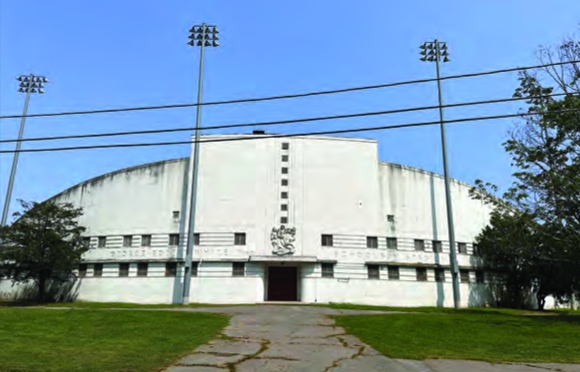
White Stadium in Franklin Park was at the center of controversies all year long.
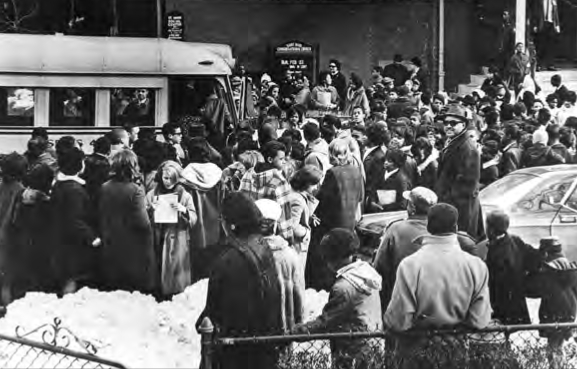
Students outside of Freedom School during 1964 Stay Out. 2024 marked the 60th anniversary of the Freedom Stay Outs.
In 2024, national and statewide issues had major implications for Boston neighborhoods like Roxbury and Dorchester, where immigration and proposed construction projects were hot-button issues. The year was also filled with civil rights anniversaries, and as Boston reckoned with its past, the city, alongside the country, wrestled with how to move forward.
Grappling with immigration
In fall 2023, Gov. Maura Healey announced that family shelters across Massachusetts had reached capacity. By January 2024, left with no options, migrant families, many of them Haitian, had taken to sleeping on the floor of the arrivals terminal at Logan Airport.
So, when plans to use the Melnea A. Cass Recreational Complex in Roxbury to shelter migrant and homeless families emerged, community members and sports coaches juggled a mix of sympathizing with the families and feeling disappointed over the state’s lack of communication, with some saying the shelter was an example of Boston’s Black community shouldering the state and city’s burden yet again and losing out on necessary resources.
Still, neighbors and community leaders rallied to support the families. Bethel AME Church in Jamaica Plain opened its doors to some recently arrived Haitian families, offering shelter in its rectory.
The church’s Migrant Neighbor Initiative provided living space, job support, and educational services to families seeking to make a new life in Boston, as the state, which has a “Right to Shelter” law, struggled to keep up with demand.
The families the Bay State Banner spoke to said they fled their countries for better opportunities or because they did not feel safe in their home country. In March, Haiti devolved into chaos as gangs took over the nation’s capital, and the resultant humanitarian crisis had personal implications for many local leaders in Boston, home to one of the largest
populations of Haitians in the United States. Elected officials and
nonprofit heads mobilized to help the country and called on Congress to
take urgent action.
A spotlight on Franklin Park
Franklin
Park, the largest expanse of green space in Boston, was at the center
of controversies all year long. White Stadium, the 75-year-old sports
arena in the park that has fallen into disrepair, is set to undergo
significant renovations in preparation for use by a national women’s
soccer team owned by Boston Unity Soccer Partners. A survey published by
the Franklin Park Coalition showed majority support for the over $100
million renovation, but the redevelopment project received pushback from
community members who feel it’s not in abutters’ best interests.
“The
Franklin Park Defenders,” a group of neighbors and members of
environmental nonprofit Emerald Necklace Conservancy, have stood firm in
their protest against the project even though a judge ruled in support
of the renovation and the Boston School Committee approved the lease.
Franklin
Park neighbors also resisted plans to revamp the Lemuel Shattuck
Hospital in the park’s vicinity as the state and Boston Medical Center
seek to expand substance use treatment services. Elected officials
chimed in during a City Council meeting to voice concern about Boston
taking on a statewide issue.
Remembering desegregation and busing
This
year also brought key anniversaries of significant moments in Boston’s
history, the most notable of which was the start of school busing. In
September 1974, Judge W. Arthur Garrity ordered that Black students be
transported by bus to predominately white schools in the city after
years of activism by Black civil rights leaders and parents.
The
year of remembrance kicked off with the 60th anniversary of the Freedom
Stay Outs of 1964, during which thousands of Black and white students
boycotted their everyday
schools to protest de facto segregation. Led by local activists like
Hubert “Hubie” Jones, this oft-forgotten period in Boston’s history was a
crucial step in achieving desegregation a decade later.
Desegregation
in Boston would take 10 more years to begin, a whopping 20 years after
segregation in schools was outlawed. The Boston Desegregation and Busing
Initiative marked the anniversary of busing with a walking tour through
downtown Boston, South Boston, and Roxbury, exactly 50 years to the
day. Led by longtime community organizer Lewis Finfer, the trip included
stops at sites integral to that part of the city’s past.
One
of those places was City Hall Plaza, where lawyer and civil rights
advocate Theodore “Ted” Landsmark, who is now a professor of public
policy and urban affairs at Northeastern University, was attacked during
an anti-busing riot two years after busing began. Photojournalist
Stanley Forman captured the incident, and the image became the Pulitzer
Prize-winning photo titled “The Soiling of Old Glory.” In March, Foley
Hoag, the law firm that represented the families in the Morgan v.
Hennigan (1974) court case that led to desegregation, reflected on what
has and hasn’t changed since the violent reactions to desegregation and
busing.
Honoring the past
Even without anniversaries to lean on, events throughout the city paid tribute to the past. Ruth Batson, a key player in the
desegregation movement and the founder of METCO, was honored in
Dorchester after the School Committee voted to rename Boston Community
Leadership Academy/McCormack 7-12 School for her. Now called the Ruth
Batson Academy, the school joined others like the John D. O’Bryant
School and the Melvin H. King South End Academy in immortalizing the
city’s civil rights icons.
Performer
Tony Wilson helped spectators at the Strand Theatre commemorate the
moment in April 1968 when soul singer James Brown took the stage at
Boston Garden the day after Martin Luther King Jr.’s assassination.
Brown’s performance was said to have prevented Boston from breaking out
into riots like other U.S. cities did, and Wilson’s show was a window
into that feat.
The 1960s and 1970s were tumultuous decades in
Boston, but on the airwaves, 1090-WILD kept Boston’s Black music scene
alive, later giving a home to hits by the likes of Roxbury-bred boy band
New Edition. In July, Elroy Smith, who programmed the station from 1983
to 1988, reunited former employees and supporters to celebrate the
now-defunct WILD.
In
Newport, Rhode Island, an exhibition at the Rosecliff Mansion brought to
the forefront the names of African American entrepreneurs who thrived
during the Gilded Age, the 19th-century period marked by economic boom.
The showcase included 150 items from as far back as the 18th century
that spoke to how African Americans in Newport, Philadelphia, and Boston
invested their wealth into building their communities.
The state of Black America by the numbers
In
2024, academic studies and nonprofit reports illuminated the ongoing
challenges faced by Black people and people of color locally and
nationally. A year after the Supreme Court effectively banned race-based
admissions, colleges and universities like the Massachusetts Institute
of Technology reported declines in enrollment of Black and Hispanic
students. Among its class of 2028, 5% identify as Black or African
American, compared to about 16%in previous years.
Two
months before higher-education institutions began releasing demographic
information for their first-year classes, experts expressed worry over
how the Supreme Court’s decision had already begun to affect schools and
businesses and wondered how it would impact diversity and inclusion in
work settings and education.
In
corporate settings, Black women already struggle. A study by scholars
at Harvard University, Boston University, and MIT found that Black women
with mostly white co-workers had higher turnover rates and lower
promotion rates compared with their white counterparts. Black women were
51% more likely to leave their jobs earlier and 26% less likely to be
promoted on time.
Many
Black women in Boston are considering leaving the city, citing a lack
of job availability and high cost of living. According to a March survey
published by the Greater Boston Chamber of Commerce Foundation, 35% of
young Black women are thinking about moving to a new city for want of
better opportunities and inclusive social spaces. Sheena Collier,
founder of Boston While Black, said the city needs to invest in “more
physical gathering spaces that really are owned by Black people,
programmed by Black people.”
Other
reports highlighted challenges for Black homeowners and the coping
skills Black Americans develop to deal with discrimination.
Black women at the helm
Kamala
Harris campaigned for president, the first Black and Indian woman to do
so. While Harris ultimately lost to President-elect Donald Trump, she
had the support of many, including Black women, 92% of whom voted for
her, and her Alpha Kappa Alpha sorority sisters, who rallied behind
Harris after she announced her bid in July.
While
Harris took the national stage, Black women made waves throughout New
England. In April, the U.S. Senate voted to confirm Judge Melissa DuBose
to a post on the U.S. District Court for Rhode Island.
Boston-based
public relations professional Colette Phillips published a book about
why it’s important to include white men in discussions about diversity,
equity, and inclusion, and Chaz Ebert stopped by Hummingbird Books in
Chestnut Hill to discuss her new book, inspired by her late husband,
film critic Roger Ebert.


