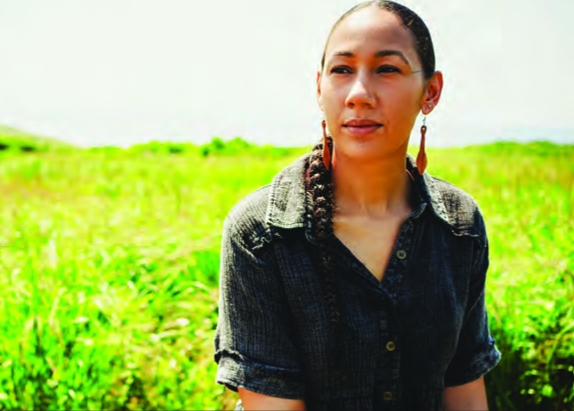
NaDaizja Bolling, member of the Aquinnah Wampanoag tribe. Every February, Martin Luther King Jr. and Maya Angelou are taught in classrooms, and come September, America celebrates Latinx and Hispanic culture and community. But November marks a month dedicated to celebrating an often overlooked and glossedover community.
November is National Native American Heritage Month. The month signifies the recognition of the first Americans who settled in this country. History often leaves out the parts that are crucial to understanding the development and birth of our nation.
Native American Heritage Month provides an opportunity that should not be restricted to November; however, it allows us to interface with and celebrate the vibrant cultures, histories and contributions of Native people across the country and within the Commonwealth.
NaDaizja Bolling and Amira Madison are both members of the Aquinnah Wampanoag tribe located on the southwest tip of Martha’s Vineyard. Both women have dedicated their lives to their tribe and culture.
“One of the biggest parts of this role is having to tell the story of Natives in New England,” said Madison.
“You’ll
see our language represented in cities and towns across the state. Our
streets and highways are based on trails created [by Indigenous
peoples/communities] prior to 1630. Storytelling is how we build
cultural competency, which then helps non-Native people understand our
communities. Being able to talk about history just feeds my need to
educate and learn.”
Madison,
originally from Boston, grew up in foster care in her early youth and
spent a lot of time with her grandparents. But her connection to the
Aquinnah Wampanoag tribe came into her life in a prominent way when one
of her grandmothers let Amira’s social worker know of her connection to
the tribe.
Because of
the Indian Child Welfare act, Native American children who are enrolled
in a tribe simultaneously with being in foster care are entitled to
access to their Native tribe and community. For Madison, that was the
Aquinnah Wampanoag tribe on Martha’s Vineyard.
“I
got into foster care, and eventually, I returned home to Martha’s
Vineyard because I was a native. My grandmother had noted to my social
worker at some point that I was Native American and belonged to a tribe
and so she pushed for them to connect with my tribe. So, I returned to
the Vineyard when I was 11 or 10, and I moved into a foster home that
was more local to the Vineyard and where I was able to be in community
with my tribe.”
A
graduate of Northeastern, Madison, has been involved in various roles
dedicated to supporting the Indigenous community in the Commonwealth.
She has been a tribal youth coordinator and docent at the Aquinnah
Cultural Center, and now, in her role as a program manager supporting
Indigenous communities in the City of Boston’s Mayor’s Office, Madison
continues to use her knowledge to work with others to spread cultural
awareness.
NaDaizja
Bolling, also a member of the Aquinnah Wampanoag tribe, like Madison,
has dedicated her work to Aquinnah, the place she considers her home.
“I’ve
always known that I’d end up home in Aquinnah, but this wasn’t a
calculated decision. Things just lined up in a way that made so much
sense that the transition felt easy and natural,” she said.
The
Boston native began her early career in public health after graduating
from Syracuse University. From Syracuse, she went on to earn her
master’s degree at the University of Virginia in business analytics
before pivoting to a career that spoke to her heritage and community.
While her path back to her tribe wasn’t linear, her work since going
home has been rooted in the development of longevity for the Aquinnah
Cultural Center and the support of her tribe.
“My
heritage and understanding of our community’s history and values
naturally guided me toward this path. Serving my community allows me to
be part of the ongoing effort to strengthen our collective identity and
resilience, which has always felt like the work I was meant to do,” said
Bolling.
“Wampanoag
culture is the heart of everything we do at the Aquinnah Cultural
Center. Whether we are curating exhibitions to share with the public at
our museum or creating spaces for families to engage with more
traditional Wampanoag ways, we are ensuring that our history and our
traditions are visible and accessible for future generations of
Wampanoag people,” she added. “It is both a privilege and a calling to
draw upon my elders’ and ancestors’ wisdom, as well as contemporary
knowledge, to deliver on the ACC’s mission as a community-centered
organization.”
Bolling considers her heritage and history to be two-fold, with her Native American heritage on Martha’s Vineyard being just as important to her as her and her family’s connection to the city of Boston.
“My
great grandfather, Royal Bolling, was the first Black state senator
from Massachusetts, and then … Uncle Royal and Uncle Bruce also had
roles in public service, and there’s a Boston municipal building named
after Uncle Bruce. I know we’re focused on Native heritage, but you know
I’m a mixed person, and I just don’t want to leave out parts of
myself.”
Referring to
the Bruce C. Bolling Municipal Building in Nubian Square, Bolling was
clear that while her work lies with her tribe, she still acknowledges
her history holistically and is passionate about both sides of her
heritage.
“Telling our
own history is vital because it ensures that our stories are shared
with authenticity, not from the perspective of our oppressors,”
exclaimed Bolling. “Aquinnah Wampanoag people are not observers of our
history; we are a continuation of it. The traditions, values, and
lessons we share come directly from our connection to the land, our
ancestors, our community, and the lives we live today. By telling our
stories ourselves, we honor those who came before us and ensure future
generations have a true and meaningful understanding of who we are.”


