MassBio
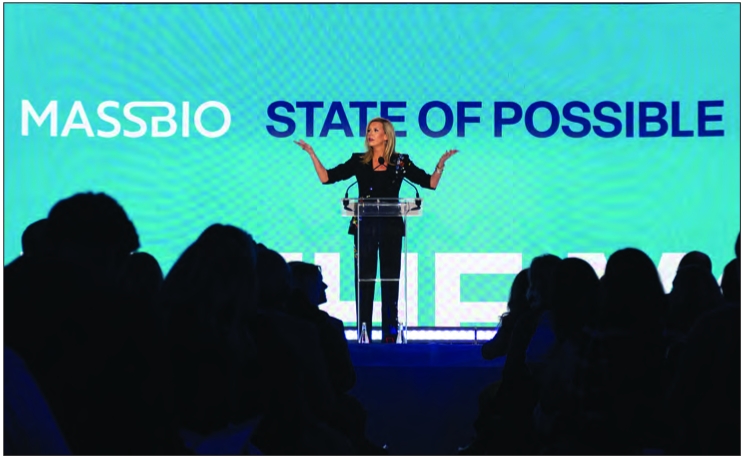
President and CEO Kendalle Burlin O’Connell addresses attendees at the
group’s annual conference on April 24. The trade group released a
five-year vision plan Oct. 2, emphasizing priorities such as growing and
diversifying the industry’s workforce as ways to keep the sector
growing in the state.As the state’s biotechnology industry looks forward toward the end of the decade, one focus on its agenda is taking steps to make its workforce better reflect the state’s overall population.
A new five-year plan released by the Massachusetts Biotechnology Council, or MassBio, Oct. 2, puts efforts expanding and diversifying the workforce on the list of main priorities to guide the statewide life sciences trade group between now and 2030.
“As we think about ways in which this is an industry that can lift all boats in Massachusetts, let’s make sure the people who are sitting on the sidelines, who live so close to the life sciences industry are able to plug in,” said Ben Bradford, Mass- Bio’s head of external affairs.
The report is a regular five-year effort completed by the trade group to aim to keep the state at the top of its game in the sector.
“If we don’t do these sorts of exercises, there’s an opportunity for other regions to come in and excel where Massachusetts really has an opportunity to excel,” Bradford said.
The report, called Vision 2030, focuses the organization’s perspective for moving the industry forward within the state on six main areas. Those priorities span everything from supporting emerging companies and expanding the state’s workforce, to building new bridges with technologies like artificial intelligence and working to adjust public perception around the sector and how it impacts communities and residents.
The inclusion of workforce development goals in the report, especially for workers from diverse backgrounds, comes as, across the city and state, efforts to train more people of color in life science jobs pop up and expand.
Advocates point to greater diversity and inclusion in the industry, which has blossomed in the state in the past decade-and-ahalf, as an important step to reduce income inequality and help close racial wealth gaps in the state.
Since the commonwealth launched the Massachusetts Life Sciences Initiative in 2008, a state effort to invest billions in the biotech industry, the sector and its economic impact have grown sharply. According to the Vision 2030 report, in 2022, the sector contributed about $35 billion to the state’s gross domestic product.
MassBio’s 2024 Industry Snapshot, an annual report tracking the field’s growth and impact, found it employed almost 117,000 people.
One of those efforts to foster a more diverse workforce, is Bioversity, a now-independent workforce development program that was launched by MassBio in January. The Dorchester-based program runs eight-week courses that train participants in lab operations as an alternative to a college degree.
At MassBio’s annual conference in April, Zach Stanley, executive director at Bioversity, touted stats that, of the 600 applicants the program had to that point, all were Black or Latinx. He said graduates from the program had gotten jobs at companies including Vertex Pharmaceuticals, Flagship Lab Services and Foundation Medicine.
In an interview, Stanley said that by the end of the year, Bioversity expects to graduate 65 students from its program.
“As
we look forward, it’s critical, from my perspective, to make sure not
only that employers have the access to talent, they need to choose
Massachusetts and grow in Massachusetts, but that the residents who live
around all these new developments have the opportunity and awareness
that there’s jobs there for them, even if they don’t have a college
degree and even if they’re not a scientist,” Stanley said.
It
works alongside other programs locally, including six others — like a
workforce development program through Quincy College and degree programs
at Benjamin Franklin Cummings Institute of Technology, Roxbury
Community College and Bunker Hill Community College — that, along with
Bioversity, were awarded $4.7 million in a round of Boston city
investments in February.
Bradford
said that focusing on an array of programs will be necessary to fill
the gaps in the industry’s workforce that MassBio is looking to address.
“We
believe that Bioversity is a great option, but we know that the
training that happens at Bioversity will not fill every single role,” he
said. “We want to make sure that Bioversity is successful as long as
the training that is needed at Bioversity fits the needs of industry,
but we will continue to support other programs to ensure that our member
companies and industry roles are being filled with people who already
live in Massachusetts.”
The
$4.7 million investment from the city of Boston also included funding
jointly to MassBio and education and job-skills nonprofit Year Up to
create a Greater Boston clearinghouse of workforce development
opportunities to connect community members with a wider array of
programs.
MassBio is also looking to see the reach of the state’s workforce development programs expand.
In a move to increase access to the Bioversity program and to grow the state’s entry-level biotech
workforce — a key goal according to MassBio’s five-year plan — the
training program is working to expand its offerings in a push that the
trade group officially called “Bioversity@Scale.”
That effort would create outposts across the state to provide training based on regional specialization.
The
program is expanding, first to Lowell and the Merrimack Valley, through
a partnership with the University of Massachusetts at Lowell, announced
Sept. 12.
Stanley
said the expansion, which is set to officially launch in February, will
initially start with a curriculum that’s pretty comparable to the one
offered at the Dorchester training center currently, but they plan to
adjust it to meet regional needs, following ongoing conversations with
employers in the area.
That
kind of regional specialization will be key to making sure the program
is effective across the state, Bradford said, pointing to the difference
between Boston-area roles where the general life sciences lab training
from Bioversity’s Dorchester program is the right fit, compared to other
roles in Lowell and nearby communities where jobs might lean more
toward manufacturing.
“I
think it’s really important to meet people where they are across
Massachusetts, to ensure that we aren’t training the same skill sets in
Boston as the Merrimack Valley,” Bradford said.
Stanley
said expansions of the program could be coming in the future — he
specifically identified the Metro West and Worcester regions as places
of interest, given a recent growth of biotechnology jobs in the area —
but any actual new locations will be based on if employers show a desire
for the workers Bioversity’s programs can train.
“If
we can go and make a difference there, we’re eager to do so in the
coming years, but that will largely be driven by employer demand,”
Stanley said. “There’s no point in running a workforce training program
if you’re not doing something that employers need.”
But
MassBio’s focus on employment efforts goes beyond entry level
positions. The report highlights a need for greater diversity in jobs
across the career ladder in the sector, including — and particularly —
in senior roles.
A
2023 diversity report from MassBio found that Black, Latinx and
Indigenous people made up 6% of the executive leadership of the
Massachusetts biotechnology companies surveyed.
One
step Bradford said the trade group is looking to pursue to increase
diversity at the top of the ladder is supporting programming that brings
in more founders and CEOs of color who are looking to start companies
in Massachusetts’ biotechnology sector.
That
work pairs with expanding support for early-stage companies in the
state’s life sciences, also one of the main priorities identified in the
MassBio report to continue supporting the state’s biotech sector.
Bradford said the trade group sees an opportunity to work on diversifying the industry at “both ends of the spectrum.”
“We
can do it at the entry level. We can train those folks and continue to
work and advance their careers within the industry. But we can also
focus on ensuring that diverse founders have what they need to grow
successful companies in Massachusetts,” he said. “I think that will give
the ecosystem a different look and feel.”
The
MassBio report said that venture philanthropy, a type of investing that
takes concepts from venture capital but directs them toward
philanthropic goals, could help increase industry inclusivity by
directing funds toward more diverse founders or underserved disease
areas.
Bradford also
pointed to one program in particular, called the CEO and Founder Link,
which MassBio launched with the Cambridge-based Termeer Foundation, a
group focused on supporting life science innovation.
That
program looks to help founders build a network and find new ideas and
support from a community of other new company leaders. The Termeer
Foundation, he said, has a history of focusing efforts from diverse
backgrounds.
That kind
of work, Bradford said, can help support a whole range of diverse
founders, and help keep them in the state to keep the industry moving,
matching the goal behind all of the efforts in the Vision 2030 report.
“We
want to make sure that the bread and butter of Massachusetts, which is
our early-stage innovators, have the support here, so that when these
companies start to grow, they consider Massachusetts home and don’t look
elsewhere,” Bradford said.


