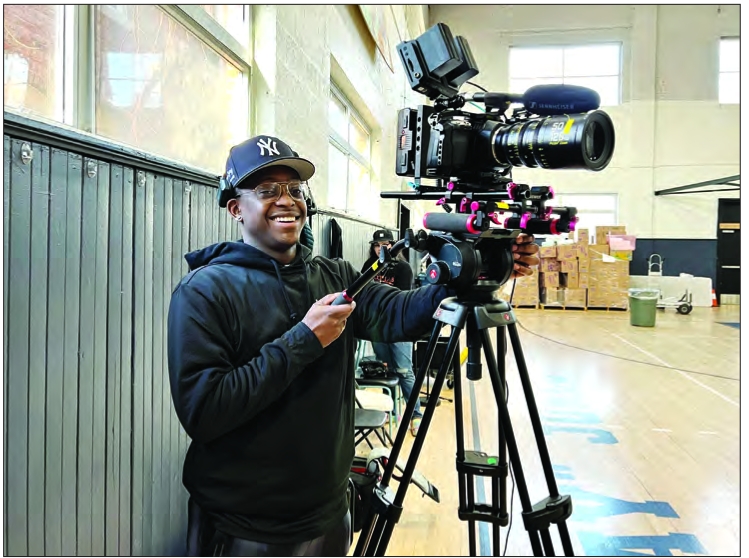
Abraham Lopez works with a camera in a production for state Rep. Marjorie Decker.In 2023, Anna Montana had been looking for a third place, a space for social interaction outside of work and home. She was working a part-time job and had found herself bored. That’s when a friend introduced Montana to The Loop Lab, a media arts nonprofit that started in Cambridge but has since expanded to Boston and beyond.
Montana had always been interested in the media arts, and The Loop Lab’s offerings aligned perfectly with her interests. So, she applied to one of the organization’s programs. During a six-month apprenticeship from June to December 2023, Montana learned about lighting, video production and photography.
The softer skills she acquired, such as “team leadership” and “community strength,” were equally as valuable, she said.
“I feel like there’s always been a lack of spaces like that for people of color,” said Montana, 23.
“Especially growing up, I noticed a lot of people of color don’t have these spaces, so they essentially fall under the wrong things, and they don’t have anywhere to kind of exert their creative energy.”
When he founded The Loop Lab in 2017, Christopher Hope’s goal was to give young adults from underestimated — not underrepresented, he distinguished — backgrounds access to career advancement and digital storytelling
opportunities. Now the organization is focused on growth, said Hope, its
founder and a professor at Boston University.
On
Oct. 18 at the Yawkey Theater, The Loop Lab will hold its inaugural
Loop Dreams gala where the organization will celebrate student projects
and honor Cambridge Rep. Marjorie Decker for her support. The gala is an
opportunity for the organization to expand its offerings and continue
its mission, Hope said.
“When
I look at a lot of Black and brown communities and other kinds of
communities that are highly underestimated, I often see [that] those
stories about their communities and our communities are often told by
people not from our communities,” he said. “And
that, to me, is a challenge, because there’s a lot that’s lost in
translation culturally as well as maybe even literally.”
Instead,
he said he believes it’s important to teach people to tell their own
stories using media technology. The Loop Lab’s primary offering is its
media arts apprenticeship program for 18 to 30-year-olds from Greater
Boston who “identify with an underestimated population,” Hope said,
meaning they might come from a low-income community, have a disability,
or be a minority — all identities that are underrepresented in the media
arts.
“It’s really about envisioning what the
possibilities are for our young people in … the city of Boston,” he
said. “What are our dreams for the possibilities that could exist for
the youth, for media and media entertainment?”
Through
a rigorous admissions process, The Loop Lab admits about 10 students to
its program each year who learn the ins and outs of audio production,
video production and filmmaking. The organization eliminated barriers to
entry, Hope said, by giving students transport passes, partnering with
organizations to ensure food security and counseling services and paying
students starting at $17.50 per hour.
After
students complete the program, they are set up with six months of an
internship where they get hands-on training in an industry of their
choosing.
Students have landed internships at radio stations and local film and recording studios, theatres and universities.
Beyond
teaching the tools of media arts, The Loop Lab focuses on preparing its
participants to enter the workforce. The organization partners with
financial institutions to teach students financial literacy,
entrepreneurship and contracting.
Past
participants of The Loop Lab can “work in pretty much any major
environment professionally as you have those concrete skills of not just
the production piece and the technical piece, but also the customer
service and the soft skills needed to really be successful in the
21st-century workforce,” Hope said.
For
Montana, having a “safe space” like The Loop Lab allowed her to be
herself and uncover her capabilities, she said. Where she normally was
one to take a step back in group settings, in The Loop Lab, she found
herself taking on leadership roles.
“In
any other job outside of The Loop Lab, I don’t think I’ve ever felt the
need to want to take the lead and to want to participate in things. I
think they kind of opened that door for me to take those steps on my
own,” she said. “It didn’t feel forced. It felt like I could take the
initiative to continue doing this awesome and amazing work.
Dorchester
native Abraham Lopez, 28, who also participated in The Loop Lab’s
apprenticeship program in 2022, said the value he got from it was
“endless.”
“I’ve
gotten jobs, I’ve gotten … knowledge and opportunities. It’s so much
that it gives, it’s incredible, even in areas that I didn’t see
happening,” he said.
When
he first learned about the program, he didn’t have a formal college
education and thought The Loop Lab could serve as a good launching pad
for a career in the media arts. During his time there, he was able to
explore his interest in fashion by creating promotional merchandise for
The Loop Lab.
Lopez
called the program a “pathfinder” that helps participants unearth areas
of interest they might not have previously considered.
“Going
through the program, [you] can align yourself with whatever it is that
you feel for you or best fits for you, whether it is media arts, whether
it is entrepreneurship, whether it is retail work, whether it is any
kind of corporate work or anything like that,” he said. “You’re going to
have those keys and those lessons and skills that you kind of learned
from a program like this that you can take into real life.”


