(above)
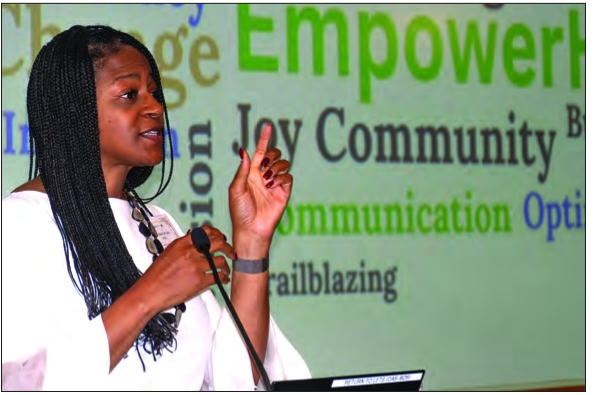
Dr. Bisola Ojikutu, executive director of the Boston Public Health
Commission, delivers welcome remarks at the inaugural EmpowerHer Black
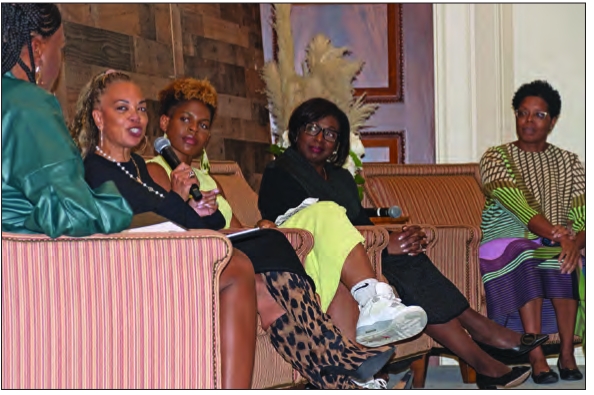
Women’s Health Conference, Oct. 4. (below) Petrina Martin Cherry (left),
Boston Medical Center’s vice president of community engagement and
external affairs, speaks during a panel on the future of Black women and
their health at the conference.
BPHC’s inaugural event addresses health equity of Black women
A jam-packed room came together Oct. 4 for the EmpowerHer conference, a health equity conference focused on the health of Black women.
The event, hosted by the Boston Public Health Commission and held on Boston University’s campus, aimed to motivate action in the improvement of health outcomes for the women who attended and others across the city like them.
Dr. Bisola Ojikutu, executive director of the Boston Public Health Commission, said the gathering of Black women is the kind of event that she hoped would spark action among the 60,000 Black women living in the city.
“There is a collective mass of us,” Ojikutu said. “When we work together, if we think about how we move things forward, there are a lot of us who could be doing this work.”
The conference, the first of its kind hosted by the Public Health Commission, is the start of a more general women’s health initiative that the commission intends to launch next year.
That effort will look to develop new interventions and educational programs to address health equity for women across racial demographics, but Ojikutu said statistics the health commission has collected illustrate gaps in care and outcomes for Black women that made these women’s health the clear place to start.
“A lot of people asked me, ‘Why are you doing a Black women’s health conference? Why not
all women’s health?” Ojikutu said during remarks at the event. “Well,
the reality is, you just saw the data. It’s obvious why we’re doing this
first.”
During her
welcoming remarks, Ojikutu listed of a host of statistics around poorer
health outcomes that Black women in Boston face.
Their
life expectancy lags six years behind the city’s female population
overall. Black women with breast cancer face a mortality rate that is
almost two times higher than their women in the city overall. The rate
of diabetes mortality is similarly staggered.
When
it comes to maternal morbidity, Black mothers and infants saw lower
birthweights and more frequent preterm births. Infant mortality among
the city’s Black population was over twice that of Bostonians overall,
and more than three times that of the city’s white population.
“In order for us to move forward, to know where we should be, we have to know where we are and where we’ve been,” Ojikutu said.
Looking beyond hospital walls
Kate
Walsh, the state’s secretary of health and human services, said state
data shows that across Massachusetts, outcomes are largely similar.
But
even with all the disparities in the health results Black women face,
speakers said, the solutions don’t lie in hospitals. Dr. Melissa
Gilliam, president of Boston University and a pediatric and adolescent
gynecologist, said during her keynote address that Black women’s health
is a social problem, not a medical one.
“The
key to addressing it is not only in the operating room and in the
clinic room, it is in our neighborhoods, our homes, our nursery schools,
our preschools, our workplaces,” Gilliam said. “The key is in the food,
it is in the water and it is in the media that we consume.”
The need for social solutions to the health disparities was addressed by speakers throughout the program.
During
a fireside chat with Dr. Gloria White-Hammond, co-pastor at the Bethel
AME Church and a retired pediatrician, and Byllye Avery, founder of the
Black Women’s Health Imperative, who were highlighted as trailblazers in
Black women’s health equity efforts, Avery said that for all the
hospitals and doctors in the city, the disparities persist.
“God
knows they’ve got more medicines in Boston — we call it the medical
mania — still, the babies are dying,” Avery said. “They can’t solve
these social problems, but when we get together as Black women, we can
figure out how to save ourselves.”
During
a panel on the future of Black women and their health, Petrina Martin
Cherry, Boston Medical Center’s vice president of community engagement
and external affairs, said that her hospital system sees many patients
who struggle to access care not because of health restrictions, but
because they struggle to take time off work to go to appointments, or
have reliable transportation to get there, or are too focused on making
sure they can put food on their family’s table.
“We
have to go way upstream and look at some of the systemic issues that
cause poor health disparities for our patients,” she said.
“We understand that it’s hard for some of our patients to prioritize health care when they’re trying to prioritize survival.”
The
conference was targeted at everyday women as much as people working in
health-related fields. Sessions about broad systems were paired with
presentations about how to take care of cervical health or better manage
one’s finances.
Health
officials at the city and state level also saw the direct line to women
in the community as an opportunity to identify needs.
“Our
secretariat spends almost $30 billion every year. How can we spend it
more wisely, and how can we spend it to improve and change these
disparities, and fix these, and improve the health outcomes?” Walsh
said.
The Public
Health Commission solicited feedback about the sessions and conference,
as well as how to structure its pending women’s health initiative
generally.
“Our plan
is to educate, develop new interventions and advance health equity. That
is the plan,” Ojikutu said. “The details of that plan? We need to work
them out, and I need your help.”
Sisterhood and support
Within
the conversations about health, it was an event focused on sisterhood,
as the crowd of assembled Black women spent the day discussing how they
could support not only their own health, but also the health of other
Black women.
During
the panel on the future of Black women’s health, Michele Courton Brown,
chief talent equity officer at Blue Cross Blue Shield of Massachusetts,
said she was struck by a question an attendee had asked earlier in the
day about how Black women can better support each other.
“This is not an easy life to get through, but I think we get there faster and further [if Black women support each other],” Courton Brown said. “We have the opportunity to do just that.”
Speakers at the event advocated extending that support to the next generation through sponsorship and mentoring.
“There
are young boys and girls who have purpose in them,” Martin Cherry said.
“They might not have the access, but they have the talent to find a
cure for cancer or to solve the problems that we’re looking for. If we
don’t open doors for them to create access for them, we’re doing our
whole community a disservice.”
A mix of gravity and joy
The
event — though grappling with sobering data and hefty disparities —
aimed to stay light, tempering serious themes with a poetry reading by
Porsha Olayiwola, Boston’s poet laureate, and a musical performance by
Aidan Thomas.
Advice
from longstanding leaders in Black women’s health equity during the
Trailblazers fireside chat was paused as Avery led a sing-along of “I
Love Black Women,” a song from the Black Women’s Health Imperative.
“This
is a day of joy and optimism. I want you to leave here inspired,
excited, wanting to do something new this weekend,” Ojikutu told
attendees.
Part of the
optimism was that through efforts like the conference, the city, state
and other organizations will start to move together toward greater
health equity for Black women.
“The
goal is for us to create an ecosystem, whether we are clinicians or
entrepreneurs, that we are working together to make sure that we create
pathways to wealth and to health and to wellness for others in our
community,” Martin Cherry said. “That doesn’t happen unless industry and
policymakers and business, we all find a way to work together, so that
we’re all creating access.”


