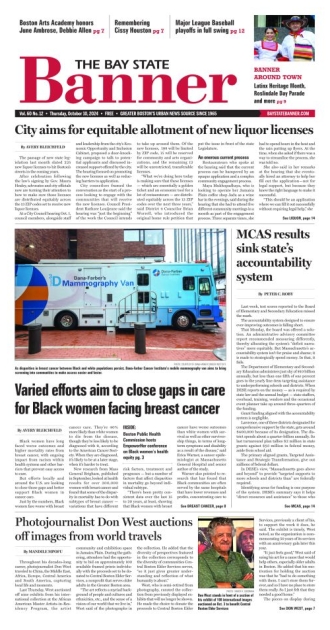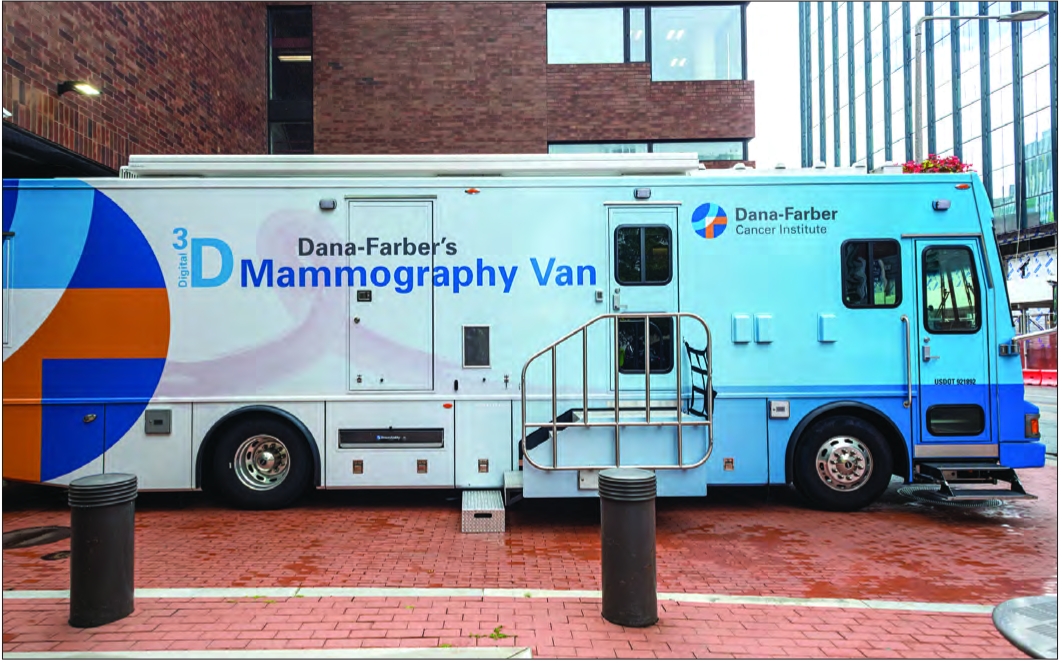
As disparities in breast cancer between Black and white populations persist, Dana-Farber Cancer Institute’s mobile mammography van aims to bring screening into communities to make access easier and faster. 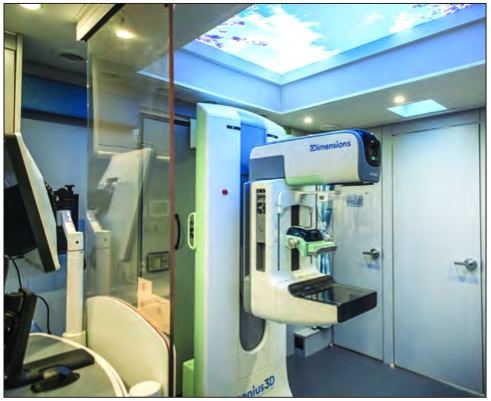
An interior view of Dana-Farber Cancer Institute’s mobile mammography van.
Black women have long faced worse outcomes and higher mortality rates from breast cancer, with ongoing impact from racism within health systems and other barriers that prevent easy access to care.
But efforts locally and around the U.S. are looking to close those gaps and better support Black women in cancer care.
Just by the numbers, Black women fare worse with breast cancer care. They’re 40% more likely than white women to die from the disease, though they’re less likely to be diagnosed with it, according to the American Cancer Society. When they are diagnosed, it’s likely to be at a later stage, when it’s harder to treat.
New research from Mass General Brigham, published in September, looked at health results for over 200,000 women with breast cancer and found that some of the disparity in mortality has to do with subtypes of breast cancer — variations that have different risk factors, treatment and prognoses — but a number of factors that affect disparities in mortality go beyond individual subtype.
“There’s been pretty consistent data over the last 15 to 20 years, at least, showing that Black women with breastcancer have worse outcomes than white women with survival as well as other survivorship things, in terms of longterm symptoms and disability as a result of the disease,” said Erica Warner, a cancer epidemiologist at Massachusetts General Hospital and senior author of the study.
Warner also pointed to research that has found that Black communities are often served by the same hospitals that have lower revenues and profits, concentrating care to a relatively small number of locations that tend to be more poorly-funded.
In
addition, factors like transportation, language barriers and work
schedules — what public health experts call social determinants of
health — can all pile up until the individual hurdles for a patient
looking to access care can become very high, said Dr. Naomi Ko, an
oncologist at Boston Medical Center who focuses on breast cancer.
“You
don’t know how to get there; you don’t know how to advocate yourself;
you don’t know how to speak English — all of the above is going to make
it hard,” Ko said. “Or you get somewhere and someone doesn’t treat you
right; someone doesn’t hear you; someone doesn’t value what you’re
asking for; or they’re burnt out or tired; or they don’t take your
insurance, and you’ve got to go to a different place.”
Addressing
concerns around systemic racism in the system and poor treatment of
Black patients is a priority for Jamil Rivers, founder of the Chrysalis
Initiative, a Philadelphia-based organization that works to addressing
barriers to equitable care.
Rivers
was diagnosed with metastatic breast cancer de novo — meaning it had
already spread to other parts of the body at the time of her diagnosis —
in 2017.
“When I was
first diagnosed, I was told these disparities were due to socioeconomic
issues and social determinants of health, which is a contributing
factor, but I think that it doesn’t acknowledge the fact that we have
racism in health care,” Rivers said. “We have implicit and explicit bias
in health care, where patients are going into these care settings and
not receiving quality standard of care because of it.”
Multi-level action needed
Solutions
to the disparity won’t necessarily come easily. Ko said that the
challenge becomes thorny to address with care inequity being so rooted
in so many different places.
“It
requires all hands on deck, from the provider to the hospital to the
city to the state,” Ko said. “It isn’t until we have a very concerted
effort do I think we’re going to see real equity happen.”
Warner,
too, said she thinks it will take a “multilevel intervention” to
address all the factors that create the disparities — but said that she
is hopeful that gap can be closed.
She pointed to data from 50 years ago, at which time the disparities between
Black
and white women were limited. A 1997 study, published in the American
Journal of Public Health, showed that in 1970, for women aged 25 to 59,
rates of mortality among Black women were about the same as white women,
and among women 60 and older, Black women on average tended to fare
better.
“The lines on
that graph have diverged over time, and I think that tells us that this
difference isn’t inevitable,” Warner said. “I think that the fact that
this hasn’t always existed and has been created over time suggests that
there’s something that we can do to intervene.”
A coaching approach
Rivers’
Chrysalis Initiative is looking to address barriers around care and
increased mortality by working with patients to try to reduce gaps in
access to quality care.
That
program connects Black women who receive a breast cancer diagnosis with
a coach — another woman who is a breast cancer survivor herself — to
receive social support along with guidance through the process and
information about what standard of care should look like, to help a
woman advocate for herself through the process.
“No
matter what area in that particular area of care, regardless of social
economic status, income, resources, type of center, age, this
intervention is proven to be effective time after time,” said Rivers,
pointing to statistics the group has tracked that show more women
participating in their program receive treatment that meets standard of
care.
She said the
group has also tracked that participants in the program are more likely
to adhere to treatment plans and have fewer ER visits, hospitalizations
and complications.
The
Chrysalis Initiative takes other actions, too, like providing training
to health systems to try to identify and reveal blind spots in their
care process.
Speeding up mammogram reads
Locally, hospitals and other health care institutions are also taking some steps to try to close the gap.
In
2020, Mass General Hospital implemented a same-day read program.
Instead of having a patient come to the hospital, get a mammogram and go
home to wait for the results before potentially having to return for a
follow-up scan and then, potentially a biopsy, radiologists read the
mammogram while the patient is still at the clinic so they can offer
further steps for an abnormal finding that day. That aims to avoid
asking a patient to return, which could present challenges around taking
more time off from work or accessing transportation.
The
effort follows a same-day biopsy push from the same hospital. Starting
in 2017, the hospital began offering to perform a biopsy as soon as a
follow-up test result showed the need to examine potentially cancerous
cells.
Bringing access to neighborhoods
Other
efforts are bringing multiple providers together to increase care in
the neighborhoods that might otherwise see access and care gaps. Much of
that work focuses on increasing access to mammography.
Though
she interacts with patients after they get a cancer diagnosis, Ko said
that if she could fix something in the system, the first thing would be
reducing difficulties in accessing mammograms, to identify instances of
cancer sooner.
Dana-Farber
Cancer Institute has a partnership with Whittier Street Health Center
in Roxbury to bring those mammography services out of hospital enclaves
and into the community.
At
that facility, a cancer care team offers services twice a week — on
Mondays and Wednesdays — with the goal of connecting low-income,
elderly, and medically underserved women with high-quality care.
The
Institute also has a mobile mammography van, which drives to community
organizations and community health centers in and around Boston. Local
health centers served include the Dimock Center in Roxbury and Daniel
Driscoll Neponset Health Center and Bowdoin Street Health Center in
Dorchester.
Both of
the Dana-Farber efforts aim to reduce barriers for women and streamline
the process by providing closer and faster service to patients, said
Magnolia Contreras, vice president of community health at Dana-Farber.
“Part of the challenge of the access to mammography is that sometimes the appointments are too far out. For some people, it’s
an all-day affair,” she said. “You have to take a day off work; you have
to get to one of the hospitals and go through that process. It prevents
people from having easy access where they can just go in and out and
get the service.”
Instead,
staff at the van prep all the clinical processes before a patient comes
to an appointment, so women can generally get in and out in about 10 to
15 minutes, Contreras said.
The
Dana-Farber teams don’t read the mammograms then and there, but
Contreras said there’s a focus on relying on technologist’s experience
and skill to make sure the first image is clear and captures the needed
information. And if the radiologist identifies an abnormal finding in
the mammogram, she said the team at Dana-Farber works to proactively
reach out to patients, rather than waiting for them to call, and can
offer things like transportation assistance if a return visit is needed.
She said patients who access services through the van should expect to
hear their results within five or 10 days.
Those
services are particularly important now, to patch up any new gaps
forming in the area. Ahead of the closure of Carney Hospital at the end
of August, Dana-Farber prepared to ramp up their offerings through
Whittier Street Health Center and its van as one way to close gaps in
care previously provided at Carney.
Contreras
said Dana-Farber has seen success in increasing access to mammography
care following the closure of the hospital, with some community health
centers that had formerly hosted the mammography van, partnering with
the Institute.
Separately,
Mattapan Community Health Center and Upham’s Corner Health Center offer
mammograms through a partnership with Boston Medical Center, while some
other local health centers run their own facilities.
According
to state data, as of 2019, the most recent records available, five
community health centers in Roxbury, Dorchester and Mattapan offered
mammography services on site.
Broader efforts
Efforts
to increase access to mammography services in neighborhoods like
Roxbury, Dorchester and Mattapan are important steps, Ko said, but that
work must be done with the community, not just at it. Services should be
offered outside of the workday on Mondays through Fridays, she said,
and that support shouldn’t end when someone is diagnosed with cancer.
“Doing
it right means being really patient-centered about your approach,” Ko
said. “It’s being thoughtful and intentional about when you go to the
community that you’re doing something that’s really in the service of
them.”
That support might also include helping guide patients who are unfamiliar with the medical system through the process.
For
patients at the Dana-Farber mammography van, in the case of an abnormal
finding, staff members act as patient navigators, connecting patients
with the next steps and potential care options, either through
Dana-Farber or other facilities. And if a patient pursues care from
Dana-Farber, a navigator there will meet the patient in the lobby when
they arrive and continue to support them through their treatment
process.
Contreras
said the Institute also has a focus on social determinants of health,
factors outside of a medical system that impact a patient and their care
and well-being, working to close other gaps in patients’ lives, like
transportation challenges or housing and food access, that might prevent
them from accessing care.
“Imagine
not being able to go get your chemotherapy because your ride fell
through. We can address that, right? Not being able to get your
chemotherapy because that particular day you’re not sure how you’re
going to feed your family, or you don’t have any food yourself,”
Contreras said. “We help with those types of things that we know could
affect your ability to conclude your care.”
Individual actions
While
the broader challenges around the disparity are happening — and must be
addressed — at a systemic level, Warner said that individuals looking
to address their own health can take some steps to better protect
themselves.
She
pointed to actions like making sure they get mammograms on time to avoid
getting a diagnosis at a later stage of the cancer; asking about what
resources, such as patient advocates, can help support a patient through
care if the mammogram presents and abnormal finding; and seeking a
second opinion where possible. All these could help improve a patient’s
care and outcomes.
Clinical trial participation
Warner
also recommended patients ask about clinical trials — which she said
patients often considered as a last-ditch effort, but really can be an
effective earlier step in a treatment regimen.
“Clinical
trials can be a part of a first-line therapy, and they are the way in
which clinical innovation happens,” Warner said. “The best treatments
that we have right now were offered in a clinical trial 10 years ago.”
Participation
in clinical trials by communities of color continues to be lower than
by their white counterparts, in no small part due to access-related
barriers, fewer clinical trials being offered through the hospital
systems where communities of color are more likely to receive care, and a
history of medical abuses and limited trust in doctors and the medical
system.
According to
data from the U.S. Food and Drug Administration, in 2020, 75% of
clinical trial participants across the country were white and just 8%
were Black.
Clinical
trial participation can be important to ensure that medications are
effective across the population. For example, since its approval in
2001, Albuterol, one of the commonly-used medications in rescue inhalers
to treat asthma, has been found to work less effectively in
African-Americans and Puerto Ricans, despite asthma impacting Black
individuals at higher rates.
One
of the many focuses of the Chrysalis Initiative is increasing access to
clinical trials. Rivers said the program offers support in clinical
trial design and uses its network to help with patient outreach. It also
looks to support patients through any barriers that might limit or
prevent their participation.
That work is important, Rivers said, to make sure that treatments developed through the trials are effective in women of color.
“There
have to be drugs on the market, that are in development, that we know
work on women of color,” Rivers said. “The only way we’re going to know
that is if Black women participate in these clinical trials.”