A
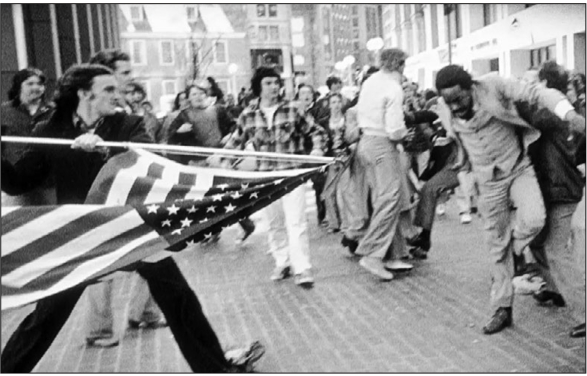
white teenager, Joseph Rakes, assaults lawyer and civil rights activist
Ted Landsmark with a flagpole bearing the American flag in this
Pulitzer Prize-winning photo taken by Stanley Forman during the Boston
busing crisis in 1976. Stanley Forman’s powerful image from Boston’s busing crisis became a catalyst for change
The incident occurred in a snatch of time.
On April 5, 1976, Theodore “Ted” Landsmark, a Black, New York-born lawyer living in Boston, was rushing to a meeting with a development agency to discuss how to create opportunities for minority construction workers.
When the 29-year-old reached City Hall Plaza, he crossed paths with a rowdy group of antibusing demonstrators.
Nearby, a news reporter was on site. Stanley Forman, a photojournalist who had asked to cover the demonstration, had been photographing the mob. He noticed a Black man — Landsmark, dressed in a three-piece suit — in the vicinity and had a hunch the situation would escalate.
Acting on his instinct, Forman pointed his camera in Landsmark’s direction, thus capturing the moment one of the demonstrators attacked the unsuspecting lawyer with a pole bearing the American flag. The image became the Pulitzer Prize-winning photo “The Soiling of Old Glory.”
“At that moment, I didn’t realize the impact of what I’d just photographed,” Forman said at a fireside chat on Feb. 27. The event was held at Foley Hoag, the law firm that took on pro bono the monumental Morgan v. Hennigan (1974) court case that led to school desegregation in Boston.
Sitting
side by side, Landsmark and Forman recounted the day from memory,
reflecting on the striking image’s immediate effects and its impact
nearly 50 years later.
“What
the photo did was to force Bostonians from the region to hold a mirror
up to themselves and to ask themselves how it was that this horrible
thing could have happened to an innocent person who hadn’t provoked
anything,” Landsmark said. Today, he is a professor of public policy and
urban affairs at Northeastern University and a civil rights advocate.
The
demonstrators “chose the wrong guy to attack,” said Landsmark, who grew
up in a family that was actively involved in the civil rights and
social justice movements. During the attack, his mind was set on
survival. But immediately after, he saw an opportunity.
When
he found himself standing alone on City Hall Plaza with a broken nose,
he took a moment to consider what he would say to reporters. He wanted
to communicate that the incident was not about him but instead spoke to
the times in which he was living.
“I
felt immediately that I needed to place that moment into a larger
context and not personalize what had happened,” he said, “because those
high school kids didn’t know me, and I didn’t know them. But they
represented a level of racism in the
city, and I felt that I represented a person who had been immediately
victimized … less by them than by a larger system of systemic racism.”
He
said the iconic photograph establishes enough distance in time between
what happened then and what’s happening now, making people comfortable
enough to discuss the social justice issues Boston continues to grapple
with today.
For his
part, Forman said when he took the photo, he didn’t know Boston was
racist but acknowledged that it was because he wasn’t the one being
attacked. He was simply a reporter doing his job. Years later, when he
looked back on the image, he was “amazed at how much hate there was.”
“I’m sorry it happened,” he said. “I’m glad I’m the one that got that picture.”
Landsmark
said he was glad, too. He said Forman could have hardly performed a
better service because the photo opened the door for conversations about
race and social justice, which he hopes will continue.
The
same commitment to social justice that drove a young Landsmark in the
1970s still drives him today. He is part of the city of Boston-funded
Reparations Task Force selected to investigate Boston’s ties to the
Atlantic slave trade and its recent history of discrimination against
African Americans.
“Work
on racial justice is part of a continuum that began long before I was
born, and will continue until we can achieve justice,” he said. “And the
work I did on voting rights or economic development in the ’60s is
being carried on now through discussions about reparations.”
Jeff
Mullan, the Foley Hoag attorney who moderated the talk, said “The
pursuit of justice isn’t over.” In the 1970s, the firm used the award
money from the Morgan v. Hennigan (1974) case to establish the Foley
Hoag Foundation.
The
foundation has continued its socially oriented work. It awards grants,
works with a pro bono program to match its lawyers to organizations that
are central to its mission and raises awareness of important issues, as
it did with the fireside chat.
“It’s
as Ted said: It’s all about the conversation right now. I know that’s
not enough, but it’s something. It gets people thinking, and maybe
they’ll leave, and they’ll do something else,” he said.
Looking
toward the future, Landsmark said there has been progress in the public
sector, but there’s still work to be done in the private sector,
specifically in corporations and universities.
“I
believe the emerging generations of activists will bring about change
in those areas,” he said, “in much the same way civil rights activists
were able to bring back progress in voting rights and education.”