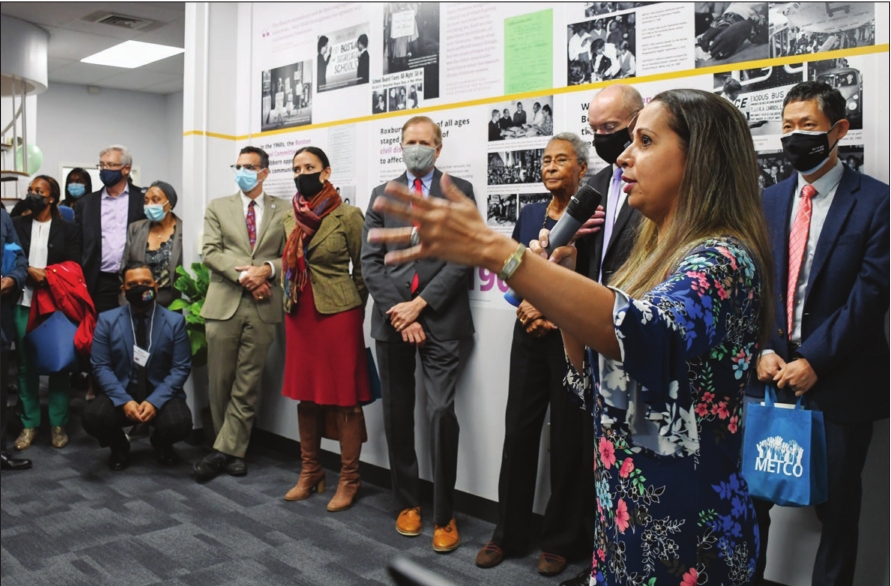
Metco President and CEO Milly Arbaje Thomas speaks at the opening of the organization’s new offices in Nubian Square. Restorative justice, sensitive teaching are the goals
A new initiative from METCO is designed to help participating school districts improve racial equity and anti-racism programing within their suburban schools.
The expansions of the busing program, which are called METCO 2.0, focus on helping the 33 participating districts identify policies and practices to most equitably support students, including restorative justice training and culturally responsive teaching. The initiative was started last year.
“We’re not saying that METCO itself is bad or was bad, because I have to respect the founders and everything that has happened to get us here — we’re 57 years old — but there’s definitely an opportunity for enhancement and improvements,” said Milly Arbaje-Thomas, president and CEO of METCO.
Work on the initiative began following the murder of George Floyd in 2020, when METCO leaders from all participating districts came
together to issue a statement of solidarity in an effort to address racial equity issues within their schools and the state-funded program.
The resulting goal was to create an anti-racism roadmap to help get the districts on the same page when it comes to working toward equity. The initiative, Arbaje-Thomas said, has been a largely grassroots effort, much like MET- CO’s initial formation in 1966.
“We all have school committees and
goals and leaders and strategic plans, but we all have one thing in
common, and that one thing in common is METCO,” Arbaje-Thomas said. “And
if you’re participating in METCO, we all have to at least align
ourselves in a particular direction moving forward.”
METCO is running audits in each of the participating districts to assess their equity programs.
State
Sen. Liz Miranda, who represents a Roxbury-based district and co-chairs
the METCO Caucus in the legislature, said it is important to understand
the state of existing programs.
“We
need to realize where we’re doing well [and] where we’re not doing
well, so the equity audits are incredibly important,” Miranda said.
The
assessments, which are being conducted through an external firm, will
identify front-runner racial equity initiatives that METCO will then
work to improve and highlight so those programs can serve as models for
other districts.
It
also includes efforts to promote culturally responsive teaching and
train staff in restorative justice. The last was included after former
governor Charlie Baker signed a new law that requires in- or
out-of-school suspensions be a last resort in disciplinary processes.
Arbaje-Thomas said METCO’s goal is to help support districts who might
otherwise have had to implement the law without support.
“Why
don’t we train our educators on how to do restorative justice
practices, which is how to heal, how to deal with a situation that
happened, how to build community and circles and safety nets so that we
can repair that relationship and repair the harm versus trying to
discipline whoever did wrong, because we want to heal relationships and
make things stronger,” Arbaje-Thomas said.
The efforts on racial equity are intended to be a comprehensive approach, focusing on all students in METCO districts.
“We want to ensure that everybody is benefiting from the METCO program being there,” Arbaje-Thomas said.
Chuck
Walker Jr., a member of the METCO board, said the initiative will have a
positive impact on all students who come in contact with the program.
“METCO
2.0 has targeted more than just putting Blacks and whites in the same
classes, but a really spirited goal — that’s infectious — to see
everyone excel, at whatever their passion is and helping them find their
way through this education morass, of really what makes them tick and
with whom it makes them tick as well,” Walker said.
Further
development of the initiative is facing complications as the state
budget, which Governor Maura Healey signed Aug. 9, didn’t include the
almost 10 percent increase, which Arbaje-Thomas said the nonprofit
organization would need to continue its initiative. METCO, through
Miranda, requested a $2.8 million increase in state funding.
In
the 2024 budget, METCO was allocated $29.4 million, the same amount it
received the year before. This year marked the first since 2018 that the
state didn’t increase the organization’s budget.
Some
of the work can continue, even without a budget increase — for example
the restorative justice training and the equity audits are already
booked and scheduled through next year — but Arbaje-Thomas said new work
can’t proceed without more funding.
“In terms of filling in gaps in looking at the report that’s going to come out, there is no money for that right now,” she said.
The
level-funding of METCO, amidst inflation and rising costs of
transportation, also means that the organization cannot provide
participating districts with an increase in per-pupil funding or pay
staff cost-of-living increases.
Potential
opportunities to increase current funding from the state are not
exhausted. On Sept. 13, Healey filed a $2.15 billion supplemental
budget. The legislature next has the opportunity to make changes to her
proposal.
METCO 2.0
follows other changes to the organization’s admissions process in recent
years under Arbaje-Thomas’s leadership. Prior to her tenure, she said
there was no written admissions policy in place.
In
2019, METCO rolled out its first written policy, opting to get rid of
the enormous, lifelong waitlist that parents would put kids on when they
were born and opting instead for an annual lottery with an online
application. In 2022, the organization revised its policy to no longer
require submission of grades and to allow parents to select three
suburban districts they’d prefer to have their students attend.
Miranda
said the changes have helped allow more students access METCO. She
recalled a meeting with METCO families where the room was filled by
immigrants from all over the world — something she credited to the
changes in admissions policies.
“I
think it was the right move,” Miranda said. “Bringing the organization
that had just deep roots in our community to the 21st century was
critically important.”
While
separate from the official METCO 2.0, Arbaje-Thomas said the admissions
policy was another step the organization has taken to improve diversity
and equity.
“In a
time where we’re looking at equity programs, we did not want to have our
students jump [through] additional hoops just to apply,” she said.
The
newer initiative builds on the organization’s legacy around racial
equity. Since its inception, Miranda said, it has served to address
issues related to racism.
“METCO,
since the beginning, has really challenged the structures and habits of
racism that limit our society’s potential,” she said. “1.0 METCO was in
itself a form of racial resistance.”
The organization hopes METCO 2.0 will continue to help its students and students in participating districts succeed.
“METCO
is nothing more than a natural phenomenon — not a legal one,” Walker
said. “METCO is what brings people together to get co-educated, to
excel.”


