
District 5 Councilor Ricardo Arroyo
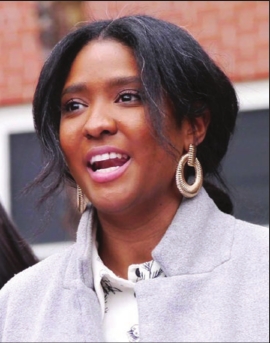
District 6 Councilor Kendra Lara
Defeats of Arroyo, Lara threaten political shift
The day after the Sept. 12 preliminary election, city councilors were in City Hall’s Iannella Chamber debating funding for the Boston Regional Intelligence Center, an agency that coordinates intelligence gathering and sharing between local, state and federal law enforcement agencies.
While progressive councilors have long opposed Boston’s participation in what is known as BRIC, citing instances where the Boston Police Department has shared information with the agency that in at least one case federal immigration agents used to deport a student, Mayor Michelle Wu sought approval for an $850,000 grant for BRIC. The vote followed familiar lines, with a coalition of conservative-leaning councilors voting for the funding against the progressive majority. The vote in support of approving the funding, put forward by at-large Councilor Michael Flaherty, lost 7-5.
The vote underscored a split that has largely defined the council over the last four years, with the body’s majority of people of color and women taking progressive stands over the objections of a quartet of Irish American councilors — Flaherty, Council President Ed Flynn, Erin Murphy and Frank Baker — who hail from and represent South Boston and the predominantly white parts of Dorchester.
Under the diverse majority, the council has passed a raft of progressive legislation — creating the Office of Police Accountability and Transparency, barring police from obtaining surveillance technology without approval from the council, protecting Boston Public School students’ information from federal immigration officials, expanding the city’s participatory budgeting program, increasing the number of liquor licenses in Black and Latino neighborhoods, extending the use of mail-in ballots past the pandemic, and restricting police use of tear gas, rubber bullets and other socalled nonlethal munitions.
Now, with two of the body’s most left-leaning members having lost their seats in preliminary balloting — Ricardo Arroyo, who represents the Hyde Parkbased District 5, and Kendra Lara, who represents Jamaica Plain and West Roxbury — some are questioning whether the Council’s progressive streak will continue into the next term with a body that will no longer have a majority of people of color.
“We’re losing two incumbents who have a vision of how to make city government address real people’s needs,” said Vanessa Snow, a member of the Right to the City Vote steering committee. “They pushed the mayor to take a more progressive stance. They pushed the other progressives to be more bold.”
Arroyo, who has been dogged by Boston Globe articles alleging he was investigated for sexual assault while a teenager, came in third in the Sept. 12 preliminary election behind Enrique Pepén, who heads the city’s Office of Neighborhood Services and Jose Ruiz, a former police officer.
Pepén was backed by Wu and helped by city workers who volunteered on his campaign. Ruiz was endorsed by former mayor Martin Walsh and received backing and campaign contributions from police unions and officers.
The two finalists will face off in the Nov. 7 general election.
Lara,
who is fighting charges in connection with her crashing a car into the
front porch of a house in Jamaica Plain, came in third behind attorney
Ben Weber and William King, an IT director with a local nonprofit. Lara
does not have a valid driver’s license, and the car she borrowed had a
lapsed registration.
The
outcome of the preliminary election in that district means the new
council seated in January could have one less member of color. Weber and
King are white, while Lara is Afro-Latina.
Among
those targeting Lara and Arroyo were a super PAC called Enough is
Enough, which hasn’t reported activity to the Office of Campaign and
Political Finance, and Boston Forward, a PAC funded largely by a
$150,000 donation from Trump supporter and New Balance Chairman Jim
Davis. Boston Forward spent $93,000 on phone calls, text messages and
other voter outreach in support of King and Weber in District 6 and Ruiz
in District 5, according to a WBUR report.
Boston
Forward also backed District 3 candidate John Fitz-Gerald, who reported
an unprecedented $184,789 in campaign donations in advance of the Sept.
12 preliminary. FitzGerald, who is white, finished first in the
preliminary election and will face teacher Joel Richards, who is Black,
in the majority-minority district’s final vote on Nov. 7.
Also
targeting Arroyo was the group Democrats for Education Reform, now
helmed by Mary Tamer, a West Roxbury resident who ran against Lara in
the 2021 election and lost. The pro-charter-school organization reported
spending $25,209 in September opposing Arroyo and supporting Ruiz,
among other candidates.
In
July, public relations maven George Regan held a fundraiser for Flynn,
the council’s president, and sent a fundraising email announcing the
formation of a group he called “Save Our City,” claiming he planned to
embark on “a 3-year mission to save the City of Boston from the negative
impacts of the ultra-progressive policies [that] dominate the current
City Council and current administration at Boston City Hall,” according
to a report in the Dorchester Reporter.
Regan’s
email listed councilors Flynn, Baker, Murphy and Flaherty, as well as
at-large candidate Bridget Nee-Walsh and FitzGerald, the District 3
candidate, as attendees of a planned fundraiser at Regan’s Mashpee home.
Flynn
later told the Reporter he understood the fundraiser to be for him
alone, and the other councilors and council candidates said they had no
foreknowledge of the fundraiser.
It’s
unclear whether Regan’s effort raised any funds for anyone other than
Flynn, but his email underscored the depth of opposition to progressives
among Boston’s more conservative elements. With well over $100,000
spent on opposing progressive candidates and propping up right-leaning
candidates, deep-pocketed donors have left a sizeable imprint on the
city’s political landscape.
“It’s
incredible that you have PACs out there raising money against incumbent
district city councilors,” said political consultant Kristen Halbert.
“It’s a level of engagement that’s just ridiculous.”
In
many ways, Lara and Arroyo were running not just against challengers
and super PACS, but also a narrative in the local media painting the
Council as a body plagued by infighting and dysfunction.
Snow
of Right to the City Vote said the progressive bent of the Council
highlighted the body’s ideological differences more than in the days
when there were just four people of color on a council dominated by
conservative-leaning Irish American and Italian American councilors.
“What’s
dysfunctional was Flynn using his bully pulpit to change the rules when
he felt like it,” she said, citing the council president’s removal of
Arroyo from the chairmanship of the redistricting committee. “That’s not functional.”
Snow
says the media’s framing of the council’s divisions as dysfunctional
too often put the blame at the feet of the body’s progressive wing,
despite the large volume of legislation and home-rule petitions the
Council has passed in recent years.
That
narrative along with the funding provided by right-leaning donors and
the more conservative elements in the city’s civic sphere conspired to
undermine voters’ confidence in Lara and Arroyo, according to Snow.
“This is what happens when you have the corporate media, real estate developers and the police working together,” she said.
As
the council appears poised to tack more toward centrist policies, so
too is Wu, said Fatema Ahmad, executive director of the Muslim Justice
League.
“She ran on a
progressive platform, but is continuing to do the opposite of what she
promised, particularly with policing,” she said, pointing to the
proposal to channel $850,000 to BRIC.
On
the campaign trail, Wu told Progressive Massachusetts chapters she was
opposed to BRIC and the police department’s controversial gang database
it manages.
With Lara
and Arroyo on the way out, Vicki DiLorenzo, a former Ward 1 Democratic
Committee chair, says the tenor of Boston politics will likely become
far more moderate.
“I
think we’re going to see significant changes in the balance of power,”
she said. “We won’t have people pushing the mayor to be more
progressive. The administration will govern differenty from how Wu
campaigned.”


