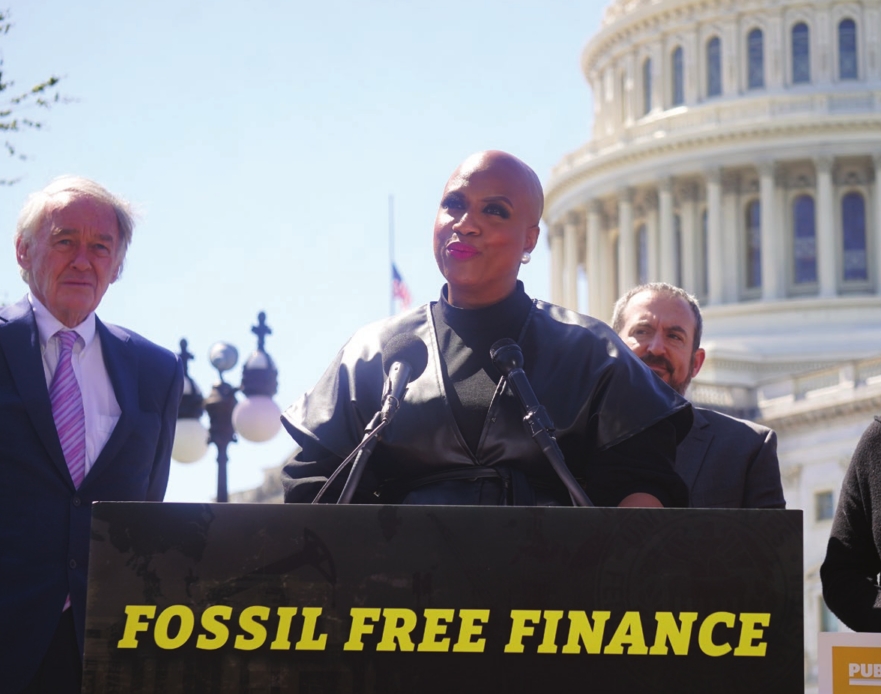
U.S. Rep. Ayanna
Pressley addresses reporters during the announcement of the Fossil Free
Finance Act in Washington as U.S. Sen. Ed Markey looks on.
Joins colleagues in Health Protection Act
Congresswoman Ayanna Pressley, along with colleagues in the House of Representatives, introduced legislation March 30 to federally codify protections for access to abortions nationwide.
Under the bill, called the Women’s Health Protection Act (WHPA), states would not be able to restrict the right to an abortion before a fetus is viable outside
the uterus. Abortions would be permitted post-viability in cases where the life or health of the patient is at risk. It would also specifically protect an individual’s right to travel to obtain reproductive healthcare.
At a press conference introducing the WHPA, Pressley said that no one should feel shame for seeking an abortion.
“There is no shame in seeking abortion care. There is no shame in having had an abortion. The only shame is there are unrelenting, coordinated forces at work to deny your access to that which is a fundamental human right, and that is health care,” Pressley said. “Trying to deny the mother working double shifts who just cannot manage the physical demands of another pregnancy; the student who decided to finish their degree and begin their family on their own terms; the parents who receive the heart-wrenching news that they have miscarried and will need abortion care immediately. I see you, I love you, and I stand with you.”
The
announcement of the bill marked its seventh reintroduction since it was
first introduced in 2013. California Congresswoman Judy Chu has
introduced the bill in the House every time. Chu called the bill one of
the top 10 priorities for House Democrats.
“We
are all standing here today because every person, no matter their
circumstances, no matter how they became pregnant, deserves dignity,
safety and care in seeking an abortion,” Chu said. “You should not have
more rights if you are pregnant in California than if you get pregnant
in Texas. And because, most of all, no one, not the president, not a
Supreme Court justice, not your partner, should be able to force you to
remain pregnant if you do not wish to.”
Democratic
members of Congress at the press conference set up the fight for
abortion access as a fight between their party and Republicans across
the aisle.
“House
Democrats are not going to stand for women in this country to be made
second-class citizens, but tragically, because of extreme MAGA
Republicans, that is the reality facing women across this country,” said
House Whip Katherine Clark of Massachusetts.
Pressley said that in this fight, she and her colleagues are not giving up.
“[They
are] using every tool available to them to put bans on bodies, to deny
access to this critical lifesaving health care, and so we’re doing the
same,” Pressley said. “Whether it’s litigation, or whether it’s
mobilization, we don’t stop organizing because we don’t have the gavel
and we’re not in cycle. The other side isn’t stopping, and neither are
we.”
Addressing climate change
The
same day, Pressley joined other members of Congress to introduce
legislation to limit investments by major banks in projects related to
increased greenhouse gas emissions.
At
a separate press conference, Pressley joined with Massachusetts Sen. Ed
Markey and other members of Congress to introduce the Fossil Free
Finance Act (FFFA), legislation that would mandate that banks with
assets higher than $50 billion reduce financing for greenhouse gas
emissions. The FFFA was previously introduced in 2021.
Under
the bill, these large banks would have to reduce financed emissions by
50% by 2030 and eliminate them completely by 2050. The Federal Reserve,
which would monitor the progress of the banks, would be required to
report to Congress with commitments made by the banks and progress in
those goals. Pressley, who is leading the House version of the bill
alongside Michigan Congresswoman Rashida Tlaib, said the bill would aim
to shift bank funding in line with science-based emissions targets.
“Climate
change is real; climate change is here; and climate change is impacting
every aspect of our lives, from public health to infrastructure to
racial justice,” Pressley said. “For constituents living in the
Massachusetts 7th, which I have the honor of representing, in
communities like East Boston, Chelsea and Everett, climate change is a
reality they are already grappling with. These cities are located close
to the coast and are experiencing an increased frequency of extreme
weather events such as flooding, storm surges, rising sea levels and
heavy rainfall.”
Markey,
who is co-sponsoring the bill in the Senate, said that large banks in
the United States have played a role in worsening the climate crisis and
must be involved in addressing the crisis.
“Banks
are supposed to keep our economy safe; they shouldn’t be gambling our
economy on risky investments that will supercharge climate change by
doubling down on our fossil-fueled past,” Markey said.
The
reintroduction of the FFFA comes following the collapse of Silicon
Valley Bank, which attendees of the press conference said shows the need
for greater oversight from regulators.
“We
saw with the collapse of Silicon Valley Bank that when regulators act
too slowly, the broader financial system can come under threat. The risk
posed by banks that fail to adapt to climate change are similar,”
Pressley said.
Tlaib
said that she thinks Congress must get involved, as banks have not taken
enough action to address climate change independently.
“The
climate crisis is here, and Wall Street isn’t going to do the right
thing on its own, so the Fed has a supervisor responsibility — and, I
would argue a moral imperative — to address the systematic risk climate
poses to our financial system and our economy,” Tlaib said.
For Pressley, adding guidance to the U.S. financial system is an important step to help curb the effects of climate change.
“This
is unsustainable, and it is literally killing us,” Pressley said. “It’s
clear that big banks are ignoring the threat of climate change and
putting profits over people. Our financial system is not prepared to
deal with the risk of climate change, and our regulators are dragging
their feet, refusing to do the right thing and require the banks to
address these risks. This must end.”