
Center for Teen Empowerment Executive Director Abrigal Forrester (left) joins Stanley Pollack, former executive director, on stage during the nonprofit’s 30th anniversary celebration.
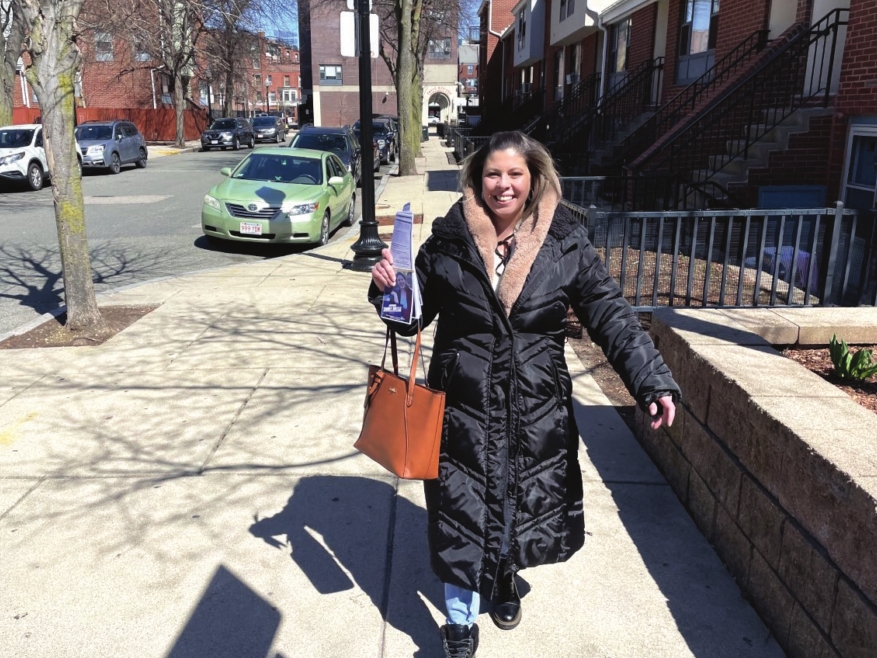
Amparo “Chary” Ortiz knocks doors in the Villa Victoria housing development.

John Moran
District has high concentrations of wealth and poverty
The South End is in many ways a study in contrasts. A neighborhood where subsidized housing developments abut luxury condo buildings, and where Black and Latino Bostonians have deep roots, but where few have pockets deep enough to afford rents.
“There are two South Ends,” said Pedro Cruz, a political activist and city worker who grew up in the Villa Victoria public housing development. “The high-end side and the low-income side. You have kids leaving the Villa to go to school, walking past million-dollar condos. It’s two different neighborhoods.”
A race to fill the South Endbased 9th Suffolk District House seat recently vacated by Jon Santiago is surfacing those contrasts.
So far, two contestants have submitted the signatures needed to secure a spot on the ballot:
Amparo “Chary” Ortiz, a lifelong resident who grew up in the Cathedral public housing development and who directs Boston University’s external relations department; and John Moran, a Scranton, Pennsylvania native who’s lived for 24 years in the South End and who is an associate director at the biotech firm Biogen.
On Monday, Moran’s campaign blasted out a press release noting
See SOUTH END, page 12
South End
continued from page 1
more
than $54,000 in campaign contributions in the first 23 days since he
filed papers with the Office of Campaign and Public Finance (OCPF). Add
to that $10,000 that Moran loaned his campaign, and it’s an impressive
haul for a first-time candidate.
Ortiz’s campaign has yet to log a single donation with OCPF.
Four other would-be candidates opened OCPF accounts, but have since dropped out of the race.
For
the last 50 years, the 9th Suffolk District has included most of the
South End along with parts of Roxbury and the Fenway and has been
represented by left-leaning legislators of color: Mel King from
1973-1983, Byron Rushing from 1983-2019 and Jon Santiago from 2019 until
March 1, when he was appointed secretary of veterans’ services in the
administration of Gov. Maura Healey.
Back
when the district was drawn into its current South Endbased
configuration, it corresponded to the center of the city’s Black and
Latino communities. But over the decades, as Blacks and Latinos moved
south and the South End has gentrified, the district has become whiter.
In the most recent re-drawing of district lines, the 9th Suffolk dropped
a section of the Fenway neighborhood and picked up a precinct in Back
Bay and the Polish Triangle section of Dorchester.
The
district’s population is now 49.2% white, 17.7% Latino, 16.8% Asian and
16% Black. It has one of the highest concentrations of public housing
of any legislative district in the state, with developments such as
Cathedral, Villa Victoria, Methunion Manor, Tent City, Lenox/Camden,
Mandela Apartments, Grant Manor and Orchard Gardens.
Ortiz
says her experience growing up in public housing gives her a
perspective that would inform her work advocating on behalf of the
district.
“The
representative should be someone who understands the struggles and
challenges that low-income people and working families face in getting
the resources that they need,” she said.
Ortiz,
who rents a three-bedroom apartment with her 16-yearold daughter, says
her income has risen over the 25 years she has worked at Boston
University, but she still earns just enough to afford living in the
South End.
“I
understand the cliff effect,” she said. “You work hard to get to an
income level where you can support your family. Once you get there, you
lose the supports you need to get by. I pay my bills, and after, there’s
not a lot left to live on. I’m only able to stay in the South End
because I’m still receiving a subsidy to stay in my apartment.”
Ortiz says she wants to ensure that low-income people have the resources supports they need, even as their incomes increase.
“If I get into the State House, I’ll be representing other people like me, not just in the South End, but across the state.”
Moran,
who spent part of his childhood in Scranton living in public housing,
says he, too, wants to press for more funding for affordable housing.
“There’s
an economic divide in the South End,” he said. “You see people in
million-dollar condos and other people struggling to get by.”
He
says his work on the District 7 advisory council organized by Councilor
Tania Fernandes Anderson inspired him to run for office and work to
increase diverse housing opportunities.
“We have to make sure we’re building all types of housing, including housing middle-class people can buy into and build wealth,” he said.
Moran says his campaign has knocked on more than 3,300 doors in the first few weeks of the campaign.
“We’re going back to do it again,” he said.
In
this special election, the race will likely be decided in the May 2
primary, as no Republican or independent candidates have yet turned in
nomination papers. The candidates are now facing a threeweek sprint to
reach out to voters.
In
the Sept. 2018 primary, during which Santiago was nominated, he won
with 2,236 votes out of a total of 4,465. But this year’s contest will
likely involve a lower turnout, with no other races on the ballot.
Jonathan
Cohn, a South End resident who is a member of the Ward 4 Democratic
Committee and Progressive Massachusetts, said turnout among white voters
has traditionally been higher than that of the neighborhood’s Black,
Latino and Asian residents.
But the contest won’t likely hinge on race alone, he noted.
“You
have a number of white voters who are used to voting for candidates of
color,” he said, citing Sonia Chang-Diaz, Rushing, King and City
Councilor Tania Fernandes Anderson, whose Roxbury-based District 7
includes parts of the South End.
Cohn,
who has not endorsed in the race, says the district’s history of
representation by people of color should matter to voters.
“Given
how few people of color there are in the State House, if there’s a
district with a people-ofcolor majority, it would be a real loss if that
didn’t continue,” Cohn said. “Mel King’s recent passing hangs over this
seat. This is a district where representatives have traditionally
championed civil rights issues.”