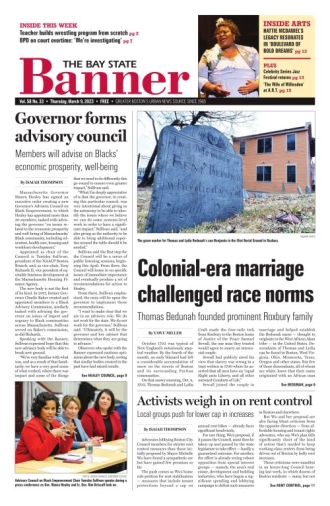
Local groups push for lower cap in increases
Advocates lobbying Boston City Council members for stricter rent control measures than those initially proposed by Mayor Michelle Wu have found a sympathetic ear but have gained few promises so far.
The push comes as Wu’s home rule petition for rent stabilization — measures that include tenant protections beyond a cap on annual rent hikes — already faces significant headwinds.
For one thing, Wu’s proposal, if it passes the Council, must then be taken up and passed by the state legislature to take effect — hardly a guaranteed outcome. For another, the effort is already seeing robust opposition from special interest groups — namely, the area’s real estate, development and building industries, who have begun a significant spending and lobbying campaign to defeat such measures in Boston and elsewhere.
But Wu and her proposal are also facing blunt criticism from the opposite direction — from affordable housing and tenant rights advocates, who say Wu’s plan falls significantly short of the kind of action that’s needed to keep working-class renters from being driven out of Boston by hefty rent increases.
Those criticisms were manifest in an hours-long Council hearing last week, in which dozens of Boston residents — many, but not all,
associated with formal advocacy groups — urged councilors to amend Wu’s
proposal and deliver what they called stronger and more appropriate
tenant protections to Beacon Hill.
Advocates
aimed those comments in particular at Wu’s proposal for capping annual
rent hikes at 6% plus the annual consumer price index, which measures
annual inflation, with a maximum allowable hike of 10% per year — double
the 5% annual cap proposed in one piece of statewide legislation
pending on Beacon Hill.
“We
need the City Council and the office down the hall to listen to the
people — rent control is a racial justice issue,” said Mike Leyba,
co-executive director of City Life/ Vida Urbana, one of the groups
organizing for tougher rent control measures across Massachusetts.
Leyba
pointed out that nearly 60% of renters of color in Boston are
considered “rent burdened,” compared to fewer than 50% of white tenants;
and that evictions — including no-fault evictions that would be banned
under Wu’s proposal — occur disproportionately in Massachusetts
communities of color.
“The
only way to pass rent control is to have a strong version of this. If
we try to find the middle ground, we’re going to end up outside of
Beacon Hill without anything,” said Leyba. “It is magical thinking to
think there is a way to compromise our way to this. It is time for the
mayor and the City Council to stand up to the industry that is kicking
our people out.”
Leyba’s
comments were echoed by dozens who testified before the committee, with
testimony coming in English, Spanish, Chinese and Haitian Creole.
“I
appreciate Mayor Wu introducing this proposal, but it really needs to
be stronger,” said Alba Oliver, of Allston. “I am happy that we’re
finally talking about rent control … [But] Mayor Wu’s rent control
proposal would be one of the weakest in the country … 10% is way too
high.”
James Cordero, a
public school teacher who lives in Dorchester, said that he respected
Wu’s desire to see more housing built across Boston — one reason for her
proposed exemptions for new construction.
But,
Cordero said, “A 5% cap [on rent hikes] allows plenty of wiggle room
for developers. We need to ask ourselves, do we want housing that
maximizes the profits of real estate corporations, or do we want to make
sure we have a Boston for all, where people who make ordinary wages can
actually live?”
Several
councilors expressed sympathy for those arguments — but most who did
held back from endorsing calls to amend or modify the mayor’s proposal.
One
exception was District 6 Councilor Kendra Lara, who has been vocal in
urging her Council colleagues to consider tougher measures.
“This
historic moment requires us to meet the housing crisis with the urgency
it deserves … A 10% increase is beyond what should be allowed,” said
Lara, arguing that for many Boston residents — and especially
single-parent households — allowing such an annual increase would be
devastating.
“What
happens to the single parents if we pass this home petition as is and
don’t change the cap?” asked Lara. “My invitation to my colleagues and
to the administration is to consider who we are standing up for … This
is a historic moment, yes — but what good is a historic moment if we’re
going to squander it?”
District
7 Councilor and committee chair Ricardo Arroyo acknowledged those
arguments while stopping short — so far at least — of endorsing
amendments to the mayor’s bill.
“I
will just say for me personally, I too wish we could go deeper and
harder,” Arroyo said, noting at the same time that “it took a lot of
courage for this administration to do the right thing here.”
“I
think it’s an incredibly important step to do this,” said Arroyo. “I
want to make it clear that as we move forward, we know that even its
passage here is not the final step.”
Meanwhile,
support for the mayor’s petition appears to be building within the City
Council, despite indications that at least some members are unlikely to
support the measure.
A
majority of Council members must vote in the affirmative to pass the
petition, with or without amendments. Should the petition emerge from
the Council committee intact, one or more councilors may introduce
amendments on the Council floor before a final vote, and such amendments
would also require a majority vote.