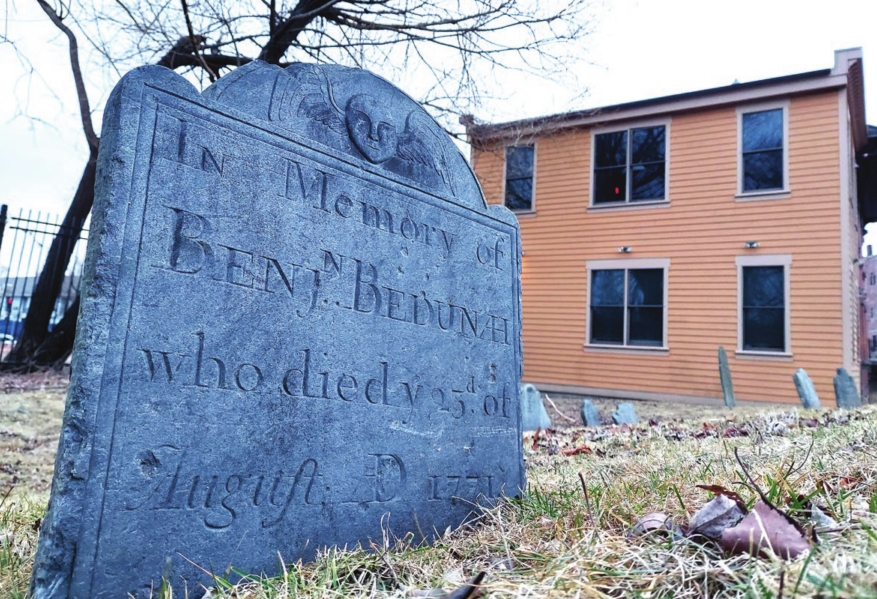
The grave marker for Thomas and Lydia Bedunah’s son Benjamin in the Eliot Burial Ground in Roxbury.

A headstone for Ebenezer Craft, a member of a founding family of Roxbury.
Thomas Bedunah founded prominent Roxbury family
October 1703 was typical of New England’s notoriously atypical weather. By the fourth of the month, an early blizzard had left a considerable accumulation of snow on the streets of Boston and its surrounding Puritan communities.
On that snowy morning, Oct. 4, 1703, Thomas Bedunah and Lydia Craft made the four-mile trek from Roxbury to the Boston home of Justice of the Peace Samuel Sewall, the one man they trusted would agree to marry an interracial couple.
Sewall had publicly aired his view that slavery was wrong in a tract written in 1700 where he asserted that all men have an “equal Right unto Liberty, and all other outward Comforts of Life.”
Sewall joined the couple in marriage and helped establish the Bedunah name — thought to originate in the West African Akan tribe — in the United States. Descendants of Thomas and Lydia can be found in Boston, West Virginia, Ohio, Minnesota, Texas, Oregon and other states. But few of those descendants, all of whom are white, know that their name originated with an African man thought to have been born in Roxbury in 1680.
It
wasn’t until 303 years after the Bedunah/Craft wedding that Curtiss
DeYoung found out his ninth great-grandfather was African.
“Our
family is white,” said DeYoung, the executive director of the Minnesota
Council of Churches. “They lost the connection to their African
ancestry.”
DeYoung’s
mother had been researching the family genealogy and was able in 2006 to
trace her grandmother Julia Bedunah’s lineage back to Thomas and Lydia.
The family has embraced this previously unknown aspect of their history.
But DeYoung says his family may have reacted differently had the discovery occurred earlier.
“Had this been discovered by our family members in the 1930s or ’40s, our racial designation could have changed,” he said.
During
most of the 20th century, racial designations in the United States
operated under the so-called one-drop rule, the idea that any known
Black ancestry, even DeYoung’s less-than-a-half percentage point
heritage, meant that a person was legally Black.
For
DeYoung, who is married to a Black woman and graduated from Howard
University Divinity School, such a revelation would hardly cause
consternation. He sees the Bedunah/Craft marriage as an interesting
window into the evolving notions of race in colonial America.
“I
find it fascinating,” he said. “It’s a point in our history when race
was still formalizing itself. It was before the one-drop rule.”
Thomas
and Lydia’s marriage was also two years before the Massachusetts
Legislature, prompted in part by their union, outlawed sexual
intercourse and marriage between whites and people of other races,
passing An Act for the better Preventing of a Spurious and Mixt. Issue.
The law included “Negros” and “Mollatos” — or mixed-race people.
Despite
that law, each of the Bedunah children who married wed whites. In the
military record of grandson Moses Bedunah, who fought in the
Revolutionary war, there is no mention of race, suggesting that he was
considered white.
Aabid
Allibhai, a Ph.D. candidate in African and African American Studies at
Harvard University, noted in a report on slavery at the First Church in
Roxbury that the First Church did not indicate the race of the Bedunah
children. Racial designations in church registers and other Colonial
records were reserved only for African and Wampanoag people.
That suggests that the church considered them white.
It’s
clear that racial mixing continued in Roxbury and throughout the
Massachusetts Bay Colony following the 1705 law banning such unions. So
what happened to the law? Was it poorly enforced? Were Bedunah children
considered white by colonial authorities?
Historian Byron Rushing, a
former Massachusetts state representative, said the Legislature may not
have bothered to define what constituted “Negro” or “molatto.” Craft’s
status as a white woman may have conferred on her children the same
status.
“Racial definitions are arbitrary,” he said.
In
Massachusetts Bay Colony, mixing between whites and Blacks was
relatively new, and the white colonists were slow in catching up to the
emerging reality.
While
the colonists often enforced laws against fornication, Rushing notes
that many people in New England lived in common-law marriages,
cohabiting without the sanction of church or state.
“It was all very relaxed in those days,” he said. “You didn’t have to marry if you didn’t have property.”
Were there others?
Given
the more fluid definitions of race in Massachusetts Bay Colony, it’s
likely there were other mixed-race families who became white.
Wayne
Tucker, a historian who documents the history of slavery in the New
England states, notes that the Black population in Massachusetts
declined from the time of the American Revolution into the 1800s.
“There’s no information about where people went,” he said.
How
many African-descended people disappeared into the white world? It’s
impossible to say. But according to a 2014 genetic study analyzing data
from the DNA Testing firm 23andMe, 4% of whites in America have African
DNA. That could mean as many as 7.8 million whites have distant — and
not-sodistant — Black ancestors. Among them, probably hundreds of
Bedunah descendants.