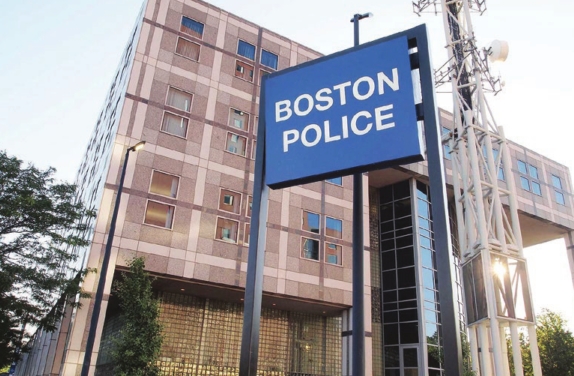
More than 120 police officers who received court overtime appeared to be on duty elsewhere in the city.
Police still investigating irregularities in records
Last year, police reform activists found more than 120 instances of Boston Police Department officers claiming overtime for court appearances while the department’s records showed them making traffic stops and arrests, often miles away from the nearest courthouse.
Questioned on the inconsistencies, police officials vowed an investigation. Yet, one year later, police officials have yet to disclose any information on the apparent misuse of overtime.
The BPD has been tight-lipped on the status of their efforts looking into the problem, declining to comment when asked by the Banner about its progress.
Boston police officers appear in court to testify and present evidence after making arrests. Their contract allows them to collect a minimum of four hours of overtime for those appearances when they’re called into court by district attorneys, provided they are off duty at the time of the court appearance.
In the last year, with former Mayor Martin Walsh’s pledge to cut the department’s overtime budget by 20% undermined by a rapidly growing overtime costs, the City Council has trained a laser focus on the department’s policies.
At a council hearing in March 2020, during which councilors questioned how overtime hours were managed, Council Ways and Means Committee Chairwoman Kenzie Bok noted that police are increasingly collecting pay for hours they’re not in court.
“Two-thirds
of court overtime hours are hours not worked,” she said. “That ratio
has been going up in the wrong way in the last few years.”
During
the same hearing, councilors and activists who testified remarked on
the lack of transparency in decision-making that has ended up costing
taxpayers millions of dollars.
“[BPD
officials] didn’t really seem to have any clear sense of how the system
works or what kind of rules are in place to ensure that overtime is
distributed appropriately and fairly even within the department, or that
the department is doing really anything to limit the amount of overtime
spending,” Kade Crockford of the Massachusetts ACLU told the Banner.
The
ACLU, in response to growing concern from politicians and the public,
put its own report together last year looking at police court overtime
records from 2014 to 2019. In it, the ACLU alleges that the “four-hour
minimum court appearance policy” is wasteful and that excessive overtime
creates an incentive for officers to exploit it.
The
report states that “officers can attend court for a few minutes for a
task as simple as dropping off discovery documents, and yet still be
paid for four hours of overtime at time-and-a-half.”
The
report goes on to state that in 2019, officers claiming court overtime
for unworked hours cost more than $3 million and that individuals
cashing in on the extra pay made on average $15,000.
Councilor
Ricardo Arroyo, who led much of the questioning in the March hearing
and who has filed several records requests in relation to overtime, is,
like many, left wondering where the department’s findings are.
“It’s
troubling that it’s been a year and we still have no answers,” he said.
“The reality is, if something was done here improperly, as far as court
overtime goes, that means we’ve had a whole year where we haven’t been
able to address those root causes, because they haven’t actually
completed an investigation.”
Arroyo’s
most recent pleas to the BPD for increased transparency came in May of
2021 when he filed a records request for the deployment of sworn
officers by district or shift — information the department is required
by law to share with the Council. When that request was denied, Arroyo
addressed the request to the department representatives directly.
Arroyo
argued that without this information, it would be impossible to assess
to what extent the overtime pay for officers is necessary. BPD officials
have refused to release the records.