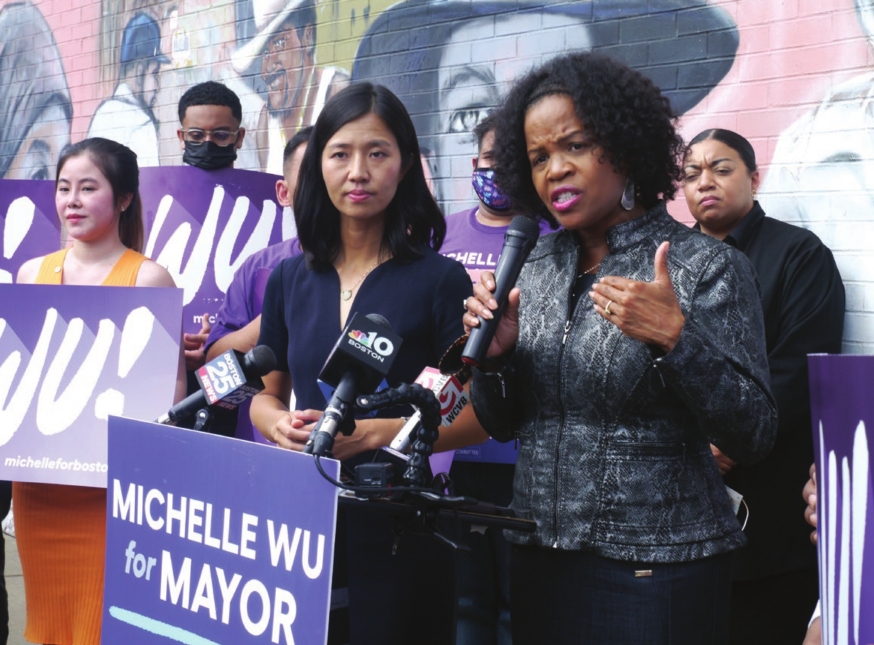
Acting Mayor Kim Janey announces her endorsement of mayoral candidate Michelle Wu in Nubian Square.
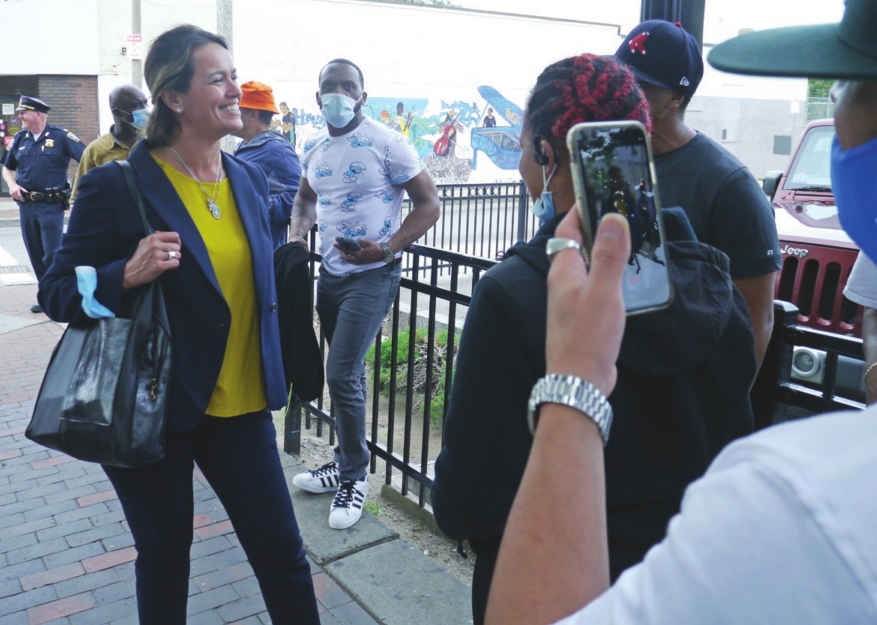
Mayoral
candidate Annissa Essaibi George speaks to Roxbury residents on Warren
Street during a peace walk held by clergy from the 12th Baptist Church.
Mayoral candidates compete for Black, Latino votes
Following the preliminary election, unions and elected officials have begun declaring their support for one of the two finalists set to face off in November. However, their impact remains unclear as campaigns set their sights on undecided Black voters.
Since securing the top spot, City Councilor Michelle Wu, who is running on a progressive platform and who finished with 33.4% of the vote in the preliminary, has been endorsed by acting Mayor Kim Janey, City Councilor Ricardo Arroyo, Suffolk County Register of Probate Felix D. Arroyo, gubernatorial candidate and state Sen. Sonia Chang-Diaz, state Rep. Liz Miranda and SEIU 1199, which represents health care workers.
City Councilor Annissa Essaibi George, the second-place finisher with 22.5% of the vote, has since received endorsements from the local sprinkler fitters union and IBEW Local 103, which represents electrical workers.
Janey’s endorsement of Wu has been categorized as “unprecedented,” as she has been the first Black female mayor in the city’s history. At the press conference during which she expressed her support for Wu, Janey acknowledged the significance of her tenure, as well as the interests of her constituents.
“It
took 200 years to get the first woman mayor, to get the first Black
mayor. Many folks here have been part of that advocacy, part of that
organizing for years,” Janey said. “And so there is disappointment, we
can’t ignore that.
We
have though, an opportunity. We cannot squander the next opportunity to
make sure the voices of Black and brown people are at the center of the
discussion, at the center of the policies that will move our city
forward.”
In her
statement, Janey captured what many are viewing as the crux of the next
few weeks — that undecided voters will be looking to align themselves
with the candidate with concrete plans to fix the city’s issues,
especially ones that have disproportionately affected majority Black and
brown neighborhoods.
“For
an endorsement for a candidate to get people excited about [voting],
you’ve got to see something that’s going to actually relate to a
practical issue that people can identify with and therefore be enthused
about coming out to vote,” said veteran Democratic activist Louis Elisa.
He
gave examples of the situation around the addiction treatment centers
at Mass and Cass, affordable housing and infrastructure plans. Elisa
also added that “putting people on the street and getting literature
out” may give a leg up come November.
Taking
this strategy to heart, Essaibi George has been pounding the pavement
in Boston’s neighborhoods, talking with Boston residents.
Friday
evening, Essaibi George participated in a peace walk with clergy from
the 12th Baptist Church and Boston Police Area B-2 commander Captain
Dennis Cogavin, visiting businesses and chatting with residents in the
Nubian Square area.
In
the El Mondonguito restaurant on Dudley Street, a man who gave the name
Giovanni leaned in as Essaibi George walked toward the counter.
“What are you going to do for Boston?” he asked. “A
little bit of everything,” Essaibi George said. “Schools, housing,
economic development. What do you want me to do?” “Fix the housing
situation,” Giovanni said.
Wu
and Essaibi George have presented differing visions for the mayor’s
office. Essaibi George has dismissed Wu’s campaign promises to push for
free MBTA rides and a return to rent control in Boston, noting that
those issues fall under the purview of the Legislature. Essaibi George
has taken a more moderate stand on issues such as policing, calling for
the addition of more officers on the force.
Another
major player in the mayoral preliminary — and a voice that may carry
weight among Black voters — is Councilor Andrea Campbell, who has not
yet endorsed either candidate. In a statement, she said, “My challenge
to Essaibi George and Wu is to tell our communities — not merely in
private meetings or phone calls with me or stakeholders, but publicly
and directly to residents — what specific, tangible plans they have to
deliver racial equity in our health, housing, schools, public safety and
economic systems.”
Yawu Miller contributed to this article.