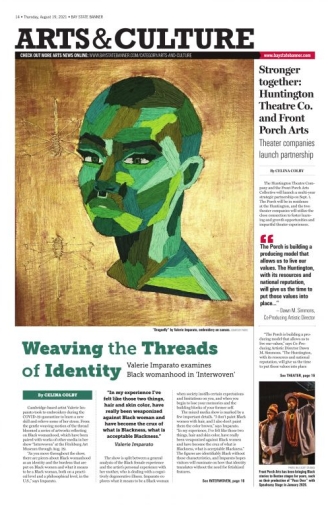
“Dragonfly” by Valerie Imparato, embroidery on canvas
Valerie Imparato examines Black womanhood in ‘Interwoven’
Cambridge-based artist Valerie Imparato took to embroidery during the COVID-19 quarantine to learn a new skill and relieve some of her stress. From the gentle weaving motion of the thread bloomed a series of artworks reflecting on Black womanhood, which have been paired with works of other media in her show “Interwoven” at the Fitchburg Art Museum through Aug. 29.
“As you move throughout the show, there are pieces about Black womanhood as an identity and the burdens that are put on Black women and what it means to be a Black woman, both on a practical level and a philosophical level, in the U.S.,” says Imparato.
The show is split between a general analysis of the Black female experience and the artist’s personal experience with her mother, who is dealing with a cognitively degenerative illness. Imparato explores what it means to be a Black woman when society instills certain expectations and limitations on you, and when you begin to lose your memories and the building blocks of your former self.
The mixed media show is marked by a few important details. “I don’t paint Black women with hair, and I also don’t paint them the color brown,” says Imparato. “In my experience, I’ve felt like those two things, hair and skin color, have really been weaponized against Black women and have become the crux of what is Blackness, what is acceptable Blackness.” The figures are identifiably Black without those characteristics, and Imparato hopes visitors will ruminate on how that identity translates without the need for fetishized features.
In
the use of embroidery, Imparato explores how to depict figures in
thread. Where shadow and depth are more easily manipulated in paint or
pencil, she relies on color to tell the story in these textile works.
“Interwoven”
has been an important turning point in her artistic practice. The work
about her mother’s illness is the first time the artist has delved into
and displayed deeply personal pieces. In the Fitchburg galleries,
visitors see photographs of Imparato’s mother next to paintings Imparato
has made of her. She explores not only how the illness has impacted her
mother’s identity, but also how it has impacted her view of her mother
and their relationship. She turns over and examines the question, what
makes a person themself?
“I
hope the show makes visitors think about the ways in which they
categorize people and take a moment to think about the roles of Black
women in their lives and in society,” says Imparato. “For Black women
who see the show, I hope they see themselves for the first time in maybe
a long time.”
ON THE WEB
Learn more about the show at fitchburgartmuseum.org/interwoven