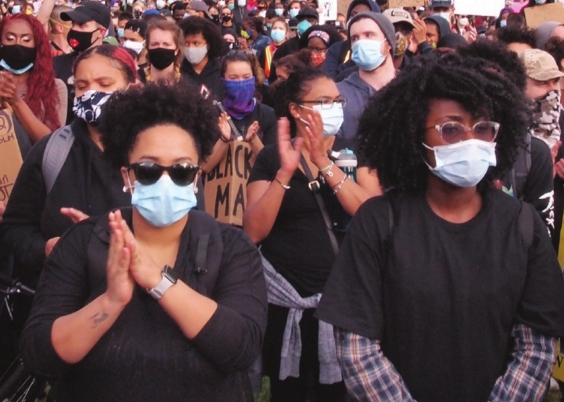
Boston’s Black population declined by nearly 9,000.
Drop comes as Mass. towns see increase
In the last 10 years, Boston has gained 58,000 new residents and grown slightly more diverse, with increases in the Latino and Asian share of its population. But 8,800 Black people dropped from the city’s count, continuing a 20-year downward trend.
Statewide, the numbers for Blacks, Latinos and Asians have grown, while the share of whites has gone from 81.9% of the state population in 2000 to 67.2% in 2020. Blacks’ share of the Massachusetts population has increased from 5% of the total — 318,000 residents — to 6.5%, with 457,000. Latinos increased from 6.8% to 12.6% of the state population, with their numbers rising from 428,000 to 887,000. There are now 504,900 Asians in Massachusetts — 7.2% of the state’s population.
The surge in Latinos in Massachusetts was fueled largely by immigration, noted political consultant Doug Chavez.
“There’s been an immigration wave in the last 20 years,” he said.
While the increase in Latino residents was modest in Boston, there were more dramatic increases in other Massachusetts cities, most of which are majority people of color. Lawrence is now 81.8% Latino and just 12.3% white. In that city, the departure of nearly 5,000 whites was more than made up for by an increase of 16,500 Latino residents.
Similarly,
Revere’s Latino population saw an increase of 10,500, Chelsea’s 4,971
and Lynn’s 15,500. In each of those cities, the white population
declined, but that decline was offset by the large increases in Latinos
and more modest increases in their Black and Asian populations.
The
numbers in Chelsea, where the Census counted 40,787 residents, may not
reflect the whole story, says Roberto Jiménez, who serves on the School
Committee there.
“Anybody
who works and lives in Chelsea knows we have way more than 40,000
people living here,” he said. “The fact that the Trump administration
and the pandemic contributed to an undercount is widely understood.”
Dorothea
Jones, chair of the Ward 12 Democratic Committee in Roxbury says she
believes a similar dynamic may be at play in Boston.
“I think the census count was a failure,” she said. “There was no follow-up and we’re always undercounted.”
According
to data culled from the 1990 census and the U.S. Census Department’s
2017 American Community Survey, the percentage of Blacks in Boston who
are foreign-born rose from 21% in 1990 to 37% in 2017, with the largest
numbers hailing from Haiti, Cape Verde and Jamaica. Given the high
number of foreign-born Blacks and the Trump administration’s aggressive
deportation regime, it’s conceivable that a sizeable portion of the
city’s Black population did not participate in last year’s count.
Jones said the perceived loss of Black residents in the city need not contribute to a loss of electoral power for Blacks.
“As long as we go out and vote, we have every opportunity to have elected officials who are accountable to us.”
The
decrease in the number of Black people in Boston comes as cities
outside of Boston are seeing increased numbers of Black, Latino and
Asian residents. Brockton gained 7,717 Black residents, nearby Stoughton
gained 2,197 and Randolph gained 2,744.
Rising
housing prices and rents in Boston may be the largest factor in the
Boston’s declining population. A Boston Indicators Project study found
that 49% of Blacks in Brockton own homes, whereas just 30% of Blacks in
Boston own their homes.
Boston’s Black count
The
United States began conducting a decennial census in 1790. For the
first three enumerations, slaves were counted but not free Blacks.
Because slavery ended in 1783 in Massachusetts, Black Bostonians weren’t
counted. When free Blacks were first included in 1820, there were 1,700
counted in Boston, just 3% of the city’s population of 58,000.
“Every
decennial count has increased since then,” noted former state Rep.
Byron Rushing. The greatest increase in the city’s Black population, he
said, came in the post-World War II count. In that decade, the city’s
Black population jumped from 23,000 to 40,000, an increase Rushing
attributes to the availability of jobs in the city.
The
1940s and ’50s also marked the beginning of white flight from cities
such as Boston. Aided by the GI Bill, whites began moving to suburban
communities such as Brookline, Newton and Milton.
“That’s the beginning of the decrease in white population in Boston,” Rushing said.
The
out-migration of whites increased as interstate highways transformed
farming communities such as Wellesley and Lexington into suburbs.
Between 1950 and 1980, Boston’s total population dropped from 801,000 to
562,000. By 1990, Boston’s Black population had inched up to 23.8% — a
high watermark.
There it stayed in 2000, before slipping to 22.4% in 2010, then 19.1% in the 2020 census.
At
the same time, the city’s Latino and Asian populations have continued
to climb. In 1970, just 2.6% of the city’s population was Latino and
just 1.3% was Asian/ Pacific Islander. Today, Latinos make up 19.7% of
the city’s population. Asians make up 11.2%.
‘Some other race’
One
other possible factor in Boston’s declining headcount for Blacks is the
rise in the “some other race” and “two or more races” designations.
People checking that category in Boston rose from 1.2% in 1990 to 6.5%
in 2020.
Since the
early 20th century, under the so-called one-drop rule, people of mixed
race in the United States were considered Black if had any Black
ancestry, no matter how remote. A number of Southern and Midwestern states adopted laws classifying such people as Black in the early 1900s.
In
1990, people of mixed race began identifying themselves as such on the
U.S. Census. That year, little more than 6,000 Bostonians checked the
“two or more races” box. This year, it was 32,000 people, up from 14,959
in 2010. In the Greater Boston region, 211,870 people identified as
mixed race in the 2020 census, according to the Greater Boston
Indicators Project.
Nationally, the number of people identifying as mixed race tripled, and now stands at 33.8 million.


