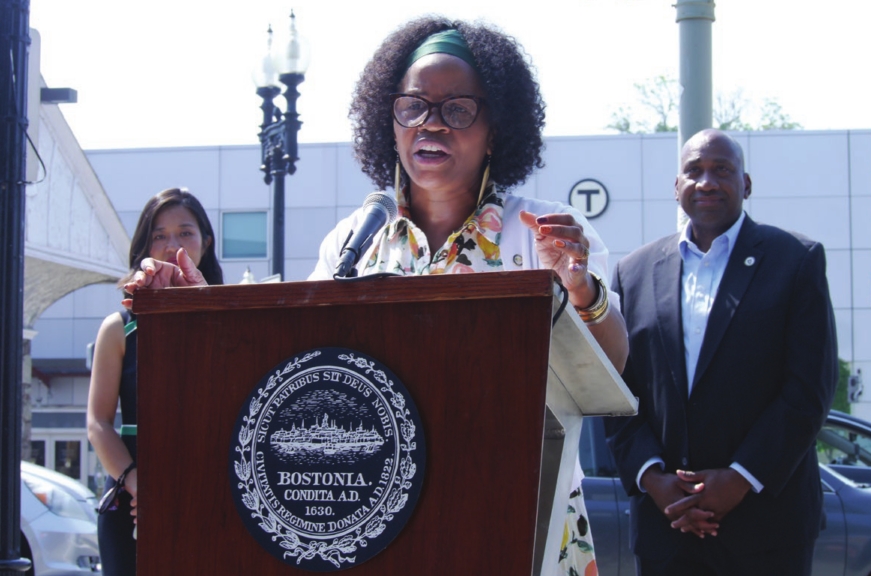
Acting Mayor Kim Janey speaks to reporters outside the Mattapan bus and trolley terminal as at-Large Councilor Michelle Wu and state Rep. Russell Holmes look on.
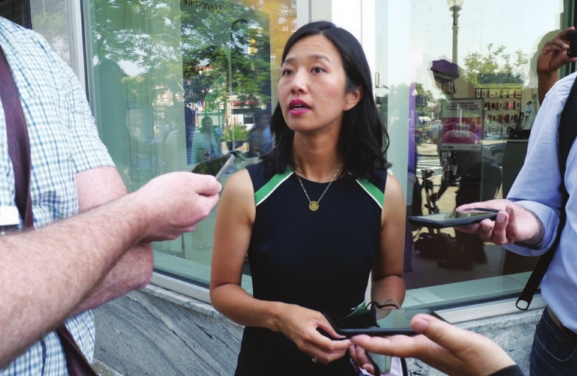
At-large Councilor Michelle Wu speaks to reporters in Mattapan Square.
Three-month trial to probe feasibility of free buses
Acting Mayor Kim Janey on Monday announced a pilot program to waive fares on the 28 bus, which travels between Mattapan Square and Ruggles Station.
The pilot project comes amid a growing chorus of transit activists calling for free bus service. While MBTA service falls under state control, at-large City Councilor and mayoral candidate Michelle Wu’s advocacy on the issue has propelled it into mayoral debates and forums.
As Janey made her announcement, Wu stood behind, along with Councilor Ricardo Arroyo and state Reps. Brandy Fluker Oakley and Russell Holmes.
“More than two-thirds of riders on the 28 bus are classified as low-income, according to the MBTA’s most recent survey,” Janey said during the press conference in Mattapan Square.
“This pilot will help us achieve rider equity, provide monetary support to riders and allow us to better understand what impacts travel.”
Janey, who does not own a car, regularly took the MBTA to work as a city councilor. As acting mayor, she is driven by a police escort.
The 28 bus is among the busiest in the MBTA system, maintaining high ridership throughout the day as it makes its way through business districts in Mattapan, Grove Hall and Nubian Square. The bus passes by Roxbury Crossing on its way to the Ruggles Street terminal.
“For
many of the residents who rely on the 28 bus to get to work, to shop
for food or see a doctor, the bus is their only mode of transportation,”
said Janey who rode the 28 bus to the press conference.
Janey said the city hopes to learn how free service will affect bus ridership.
“I would love to see free buses all throughout the city,” she said. “There’s no secret there. I have been advocating for that.”
While
the idea of free bus and train service has come up during multiple
mayoral forums and has been a key issue in Wu’s campaign, the city has
limited power to affect MBTA fares. To fund the three-month pilot
project on the 28 route, the city has committed $500,000.
Speaking to reporters before the press conference, Wu said she would like to see the MBTA expand the pilot project.
“I’m
excited to see steps coming after years of advocacy,” she said. “We
need to ensure that we are moving as quickly as we can, and not stopping
here. A three-month pilot is a small step to affirm years of organizing
and coalition building, but we have to give it the time.
We have to fight for the partnership with the MBTA to deliver a longer-term pilot that is much more expensive.”
During the press conference, Janey thanked Wu for her advocacy on making MBTA fares free.
Fares
account for $693 million of the revenue in the MBTA’s $2.12 billion
budget. More than $1 billion of the agency’s funding comes from the
state. Cities and towns served by the MBTA kicked in a total of $174
million for the 2020 budget. Transit advocates with the Livable Streets
Alliance estimate that eliminating bus fares in the Boston region would
cut $33.7 million from the MBTA coffers, 2.8% of the agency’s total
budget.
But it’s the
MBTA board and the governor who appoints its members that have the power
to make that decision, not the mayor of Boston.
During
the press conference, a reporter cited the lack of control the city has
over the MBTA and asked Janey what power she actually had to eliminate
bus fares.
“Well, one thing I just did as mayor is I’ve offered a free bus,” she responded. “Did you hear that news?”


