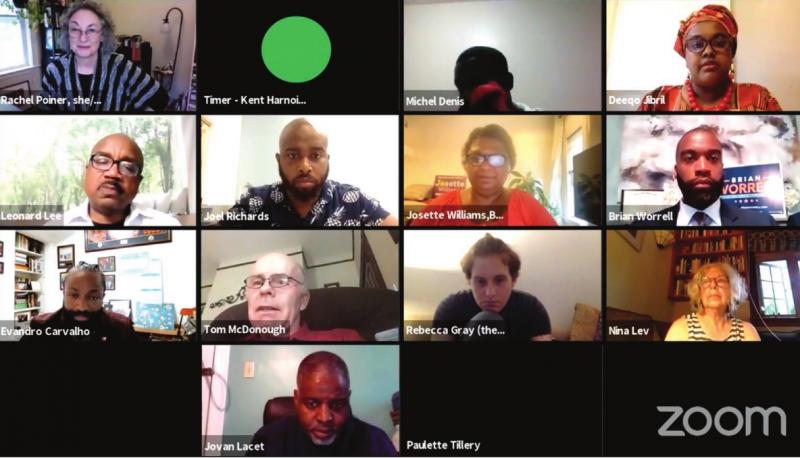
District 4 candidates face questions from Ward 18 activists.
Six candidates for City Council battled last week for the attention of District 4 voters in a crowded race for the seat covering parts of Mattapan, Dorchester, Roslindale and Jamaica Plain.
The Ward 18 Democratic Committee and Progressive West Roxbury hosted a forum via Zoom on July 1 with candidates who filled out the groups’ questionnaire. There are nine candidates in the race.
The candidate field is all people of color, including two women, Deeqo Jibril and Josette Williams. The others are Black men.
Here’s what the candidates conveyed about themselves and their platforms at the forum.
(Candidates are listed in alphabetical order)
• Evandro Carvalho — “Listen to learn, and then to lead.”
Carvalho’s main priorities are the economic status of Boston’s residents and businesses, and the racial wealth gap. Carvalho is the executive director of Boston’s Human Rights Commission, which works out of City Hall to attend to civil rights complaints and systemic discrimination.
Carvalho is also a former state representative for the 5th Suffolk district, which covers much of Dorchester and is currently represented by Liz Miranda.
“[At] 32 years old I was able to be successful and get things done, and that’s because I listen to my community,” he said.
If elected to the City Council, Carvalho said, he wants to reassess the loss of education due to COVID-19, push for affordable homeownership options and continue fighting for criminal justice reform.
“We should have special prosecutors to handle those investigations when people are killed by police,” he said of criminal justice reforms in Boston.
• Deeqo Jibril — “I bring great experience at the table.”
Jibril is focused on increasing affordability in Boston and creating more opportunities for youth.
The former District 7 candidate now lives in District 4 and is a business owner and community organizer known for starting Boston’s first African mall. For seven years, Jibril worked in Action for Boston Community Development’s housing department.
“I know how renters and elderly are easily displaced. Housing stability is my priority,” Jibril said.
As a Somali immigrant, Jibril is passionate about language access and addressing disparities for students of color.
“As a city councilor, I do want to champion mentorship programs, guidance counselors that speak multiple languages [and] understand cultural competency, teachers that reflect the students that they serve,” Jibril said.
She also addressed the danger the Muslim community is in due to Islamophobic movements in the wake of the Boston marathon bombing.
“Law enforcement is here to serve and protect us. Police should be held accountable by the people that they serve,” Jibril said.
• Leonard Lee — “I will go down to City Hall to kick in the door.”
Lee’s
first priority is recovery from the COVID-19 pandemic. Because the city
is getting ready to distribute federal aid related to the pandemic, he
wants to make sure it goes to the communities that need it most.
Lee
is a Boston Parks and Recreation commissioner and has worked for 30
years in Boston in both the public and nonprofit sectors. Most recently
he started a campaign raising money to donate masks during the pandemic.
He grew up in Dorchester, went on to work for Massachusetts Department
of Public Health and the ABCD Dorchester Neighborhood Services Center,
and has sat on commissions in and around the city.
“[District
4] can be the example of what a district should be like, where we have
one Dorchester or one D4, and not all these little different pockets of
our community,” Lee said.
Lee
supports an elected Boston School Committee and said that the schools
in District 4 are dysfunctional. He also supports council initiatives
that create more affordable housing.
• Joel Richards — “Better environments for our kids to learn in.”
Richards
is a BPS teacher entering his 13th year who has fought to bring more
social workers into schools. He hailed his experience over the last year
as chair of Boston Black Lives Matter at School as a recent success.
Richards is in support of an elected School Committee and said the community is continuously shut out of key decisions.
Other
than education, his other main priorities are housing and small
businesses. Richards pushed the development of “essential worker
housing.”
“So we
actually need to build housing focusing on 60% [of Area Median Income]
for purchase — so we need to expand our lotteries — and then 40% AMI for
rental,” Richards said.
Aside
from teaching, Richards is also a minister. He said he is working with
BPS Superintendent Brenda Cassellius to find out how churches can help
with efforts to recover from COVID-19 learning loss.
His focus on small businesses comes from his time as chair of Fields Corner Main Streets.
“When
we’re talking about reclaiming the community process … I know what I
would like to see: Green spaces and more small businesses over there,”
Richards said.
• Josette Williams — “Model what you believe in.”
Williams
is an early childhood educator who has lived and worked in Boston for
over 20 years and is originally from Brooklyn. She’s focused on recovery
as well, and also wants to increase civic engagement in District 4.
“We need to be building our communities and bridging and thriving, and not just surviving in our communities,” Williams said.
Williams
works with the First Teacher program, which is a community of families
in Boston working to prepare young children for school. She supports a
hybrid School Committee, with members elected and appointed.
“We
need to invest in all of our schools, K through 12, ensuring that we
not only have training, but we need a hybrid model for our School
Committee,” Williams said.
As city councilor, she would focus heavily on constituent services to make sure all District 4 residents are included.
“We need to ensure that the process is inclusive, that we have digital information put up,” Williams said.
Williams
was specific in her ideas on housing, showing support for the city’s
first-time homebuyer programs and suggesting an extension on the federal
eviction moratorium.
• Brian Worrell — “It’s going to take a village.”
Worrell
is the owner of a real estate business, making him an outlier among the
educators and city and state workers. He cites his work in community
engagement and communication with the city as key experience as a
District 4 candidate.
“[I’ve]
spent the last 20 years helping families create generational wealth
through homeownership, small business development and creating jobs,”
Worrell said.
Worrell
says that District 4 is underserved and not invested in properly.
Investing in quality education, affordable housing and jobs are his
three top priorities.
“It’s
my fiduciary responsibility to put my client’s interests above
everything else, and this is the mindset that I will continue to bring
as your next city councilor,” he said.
For
Worrell, investing in education means funding wraparound services that
expand the school day and adding more practical courses and access to
college credits in grade school.
He also commented on the lack of reform for zoning laws, which he said slows down affordable development in Boston.
“We also need to make sure that we are creating pathways to homeownership,” Worrell said.
Lightning round
On allowing noncitizens legally residing in Boston to vote in municipal elections, all candidates were in support.
When
asked if they would have supported City Council’s limits on police
crowd control weapons (such as rubber bullets and tear gas) all of the
candidates answered yes, with Williams adding that she would prefer the
weapons be banned altogether.
Questions
on other police issues received mixed responses. When asked, “Do you
believe that racism and white supremacist affiliations are problems
within the Boston Police Department?” Williams was the only one who
answered no, stating instead that the BPD has “bias issues.” On removing
police from schools, all candidates answered yes except for Lee.
Three
issues the candidates are all in agreement on: Aid to those with food
insecurity should serve everyone regardless of immigration status; 16-
and 17-year-olds should be allowed to vote in municipal elections; and
the city should end subminimum wages for tipped workers.
But on rent control, Worrell separated himself from the group as the only no.
Not
in attendance at last week’s forum were candidates Jacob Jaleel Urena
of Mattapan, Troy A. Smith of Dorchester and William Edward Dickerson
III of Dorchester.
The preliminary election for Boston City Council will be held on Sept. 14, 2021.