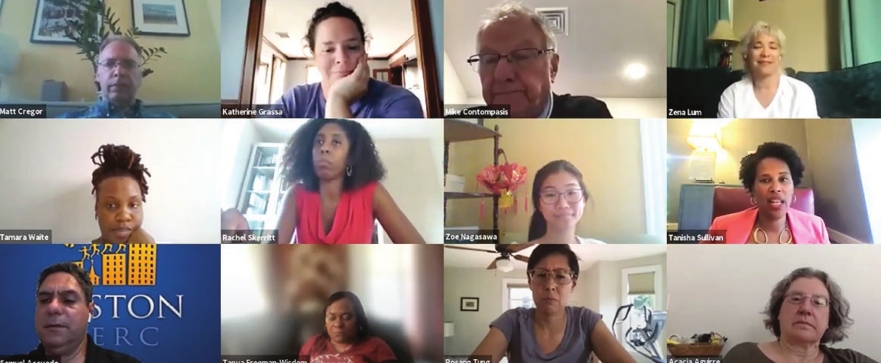
NAACP Boston Branch President Tanisha Sullivan (far right, middle) heads the Exam School Task Force.
Task force aims to increase equity, faces pressure from white parents, city councilors
With three city councilors and an acting mayor locked in a competition to lead the city, a group of white and Asian parents making a last-ditch effort to overturn a policy aimed at diversifying admissions to the city’s three exam schools and acting Mayor Kim Janey’s $3.6 billion city budget hanging in the balance at the bitter end of the fiscal year, what could possibly go wrong?
Last week, that budget nearly didn’t pass, as a group of councilors threatened a “no” vote. Several white councilors, according to people familiar with the process, made a push to exempt 20% of seats in the city’s exam high schools from the new admissions policy. Exam School Task Force members had agreed that entrance to the exam schools would be determined by students’ grades and, to a lesser degree, their score on an exam, then weighted according to the socio-economic status of people living in the student’s census tract.
The call for the 20% carve-out for students with the top overall grades-and-test-score combination regardless of socioeconomic status, came Tuesday, the day before the Exam School Task Force was poised to recommend to the School Committee that 100% of the seats be allocated under the new system. During the meeting, task force chairwoman Tanisha Sullivan indicated she received political pressure from people opposed to that system.
“While
we’re coming to this space to make a policy recommendation — that’s
what we care about — the reality of the situation is that we are doing
so in a political ecosystem,” she said, addressing fellow task force
members. “We’ve got to name it. And there are some not-so-good people
out there who do not want us to achieve our charge.”
Sullivan
did not name anyone who applied pressure to the task force, but several
people familiar with the process said District 6 City Councilor Matt
O’Malley told the task force he had six votes on the council lined up
against passing the Boston Public Schools budget. Questioned by a GBH reporter, O’Malley denied he pressured task force members in favor of the 20% carve-out.
In the end, the school budget passed 10-2, with Frank Baker and Andrea Campbell voting against.
The city’s overall annual budget also passed 10-2, with mayoral contenders Andrea Campbell and Michelle Wu voting against.
Equity concerns
At the heart of the debate over exam
school admissions is the question of equity. While Blacks and Latinos
make up 73% of the BPS population, they make up just 21% of the student
body at Boston Latin School — the whitest of the three exam schools.
Education
equity advocates have long complained that the standardized exam
creates inequities because higher-income families are able to spend
thousands of dollars on test preparation that lower-income families cannot afford.
A
temporary change to the admissions policy last year — when
administering standardized tests was considered dangerous due to the
potential for coronavirus infection — admitted students in each zip code
based on their grades and the number of students in each zip code. The
formula added special weight for zip codes with declined
from 40% to 31%. While the percentage of admitted students from Roxbury
nearly doubled, jumping from 2.6% to 5.1%, the percentage of students
from West Roxbury was nearly halved, high percentages of low-income
residents.
For
the upcoming 2021-2022 school year, the percentage of Black students
admitted to exam schools increased from 13% to 23% while the percentage
of whites admitted sliding from 13% to 7.1%.
The
economic profile of the students admitted also changed. In 2020, 35% of
the students admitted to the schools were considered economically
disadvantaged. In 2021, that population rose to 43%. In the BPS
district, 63% of students are economically disadvantaged.
In
the end, the task force voted to leave two proposals on the table — one
with 20% of the seats reserved for students with the highest grades and
test scores citywide, and one where all seats would be allocated by
grades and test scores, with weighting for census tracts with low-income
residents.
The School Committee is expected to vote on the proposals July 15.
In
the end, Janey was able to get the BPS budget, the city’s operating
budget and the city’s capital budget passed by the City Council.


