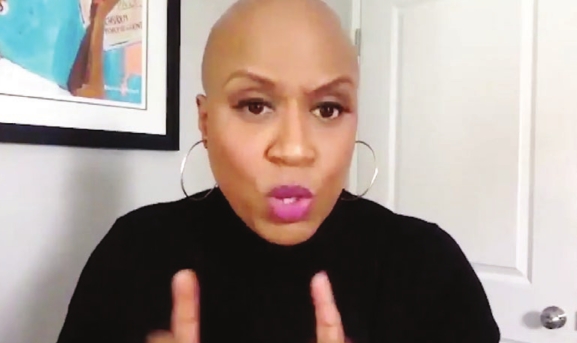
U.S. Rep. Ayanna Pressley
Millions earmarked for human services, transportation projects
U.S. Representative Ayanna Pressley is fighting for funding for local community projects to help residents recover from several of last year’s hardships. If she is successful, hundreds of thousands of dollars will go to programs at the Dimock Center, La Colaborativa in Chelsea and the mayor’s tuition-free college program, as well as several others across the Massachusetts 7th district.
Pressley has already made significant progress with transportation projects on Blue Hill Avenue and Columbia Road, securing $15 million in House appropriations for the Roxbury multimodal transit project.
After communicating with local leadership and mayor’s offices in the district, Pressley and her staff submitted seven community projects to the House appropriations bill. While the same process goes on in the Senate with a different set of submissions, the two bodies will conference between now and the end of the fiscal year to decide which projects make the final round.
The Dimock Center: $1 million for men’s substance use disorder treatment
As a health center in Boston, serving Roxbury since 1862, the Dimock Center is working to make care for those struggling with substance abuse more accessible.
While the center has a full range of services for women who need to detox and recover from substance use disorder, the men’s program has a significant gap in care.
Dr. Charles Anderson, Dimock’s president and CEO, said that many men leave care at the Dimock Center because clinical stabilization is not offered.
“Now that you’ve gotten detoxified, you have to start working through all the other clinical issues that are going on,” Anderson told the Banner.
Instead, many men who are struggling go straight from detox back into their communities, only to return with the same issue. Others seek clinical stabilization at other health centers that may or may not have the capacity to take them on.
“We have also successfully taken men from detox to the residential [recovery], but it’s not ideal,” Anderson said.
With
the $1 million, the Dimock Center would be able to bring in 300
additional community members who are in need. Without it, the doctor
said, families may continue to suffer as substance abuse destabilizes
homes.
Pressley told the Banner that the Dimock Center is crucial to fighting health disparities in Roxbury.
“Our community health centers have been overutilized and under-resourced for a very long time,” she said.
Both the congresswoman and Anderson mentioned that there has been a 69% increase in unintentional overdoses among Black men this year.
“This
funding is going to provide Roxbury residents and neighboring areas
with critically needed substance use disorder treatment and
programming,” Pressley said.
La Colaborativa: $300,000 for a COVID employment recovery program
The
Chelsea Collaborative, now known as La Colaborativa, never closed
during the pandemic, as the need was greater than ever in the city.
The
organization’s job placement program, which began before the pandemic
reached its peak, will become a COVID employment recovery program if
Pressley’s appropriations request is approved. The $300,000 will be used
to hire new job navigators and English as a Second Language (ESL)
teachers.
“Most of our members are English level one and two,” said Dinanyili Paulino, chief operating officer of La Colaborativa.
“We started with emergency ESL classes, leadership classes revamping the resume [and] interview skills,” she said.
Those
who help with training are focused on food and hospitality workers who
are trying to pivot in the aftermath of COVID closures. They’ve already
seen 1,000 people sign up for online ESL classes, with the help of the
city of Chelsea.
Paulino
said the community is suffering from eviction and gentrification
pressures at such a level that La Colaborativa was assisting families
with up to $22,000 in rent owed.
In addition to helping with job loss, they were also placing families in hotels and helping them with RAFT applications.
“We were seeing illegal eviction, even with a moratorium being implemented,” Paulino said.
The
devastation continues, she said, because of the economic impacts of the
pandemic, and so La Colaborativa spoke at length with Pressley about
supporting an economic recovery plan.
“This
funding is for rapid reemployment, and this is going to help the
Chelsea community to create pathways to jobs, and to pay rent,” Pressley
said.
City of Boston, Mayor’s Office of Workforce Development: $1 million for tuition-free college program expansion
Pressley
has joined the chorus of legislators calling for the cancellation of
student debt, and her request for support for Boston’s Tuition-Free
Community College Plan takes aim at the problem.
The
program is for qualifying students who attend Bunker Hill Community
College, Massasoit Community College, MassBay Community, Roxbury
Community College, Urban College of Boston, and Benjamin Franklin
Institute of Technology, a school that could also see support from one
of Pressley’s appropriations requests.
“We
estimate that it’s probably 150 to 200 people that we’ll be able to
help with these funds,” said Deputy Director of Workforce Development
Katy Gall.
Not only
does the program cover full tuition for an associate’s or bachelor’s
degree after the federal Pell Grant is applied, but students who qualify
also receive $250 per semester for college-related costs, like
textbooks and fees.
Gall
said that several industries are looking for employees to fill
positions within the next couple of years, because of how much of the
workforce was lost to the pandemic. Getting students this college money
right away is part of the city’s economic recovery, “particularly for
many of our talented workers that were just laid off, who were also on
the front lines of exposure.”
Those same workers, especially low-wage workers, can use this program to advance their career after pandemic-related adversity.
“Tuition is the biggest barrier,” she said.
Though
the Tuition Free College Plan receives money from a local trust,
subsidizing it with this $1 million could give more students the boost
they need to recover from job loss or switch careers.
Transportation wins
The
congresswoman is celebrating a step forward in community requests. A
transformative project for the Blue Hill Avenue corridor is included in
the House’s surface transportation appropriations bill. Like other
appropriations bills, it will go through the voting and debate process
in the Senate before it reaches the president’s desk.
The
$12 million project focuses on multi-modal transportation, improving
the layout of sidewalks, bike lanes, vehicle traffic and bus lanes.
Pressley aims to better connect Nubian Square to Mattapan Square through
Roxbury, Dorchester and Mattapan.
“Every
inequity and disparity that I seek to address, including the racial
wealth gap in the Massachusetts 7th [District]—transit is right at the
center of that,” Pressley told the Banner.
The
proposed improvements, she said, will be focused on transit
reliability, safety, climate resilience and livability in the area.
“This project, in every way, mirrors the work that I went to do in Washington for transit justice,” Pressley said.


