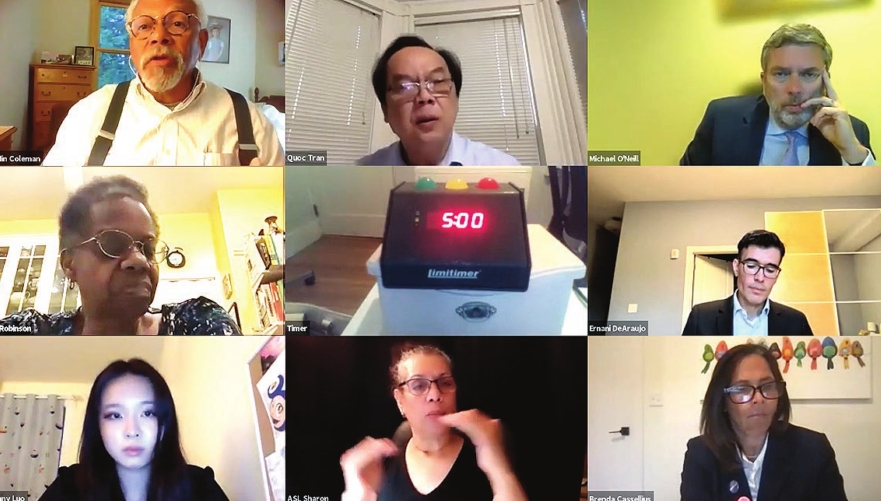
Members of the Boston School Committee are expected to vote on a new exam school admissions policy in the coming weeks.
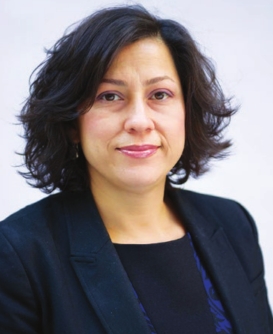
Alexandra Oliver-Davila
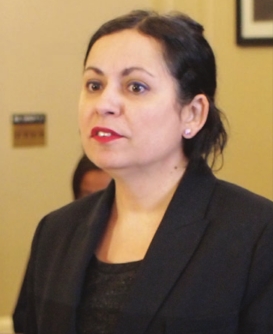
Lorna Rivera
School Committee members resign after comments
A vocal group of parents are up in arms as Boston Public Schools officials are on the verge of deciding on a new admissions process for the city’s three exam schools.
During School Committee meetings and on social media chat groups, parents have called for resignations of School Committee members and discussed contacting an employer of a member of the department’s exam school task force.
The animus boiled over during the June 16 School Committee meeting when two students concluded their testimony against the resignation of School Committee members Alexandra Oliver-Davila and Lorna Rivera, who left the body after text messages disparaging white West Roxbury parents were made public.
“Both were sent death threats and racist remarks for simply existing
as BIPOC women and wanting to represent the district, prioritizing
resources to a majority BIPOC student population that has long been
deprived of those resources,” said a recent BPS graduate who identified
herself as Shanti D. “To end — I do, too, hate white people.”
The
current battle over exam schools began last year when BPS approved a
task force recommendation for a one-year change to the admissions
policy, jettisoning for the first time in more than 50 years the use of a
standardized test in favor of a policy that allocated seats based on
grades and the zip code where an applicant lives. Increased weight was
given to zip codes, with special weight given to students from zip codes
with lower income populations.
While
white students in 2020 made up 40% of those invited to exam schools,
they made up 24% invited this year. Just 14% of the total number of
students in the BPS system are white. The percentage of Asian students
admitted to exam schools dropped from 14% to 11%.
By
contrast, the number of Blacks invited to exam schools jumped from 16%
to 30%. The number of Latino students increased from 24% to 28%. Black
students are 30% of the BPS population. Latino students are 42%.
The
temporary change, which district officials said was necessary to avoid
administering standardized tests during the COVID pandemic, angered
white parents, students and Boston Latin School alumni. Now, as the task
force contemplates a permanent change to the admissions process, many
in the white community are up in arms.
“We
may ask the state for a charter so that Boston Latin School can become
an independent entity and so that we no longer need to concern ourselves
with some of the political issues that are being hashed out in the
political system,” said Sean Ryan, a BLS graduate, speaking during last
Wednesday’s meeting.
By state law, charter schools are required to accept students by lottery.
But
the exam school task force is considering a lottery system for Boston’s
selective admissions schools — one in which students deemed qualified,
either by an exam score, grades or a combination of the two, would be
selected by lottery rather than overall ranking.
The
debate of admissions to the schools comes in large part because Black
and Latino students, who together make up about 72% of the district’s
student population, received just 31% of the acceptances to seats in the
schools.
Nationally,
test scores have been shown to correlate more closely to parental income
than to student performance. While 63% of Boston’s students are
economically disadvantaged, just 19% of Boston Latin School students
are.
At Boston Latin
School, the student body has long shown an overrepresentation of white
families from West Roxbury, Jamaica Plain, the North End and other
higher-income enclaves in the city. As task force members have debated
how to make the exam schools’ student bodies more representative of the
city’s population, white parents have reacted angrily. Former School
Committee members Rivera and Oliver-Davila complained of hate mail and
death threats in the weeks leading up to last year’s vote on the
one-year change to the admissions policy.
The
night of the Oct. 21 School Committee meeting, Rivera and Oliver-Davila
exchanged text messages in which Oliver-Davila said, “I hate WR,” using
an abbreviation for West Roxbury. “Sick of westie whites,” Rivera
responded. “Me too, I really feel like saying that,” Oliver-Davila
texted.
A parent group
obtained copies of the text messages, which are considered part of the
public record under state law, then forwarded them to news media.
The
publication of the text exchange, just weeks before the School
Committee was set to vote on a permanent admissions policy, set off a
firestorm of white parent rage. That rage continued after last week’s
School Committee meeting, during which the former student member of the
body, Khymani James, ended his testimony with the words, “I, too, hate
white people.”
“Seriously
… they are allowed to say that,” Maithily Erande wrote in the Facebook
group called Equitable & Transparent Exam School Admission BPS.
“Someone should share that with Columbia University.”
James is matriculating at Columbia in the fall.
Darragh
Murphy, a Carlisle resident whose sister Erin is running for a Boston
City Council seat, questioned NAACP President Tanisha Sullivan’s
qualifications to serve on the exam school task force in the chat group.
“The
local head of the NAACP, while she may be a brilliant lawyer, has no
place engineering academic policy for a public school system,” she
wrote. “Sullivan and the TF’s blatant failure to improve the exam school
system is obvious (painful, yes, but obvious) to everyone.”
BPS parent Marie Mercurio discussed sharing information with Sanofi Genzyme, Sullivan’s employer.
“We can always send our graphs to Genzyme as I’m sure it would upset some employees,” she wrote.
Chat groups aside, other white parents have testified and written on behalf of Oliver-Davila and Rivera.
“They
said nothing that was incorrect, wrong or racist,” said retired Boston
teacher Michael Heishman during last week’s School Committee meeting.
“Their resignation was a coup d’etat.”
Jamaica
Plain resident Jimmy Wyman said, “A small group of white parents and
families are weaponizing race against two women and two Latinas. When
one looks at the history of this city, whenever there is racial progress
or the hope of equity, white rage ensues.”
The task force has not yet released recommendations to the School Committee, which will ultimately vote on the policy.
Regardless of the committee’s decision, deep racial divisions have surfaced in Boston.
Sullivan
said that until the city can reckon with underlying causes of the
backlash Oliver-Davila and Rivera faced as the grappled with exam school
policy last year, the racial divisions will persist.
“If
we do not take our heads out of the sand and engage in real dialogue
about why Rivera and Oliver-Davila had the reaction they did to what
they personally experienced, the next generation will again inherit the
weight of racism in Boston,” she told the Banner. “We need to engage in
truth and reconciliation if we are going to be an inclusive city where
we call all live, work and thrive.”


