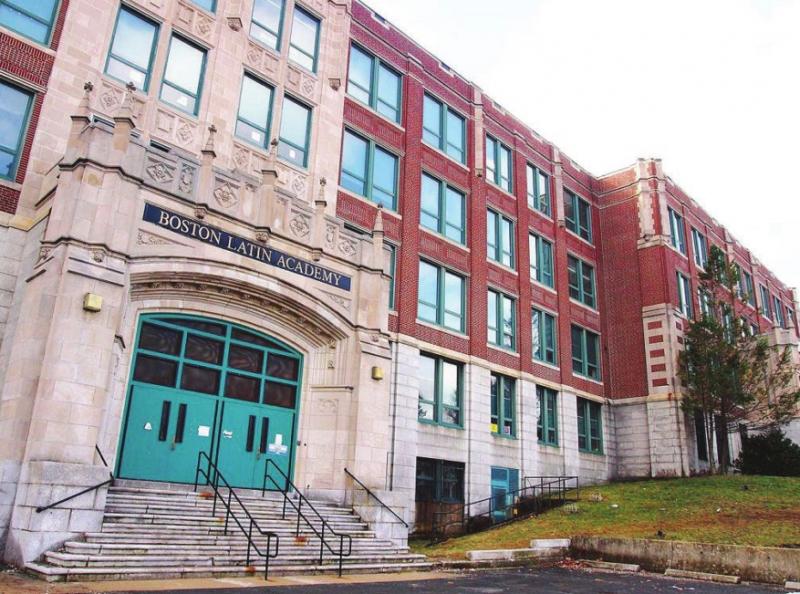
The Boston Latin Academy on Townsend Street in Roxbury.
Parents, recent grads seek say in BLA assoc.
When Boston Latin Academy received a $1 million donation in 2019 from alumnus and Airbnb co-founder Nathan Blecharczyk, the gift came with a pledge to match up to $1 million more in fundraising: a challenge that alumni and members of the school community seemed eager to take on.
Two school associations — one representing Girls’ Latin School alumnae and Boston Latin Academy alums and another representing BLA parents — agreed verbally in March 2020 to merge and better pool resources for fundraising.
But by the time the BLA/ GLS board met on Dec. 8 to elect new members, the unity the two groups had forged seemed irreparably broken. According to several of those who participated in the meeting, held via Zoom, the meeting was limited to 100 people, the chat function was disabled and everyone but the six board members who were Girls’ Latin School alumnae were muted. With no communication from outside the small cadre of GLS members, six new board members were elected, all white and all GLS alumnae.
The development has many in the school community concerned.
“I’ve been trying to understand why, in 2021, a group of older women who graduated from Girls’ Latin want the school to remain Girls’ Latin 45 years after it
stopped being Girls’ Latin,” said Crystal Haynes, who graduated from a
newly-coeducational BLA in 1975. “It sounds a lot like ‘Make America
great again.’” When Girls’ Latin School was founded in 1877, it was seen
as a counterpart to Boston Latin School, which only accepted boys. Like
the boys’ school, Girls’ Latin offered training in the classics and was
seen as a college preparatory school, educating students from 7th to
12th grades.
When
Boston Latin School went co-ed in 1972, so too did Girls’ Latin,
becoming Boston Latin Academy. The first class with boys in it graduated
from BLA in 1977.
Michael
Maguire, a BLA alum who ran for a board seat in December, said the
board of the alumni associations agreed that the 12 members of the
merged entity’s board would be evenly split between BLA members, GLS
members and parents. The fact that the board has ended up all GLS
members doesn’t sit well with many of the school’s alums.
“It’s
not a good look in this era for an organization that proports to
support one of the most diverse schools in the commonwealth with a board
that is not diverse,” said Anne Sandstrom, a class of ’72 graduate from
GLS and former alumni association board member. “There are only a small
handful of classes represented on this board. There’s been a lot of
frustration around that.”
Former BLA/GLS board members and alums interviewed by the Banner
characterized the GLS alumnae who ran the December meeting as an
insular group who have run their association for the last 15 years. Some
of the GLS alumnae appear to resent the fact that the school went
coeducational in 1972, the BLA alums say.
Haynes,
who was part of one of the last all-girls classes to graduate from the
school, says she appreciates the school’s current diversity. In her 1977
class of 300, she was one of just 13 Black students.
“We were told we were the largest number of African American students to graduate in a class,” she said.
Today,
Boston Latin Academy is among the more integrated schools in the city,
with a student body that is 21% Black, 26% Latino, 19% Asian and 30%
white.
While the
unified board was meant to reflect today’s diversity at BLA, Haynes and
others said a fracture occurred in August of 2020 when the former
president of the Girls’ Latin School Alumnae association, Karen Curran,
put a post on her Facebook page that was critical of Black athletes
taking a knee during the national anthem. The post caused an uproar.
Members of the parent group and BLA alums demanded she meet with them.
Curran wrote a Sept. 4 Facebook post stating that she had resigned from
the board.
But during a
September 21 board meeting, members included Curran as president of the
board in their notes and voted not to go ahead with the merger with the
BLA parents association.
Curran declined to answer questions for this story.
BLA
alums interviewed by the Banner said that they nominated 17 BLA alums
for seats on the association’s board, but the six GLS members who ran
the meeting only considered two for board seats, both of whom were
white. In the end, the GLS grads did not cast a single vote for either.
The
election, which has resulted in a board that is allwhite and all GLS
graduates, has Haynes wondering why such a group is seeking to control a
school association that is raising funds for a student body that is now
41% male and 70% students of color.
“The Girls’ Latin alumnae want to do fundraising for a school they don’t respect,” she said.
Sellstrom
says she and other GLS and BLA alums and parents are continuing to
communicate with each other via Facebook groups and other means, in the
hopes that the merger will eventually go through.
“I’m hoping something positive will ultimately come from all this,” she said. “But it’s been a painful process.”


