Dr. Ellana Stinson speaks to reporters during a Black Boston COVID Coalition event at the Reggie Lewis Track Facility in Roxbury (see article on P. 3)
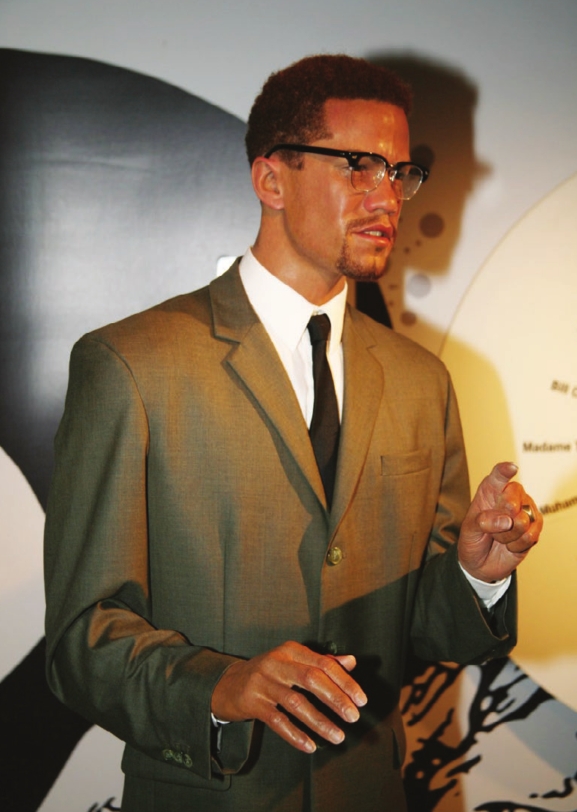
Malcom XEx cop says he unwittingly set up Muslim minister
A New York cop’s deathbed confession of involvement in the assassination of Black Power icon Malcolm X led the family of the former Nation of Islam leader to call last week for a full re-opening of the investigation into the murder.
Their plea was echoed by others demanding the full disclosure of long-hidden FBI files that may shed further light on how law-enforcement sowed violent dissension among groups like the Nation of Islam, the Black Panthers and the American Indian Movement.
During a press conference at the site of the former Audubon Ballroom in Harlem on the 51st anniversary of Malcolm X’s death, family members of the Boston-raised Black Muslim produced the letter as evidence that New York police and the FBI conspired in the public execution of their father on Feb. 21, 1965.
The 2011 letter by the late Raymond A. Wood admitted the officer’s undercover role in luring key members of Malcolm X’s security team into a plot to blow up the Statue of Liberty, resulting in their arrest by the FBI and setting the stage for the assassination just days after police took them into custody.
“I
participated in actions that in hindsight were deplorable and
detrimental to the advancement of my own black people,” wrote Wood as he
was dying of cancer. His death, however, did not come until 2020. His
cousin, Reginald Wood Jr., brought the confessional missive to Malcolm
X’s family.
Wood, who
said he acted under duress as he infiltrated the Nation of Islam and
civil rights groups, was present in the ballroom as armed assailants
gunned down Malcolm X at the podium.
“I
was ordered to the Audubon Ballroom, where I was identified by
witnesses while leaving the scene,” he wrote. “Thomas Johnson was later
arrested and wrongfully convicted to protect my cover and the secrets of
the FBI and NYPD.”
Wood claimed he was unaware that Malcolm X was the target of his actions.
Three
men, including Johnson, known as Khalil Islam, were convicted of the
murder. Mujahid Abdul Halim, previously known as Thomas Hagan, confessed
to the killing but insisted that two other convicted Nation of Islam
members, Islam and Muhammad Aziz, previously known as Norman Butler,
were innocent.
Halim
spent 45 years in prison before being paroled in 2010. Islam was paroled
in 1987 and died in 2009. Aziz was paroled in 1985.
Manhattan
District Attorney Cyrus Vance opened an inquiry into the case last year
after meeting with members of the Innocence Project, a legal group that
mounts campaigns to clear defendants unjustly convicted of serious
crimes.
“Any evidence
that provides greater insight into the truth behind that terrible
tragedy should be thoroughly investigated,” said Ilyasah Shabazz, one of
Malcom X’s daughters, who was joined at the Dr. Betty Shabazz Memorial
and Education Center press conference by two of her sisters.
Heavily
redacted sections of Malcolm X’s 10,000-page FBI file have been
publicly released, but key elements of the documents must be aired to
reveal the full truth of federal complicity in the murder of the former
Nation of Islam leader who was a trusted lieutenant of the Honorable
Elijah Muhammad before he broke away from the group, according to
historian Byron Rushing.
Rushing,
a former Massachusetts state representative who was surveilled by the
FBI starting with his activism in Boston in the 1960s and his work with
the Congress of Racial Equality, echoed Malcolm X’s family in demanding
the full release of files.
“Black
organizations should insist that President Biden release all this
information. He could do it in an instant,” said Rushing.
Rushing
also raised questions about the federal role in the murder of the Rev.
Martin Luther King Jr., as well as the disruption of militant Boston
groups that fell apart after violent confrontations, possibly provoked
by informants and plants.
“We
know the FBI was involved in the death of Malcolm X. To assume the FBI
wasn’t also involved in the assassination of Martin Luther King is
naïve,” he said. “The files need to be opened and the full stories
told.”
U.S. Rep.
Ayanna Pressley, who represents the neighborhoods where Malcolm X lived
and worked during his time in Boston, issued a separate demand for a
full investigation and document release.
“The
recent revelations about the active role the state played in Malcolm
X’s assassination allude to what many have known for years but is no
less disturbing,” said the congresswoman. “The Shabazz family and the
American people deserve and require nothing short of a full, transparent
investigation into the matter, and that includes public access to
information and evidence that offer answers to the many questions that
remain.”
Cinematic rehash
The
recently released Wood letter has surfaced in the midst of a cinematic
reckoning with the events of the 1960s when federal officials, alarmed
by the rise of Black militants and fearful of the ability of a
charismatic leader to unify African Americans around their challenge to
white authority, systematically investigated, infiltrated and disrupted
groups ranging from the Black Panthers to King’s Southern Christian
Leadership Conference.
A 2020 Netflix documentary series titled “Who Killed Malcolm X?” helped spur Vance’s re-examination of the case.
This
year’s historical drama “Judas and the Black Messiah” explores the
infiltration of the Black Panther Party by an FBI informant linked to
Chicago police action in the death of Fred Hampton, the party chairman,
who was gunned down in hail of bullets in his apartment.
Another
movie, “One Night in Miami,” portrays a fictionalized 1964 meeting
between boxer Muhammad Ali, NFL football star Jim Brown, R&B crooner
Sam Cooke and Malcolm X on the night of Ali’s victory over Sonny
Liston. Throughout the brooding drama, two white men, presumably
undercover FBI agents, trail the quartet as they discuss, among other
things, surveillance by the feds.
In
Boston, federal agents provocateurs have long been suspected of having
been at the center of murders that ended the influence of several groups
that were under FBI surveillance.
Hakim
Jamal, a cousin of Malcolm X, and the leader of his own organization,
was shot to death in his Roxbury apartment in 1973, reportedly as a
result of a dispute with the De Mau Mau group of Black Vietnam veterans.
Five men were convicted of the crime. All denied they were there to
kill Jamal.
In 1968,
three leaders of the New England Grass Roots Organization, including
Guido St. Laurent, were shot to death in their Blue Hill Avenue office,
allegedly over a dispute about a federal grant. St. Laurent, an ex-con
doing grassroots work in the Black community, was eulogized as a man of
peace at his Roxbury funeral by the Rev. James Breeden, a noted civil
rights activist.
Rushing
said activists at the time were unaware of the full range of activities
undertaken by the FBI to discredit and destroy organizations working in
poor neighborhoods on educational, nutritional and social programs.
During
a conversation with U.S. Ambassador Andrew Young, who marched with
King, Rushing said they shook their heads and said, “We were the most
naïve Negroes imaginable. We knew about surveillance, but it never
dawned on us the extent to which we were being set up, put into things
and then getting us killed.”
Malcolm
X, a preacher’s son born as Malcolm Little in Nebraska, moved to
Michigan with his family. After his father’s suspicious death and his
mother’s commitment to an asylum, he arrived in Boston in 1941 at age 15
to live with his older half-sister Ella Collins on Waumbeck Street in
Roxbury.
He quickly
abandoned education and embraced Boston’s thriving nightlife, donning
zoot suits and frequenting clubs like the Hi- Hat, Wally’s and the Savoy
as “Detroit Red.” Malcolm’s career as a small-time thief, drug-dealer
and hustler came to an end with a stint at the Charlestown State Prison,
where he embraced Islam.
After
his release, Malcolm X ran the Nation of Islam mosque on Intervale
Street before departing for New York City, where his star quickly rose
as a disciplined and eloquent organizer for the Black separatist faith.
His
falling out with Elijah Muhummad was followed by an embrace of the
Sunni Muslim sect, meetings with world leaders and a pilgrimage to
Mecca.
The 1965
release of “The Autobiography of Malcolm X,” written with Alex Haley,
catapulted him to global attention at a time of rising Black militancy
and doubts about what direction Black America would take — the peaceful,
non-violent protest of the Civil Rights Era or the unsparing rhetoric
of Black Power advocates.
While
accepting cross-racial mainstream Islam, Malcolm X continued to
denounce white leadership, never fully rejecting his slogan “By Any
Means Necessary” to accomplish the full liberation of marginalized
people.
By the time of
his death, the newly christened El-Hajj Malik El-Shabazz came to embody
elements of both militant and peaceful approaches to Black liberation, a
dichotomy left unresolved by the bullets that tore through his body in
the Audubon Ballroom and left Black America wondering what might have
been.


