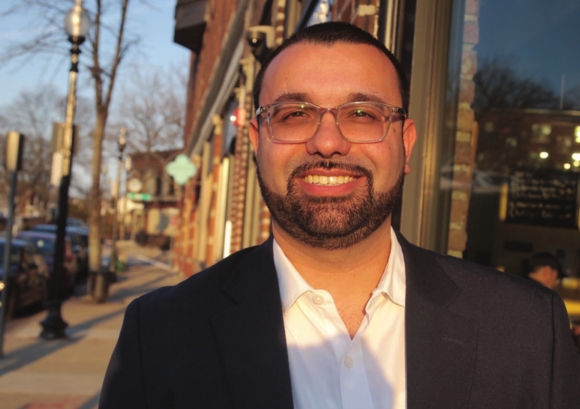
Ricardo Arroyo
Sees racism as public health emergency
District 5 City Councilor Ricardo Arroyo is advancing a hearing order to explore declaring racism a public health crisis in Boston, with an aim toward creating an independent office to assess whether ordinances and executive orders would exacerbate or reduce inequity in the city.
The hearing order, due to be filed at Wednesday’s City Council meeting, cites studies by the Boston Public Health Commission (BPHC), which in 2008 identified racial inequity as a key driver in health disparities in Boston, affecting everything from low birth weights to chronic diseases.
“Every city policy can have a health effect on people,” Arroyo told the Banner. “When you look at data for Latinos and blacks, it’s documented that those outcomes are because of how we’re treated.”
According to BPHC data, residents of the predominantly black and Latino Roxbury had life spans nearly seven years shorter than those of predominantly white Back Bay, a disparity the agency linked to racism.
“Much research has linked experiencing explicit and implicit racism to negative health outcomes and a higher death rate,” reads the 2017 Health of Boston report from BPHC.
Arroyo says the BPHC data is clear.
“I’m not issuing a hearing order to
address whether or not this is a crisis,” he said. “I don’t think
there’s any data you can find that says this is not a crisis.”
Declaring
racism a public health crisis is not without precedent. In Wisconsin,
the cities of Milwaukee and Madison have done so, as has the city of
Pittsburgh.
Arroyo
hopes such a declaration in Boston would pave the way for the creation
of an independent office that would review proposed ordinances and
executive orders in the same way the nonpartisan Congressional Budget
Office reviews issues cost estimates for legislative proposals.
Arroyo
cited city policies including the use of the ISEE test for admittance
to the city’s public exam schools and the Boston Police Department’s use
of a controversial hair test to detect drug use even though the test
was found to produce false positives among African Americans.
“If this office existed before, a lot of these kinds of policies wouldn’t have seen the light of day,” Arroyo said.
Arroyo said that like the Congressional Budget Office, an Equity Office would not have the power to veto orders and ordinances.
“What
they would do is provide the public with an analysis of how an
ordinance would affect racial equity,” he said. “I don’t think anyone
would want to put their name to an ordinance if the found it would
increase racial inequity.”
Arroyo said he has no recommendations for how many staff members or what budget such an office would have.
“That’s what this hearing is for,” he said. “I’d like as many expert opinions as we can have to help us think this through.”
Arroyo
said he plans to invite academics, public health officials, community
members and city officials to testify at the hearing. He said he has had
preliminary conversations with City Council colleagues who have
expressed support.
He has not yet brought the idea to Mayor Martin Walsh, but says he hopes to gain his support.
“I hope he’s going to look at this from the standpoint of living up to the kinds of values he’s talking about,” Arroyo said.