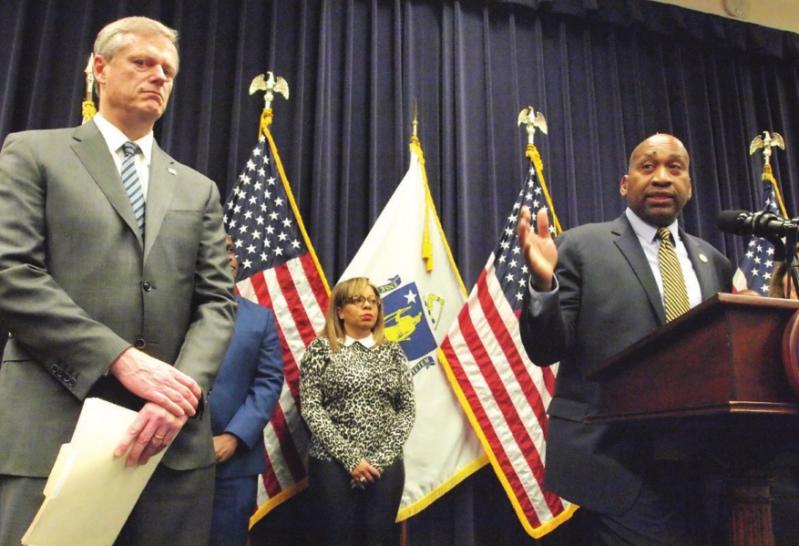
State Rep. Russell Holmes addresses reporters during a press conference on the state’s minority- and woman-owned business enterprise goals and Gov. Charlie Baker looks on.
Proposes updates to state’s 40-year-old guidelines
Gov. Charlie Baker filed legislation last Thursday, Feb. 27 aimed at increasing the share of state contracts going to minority- and women-owned businesses.
Joined by state officials, Baker announced the changes at a State House press conference and outlined proposed changes to the way the state handles contracts for construction and maintenance projects that he said would reduce burdens for minority- and women-owned businesses competing for work on state projects.
“The current requirements can and do discourage many smaller MBEs and WBEs from participating in public building projects because of the administrative burdens associated with that process,” Baker told reporters. “This will expedite and simplify the process for smaller minority- and women-owned businesses who want to participate in state contracts and at the local level.”
Among the changes Baker announced is an increase to the dollar amount for contracts at which subcontractors can participate without meeting state certification and bonding requirements.
Currently, minority- and women-owned businesses are required to have Minority and Women Business Enterprise certification and
bonding in order to participate in subcontracts of over $25,000.
Baker’s proposed requirements would increase that dollar amount to
$50,000 for projects of over $1 million.
Baker
said the relaxed rules will help smaller contractors scale up their
businesses to the point where they’re able to better compete for large
state contracts.
Baker
is also seeking a change that would extend minority- and women-owned
business goals to sub-bids — bid submissions filed by subcontractors.
Currently, 50% of state contract work is contracted out as sub-bids.
“These
sub-bids are not subject to minority business enterprise or women
business enterprise participation goals,” Baker said. “This legislation
would allow [the Division of Capital Asset Management and Maintenance]
to set minority- and women-owned business participation goals with this
particular subcontracted work on projects of over $5 million. That opens
a very big door that’s been closed for a very long time.”
Another
change the Baker administration is seeking is to set minority-owned
businesses participation goals that are distinct from women-owned
business participation goals. Currently, both goals are combined into
one figure. Participation goals for both will be increased from the
current 10.4% combined goal to 4.2% for minority-owned businesses and
8.8% for women-owned businesses.
In addition, the proposed changes will allow project-specific participation goals, Baker said.
“This
will enable goals for an individual project to be specifically tailored
and customized to accurately reflect the availability of contractors in
a local area,” he said.
A
WGBH investigation that aired in January found that minority
participation in state contracts dropped by 24% between 1998 and 2018.
The decline amounts to $135 million in inflation-adjusted dollars,
according to the WGBH report.
The
state’s Division of Capital Asset Management and Maintenance (DCAMM)
commissioned a study released in 2018 that found that just 1% of state
spending on construction and maintenance projects went to minority-owned
firms.
Baker was
joined at the press conference by officials from his administration,
along with state Rep. Russell Holmes and Gregory Minott, co-founder of
the architectural and real estate development firm DREAM Collaborative.
Holmes
noted that he and other members of the Massachusetts Black and Latino
Legislative Caucus worked on the changes with Baker. He praised Baker
for his commitment to making state contracts more inclusive.
“This has to be intentional,” he said. “We don’t do this accidentally and become successful,” he said.
Baker
noted that the original legislation authorizing minority and
women-owned business participation goals was filed more 40 years ago.
“Altogether,
this proposal is the most comprehensive construction reform to directly
benefit minority- and women-owned businesses in decades,” he said.
“These are all substantive improvements that will further our commitment
to ensuring that the commonwealth benefits from the diversity in its
business community.”
With
the exception of the separation of goals for minority business
enterprises and women business enterprises, all of the changes will have
to go before the Legislature for a vote. Baker said he is confident the
legislators will support the changes.
“We’ve
had preliminary conversations that would lead me to believe that our
chances of getting something like this done in this session are pretty
good,” he said. “I do think it’s likely that we’ll get this done.
There’s a lot of interest in this.”
First
Suffolk District Sen. Nick Collins, who has championed minority- and
women-owned business participation goals in state construction projects
in the Seaport District, said Baker’s legislation could lead to
meaningful change.
“We
have a partner in the governor, who is working closely with the Black
and Latino Caucus,” he said. “We’re getting feedback from the community.
People are hungry to do business with the state. We have a response to
that today.”