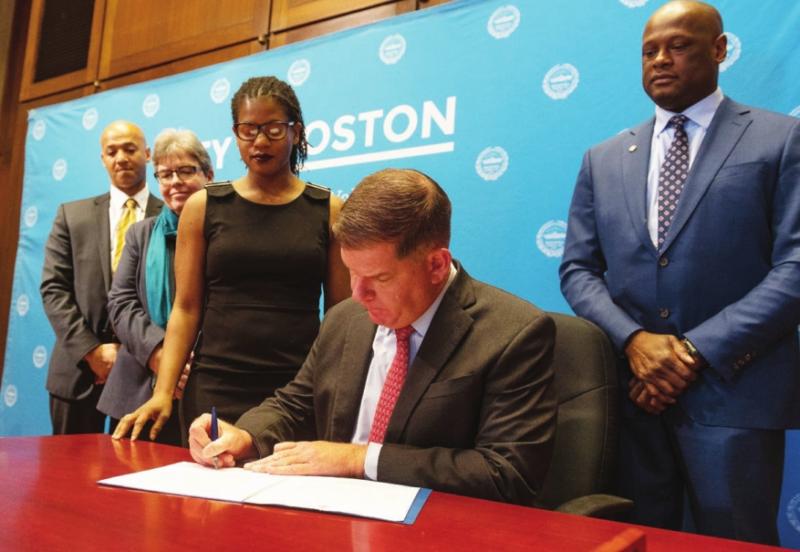
Mayor Martin J. Walsh signs an executive order that will bring a
significantly increased level of transparency, accountability and
integrity to the Zoning Board of Appeal. (l-r) Economic Development
Cheif John Barros, city councilors Liz Breadon and Lydia Edwards, Walsh
and Inspectional Services Director Dion Irish.
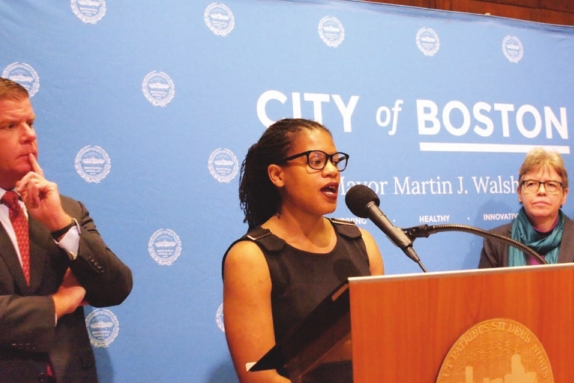
City Councilor Lydia Edwards addresses reporters, flanked by Mayor Martin Walsh and Councilor Liz Breadon.
Stricter guidelines aimed at rebuilding public trust
Mayor Martin Walsh this week announced changes to the Zoning Board of Appeal aimed at bringing greater transparency to the body. The ZBA drew fire from critics last year after a city official who oversaw development projects appearing before the board was charged with accepting a bribe from a developer.
Flanked by City Councilors Lydia Edwards and Liz Breadon, Walsh told reporters he and Edwards plan to file legislation to make the board more representative of the city’s residents and institute guidelines barring board members from voting on any project on which they participated in the previous five years.
The reforms include requirements that board members and their business partners disclose details of their business dealings, that board members make annual disclosures of their financial interests and that they participate in trainings in ethics and zoning law at the time of their appointment or re-appointment.
“To be effective in this role and to maintain public confidence, the board must operate with the highest standards of professionalism, ethics and accessibility,” Walsh said. “When potential issues came up last year, we took action.”
The
press conference came the day before a City Council hearing called by
Edwards on her menu of reforms to the ZBA. Walsh and Edwards said they
will continue to discuss additional reforms, including the composition
of the board.
Changing
the board structure, which by state law must include positions for
representatives of the real estate industry and the building trades,
will require petitioning the Legislature.
Edwards said the changes she and Walsh discussed and agreed on will help make the ZBA more responsive to Boston’s residents.
“We
are experiencing monumental growth today in Boston and reckoning with
new standards of density, development, new challenges of housing
affordability, transportation injustice and climate change,” she said.
“There’s an increasing strong sentiment that government at all levels
must work faster, and in every facet be more directly and deeply
accountable to the communities that we serve.”
ZBA at center of investigations
The
current push for changes on the board came after longtime city employee
John Lynch, a staff member of the city’s Boston Planning and
Development Agency, was charged last year with taking a bribe from a
developer who was seeking an extension from the ZBA. While Walsh
stressed that two separate investigations cleared the ZBA of any
wrongdoing in the case, board member Craig Galvin, who voted on real
estate projects his real estate firm later represented, stepped down
shortly after Lynch was indicted.
Former
Inspectional Services Department (ISD) Commissioner William “Buddy”
Christopher stepped down in September from his role as an advisor to the
mayor, leaving city government. An architecture firm Christopher
founded, which was run by his son,
represented developers who regularly appeared before the ZBA and several
whose projects were approved by ISD.
While
U.S. attorneys circulated a photograph of Lynch accepting cash from a
developer, highlighting an egregious case of public corruption, some
Boston residents who have fought unsuccessfully against
politically-connected developers have expressed doubts that the city’s
development process could give abutters a fair shake.
But Edwards said the reforms to the ZBA should help level the playing field.
“At the end of the day,
we’re trying to get people to trust growth in Boston,” she said. “Part
of not trusting growth is feeling that the government, or the process
that the government has set up, is not accessible to you.”
More on the table
Speaking
to reporters after the press conference, Edwards said that she expected
to discuss additional reforms at Tuesday’s hearing.
“Tomorrow
is where we’re going to have additional conversations,” she said. “I
know the folks of Boston are going to come through with more practical
suggestions. I’m not sure if we can get an ‘executive order 2.0,’ but I
think the mayor is open to it if we get a good idea.”
Among
the reforms she would like to see are evening meetings and a greater
frequency of meetings for the board, which currently meets twice monthly
during the day. Edwards has also proposed adding seats on the board for
an urban planner, an environmentalist and a civil rights specialist.
Edwards said she would like to see a prohibition on former board members
petitioning the ZBA on any projects on which they had voted in the
previous five years. As a city councilor, Edwards noted, she is barred
by state ethics law from petitioning city government for a year after
leaving city government.
“We’re
not going away from this moment and have the same seven [ZBA board
members], the same standards and the same way of doing business,”
Edwards said. “That is clearly off the table. So that’s a good thing.”


