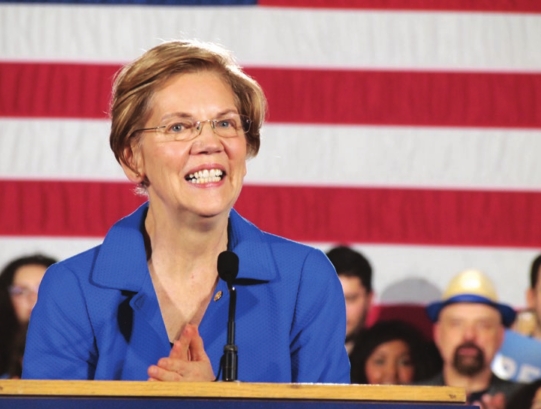
State Sen. Elizabeth Warren leads in Massachusetts polling.
Warren, Sanders lead in Mass. polling in leadup to Super Tues.
The first test among Bay State voters in the race for the White House comes to Massachusetts next week during Super Tuesday primary balloting. One-third of the delegates to the Democratic Party’s nominating convention will be chosen on March 3 across 14 states.
Going into Tuesday, African Americans will be closely following the results of Saturday’s South Carolina primary, where blacks make up 60% of the primary electorate.
Once viewed as Joe Biden’s “firewall,” polls show the surging Bernie Sanders close to overtaking the former vice president in the Palmetto State, with one survey ranking the Vermont senator first among black voters nationwide for the first time in the long campaign.
Elizabeth Warren’s spirited performance in the Nevada debate last week breathed new energy into her bid, raising hopes of her home-state supporters even as she’s mired in single digits in South Carolina, behind both Pete Buttigieg and Tom Steyer and just ahead of Amy Klobuchar.
The clinical take-down of former New York City Mayor Michael Bloomberg by the Massachusetts senator during the televised food-fight marked the first time in the primary contest she had unleashed her combative skills on a fellow Democrat rather than on hedge-fund billionaires and Donald Trump.
“She was unequivocally the winner of the last debate,” said Boston City Councilor Ricardo Arroyo, who supported Sanders in 2016 and is now campaigning for Warren. “She was the most prepared. Good candidates adapt to circumstances. Under the intense stress and scrutiny of this volatile campaign season she rose to the occasion in a way only real fighters can do.”
A recent poll from the University of Massachusetts at Lowell showed Warren with a one-point lead over Sanders on her home turf. Warren, at 21%, and Sanders, at 20, both have active surrogates and campaign operations in Bay State communities of color. Both were trailed in the poll by Buttigieg at 15%, Biden at 14%, Bloomberg at 12%, Klobuchar at 9%, Hawaii Congresswoman Tulsi Gabbard at 3% and Steyer at 2%.
Sanders, who won the popular vote in Iowa and New Hampshire and crushed the Nevada caucuses with over 50% of the balloting, heads into Super Tuesday with a commanding lead in both delegates and resources.
“Here in Massachusetts, Bernie Sanders is on the ascent,” said state Rep. Nika Elugardo, one of his seven state campaign co-chairs. “And not just among black voters but among all voters. Where we really need to do is to push hard is among black men and black non-voters who have been disenfranchised and given false hopes by the Democratic Party.”
The
self-described democratic socialist’s rise has slowed momentum among
black voters by Bloomberg, who has spent nearly $500 million of his own
money in the campaign, including massive advertising buys in heavily
black Super Tuesday states.
Just
a few weeks ago, Bloomberg vaulted ahead of Sanders in support among
African Americans. But after the former Republican mayor’s debate
debacle in Nevada, Sanders won 33% of the black vote and Biden 29%,
according to a Morning Consult poll. A separate NBC News/Wall Street
Journal poll showed Biden maintaining his lead in African American
support with 31% and Sanders with 29.
Bill
Moran, a retired school teacher from Roxbury, met Biden before he was
tapped as Barack Obama’s vice president and immediately connected with
the Delaware senator. “He moved me as someone I could speak to and
relate to, someone who was authentic in ways other candidates are not,”
said Moran, adding that he views Biden as the candidate most likely to
beat Trump.
On that
score, Moran is like most African Americans nationally, whose top
priority is ousting President Trump from office. In one survey, 70% said
they’ll vote for the Democratic nominee in November, regardless of who
that is.
But at the
same time, the survey from BlackPAC, a political action committee,
showed that one-third of those polled said they would like to see
“someone else” run, reflecting a significant unease with the field after
the withdraw of African American candidates Cory Booker, Kamala Harris
and Deval Patrick. The two U.S. senators and former Massachusetts
governor all pulled out of the race before the Nevada caucuses.
The
same BlackPAC survey tellingly indicated that 12% of African Africans
supported Trump and 12% an unnamed third party candidate. That poll
followed a clear push by the White House incumbent for black support in
his State of the Union speech. During his stem-winding address last
month, Trump touted a dramatic drop in African American unemployment,
endorsed increased aid to historically black college and universities
and highlighted black guests sitting in the gallery, including a former
inmate recently released under a restorative justice law he signed.
The
fierce fight among the Democrats has all but obscured the Republican
primary. In Massachusetts, Trump faces a flaccid challenge from former
Gov. William F. Weld.
On
Super Tuesday, 1,357 delegates will be chosen nationally, including 114
in Massachusetts. The Bay State’s share is dwarfed by states like
California, with 495, and Texas, with 261. In both those states, black
and Latino voters make up large chunks of primary voters.
Close
to 60% of the delegates will be chosen after next week but a candidate
like Sanders emerging from Super Tuesday with a significant lead will
have momentum and a clear shot at wrapping up the nomination before the
July convention in Milwaukee.
But
if no one wins a majority of the nearly 4,000 delegates on the first
ballot, delegates are released from their pledges during the second
round, when over 700 party insiders known as Super Delegates can also
vote.


