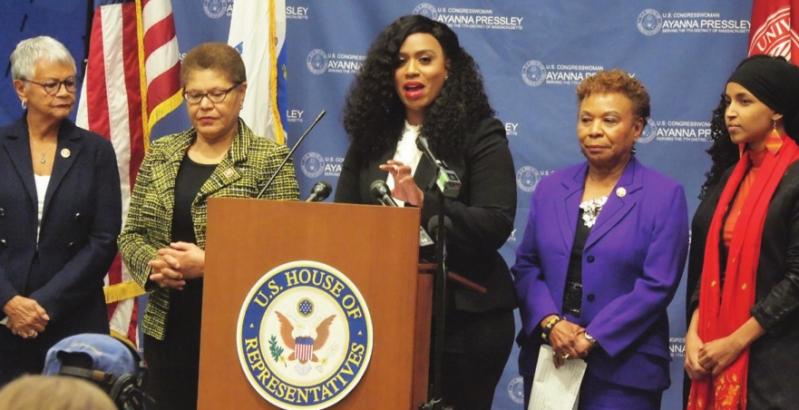
U.S. Rep. Ayanna Pressley addresses reporters during a Congressional Black Caucus meeting at Northeastern University. Looking on are reps Bonnie Watson Coleman, Karen Bass, Barbara Lee and Ilhan Omar.
Discussions center on criminal justice, equity issues
The Congressional Black Caucus made a historic visit to Boston last weekend to address the country’s systemic inequality and economic injustice. A press conference held Friday at Northeastern University’s John D. O’Bryant African American Institute commenced the “State of Black America” series, where various elected officials acknowledged America’s continuing racial disparities and advocated for progressive reforms.
“During these unprecedented times that we find ourselves in, they really do demand unprecedented leadership,” said Rep.
Ayanna Pressley. “At a time when black people are disproportionately paid less and arrested more, activism is not an option — it is a mandate.”
Pressley called out key issues plaguing the black population: deeply embedded xenophobic, racist, and discriminatory systems, she said. She promoted the Caucus’s work and recognized its value in Congress.
“We’re
frequently referred to as the ‘conscience of the Congress,’” said
Pressley. “Because we know that when the rest of America gets a cold,
black folks get pneumonia.”
Jan.
10 marked the Caucus’s first ever visit to Massachusetts — an
informative and celebratory occasion. Pressley said that too few people
recognize the power and leadership of the Caucus, a 54- member council
that seeks to empower marginalized communities and further protective
legislation.
“The
CBC’s role in combating hate, racial inequality and civil injustice
remains important as ever as the Caucus fights for the most vulnerable,”
said Pressley.
CBC
Chair Karen Bass, a representative for California’s 37th district, was
the first black woman in history to serve as the speaker of the
California Assembly. Bass said that the Caucus is represented in the
highest levels, exerting significant influence over the country.
“Oftentimes
the Black Caucus and its achievements [are] truly the hidden figures,”
said Ilhan Omar, a representative of Minnesota’s 5th congressional
district and the first Somali woman in Congress. “We don’t often talk
about the accomplishments that the CBC has made — the impact it’s made
in this country, and how it’s shaped many of the policies that have
garnered progress.”
Pressley
expressed pride at serving alongside other Caucus members, whom she
called “iconic table shakers” and “justice seekers.” She said that the
Caucus is ushering in a new movement that “reimagines equity and
justice” and advances the “dignity and humanity” of black Americans
nationwide.
Barbara
Lee, who serves as the vice chair of the steering and policy committee
for the House of Representatives, has the distinction of being the
highest ranking African American woman in the House, Bass noted. Lee has
recently focused heavily on criminal justice reform and has urged the
Department of Justice to release reports on women in prisons. Lee said
that there has not been any data, nor report, on women in prison since
2000. Along with directing the Justice Department to conduct further
investigation, she continues to look at alternatives to incarceration,
she said.
Rep. Gwen
Moore, the first black person elected to Congress from Wisconsin, said
that she is eager to “gain insights and ideas on how to move forward out
of this malaise.” She said that Wisconsin currently has the highest
rate of incarceration of African American men.
The
Caucus hopes to implement a “radical reimagining” of the criminal legal
system, said Pressley. She hopes to achieve 80 percent decarceration by
decriminalizing low-level offenses and mitigating the effects of the
1994 federal crime bill that expanded the use of mandatory minimum
sentencing. Pressley said that the “Three strikes, you’re out” policy
incentivized mass incarceration and expanded jails nationwide.
“I do not believe that mass incarceration has made any of us safer,” she said.
The
Caucus also prioritizes equity in education. Lee said that 40 percent
of African American kids in preschool are being expelled, beginning the
“school to prison” pipeline that the Caucus hopes to crack.
“How
do you expel kids in preschool?” Lee asked. “By the time they’re in
elementary school, by the time they’re 5 and 6, they don’t even have a
head start — they can’t.”
Rep.
Bonnie Watson Coleman, the first black woman to serve as majority
leader of New Jersey’s general assembly, encouraged appreciation for
black women.
“For too
often, and too long, that unique intersection of being black and female
has just not been at the center of anyone’s attention,” she said. Watson
serves as co-chair on the Congressional Caucus on Black Women and
Girls, which was created in 2016.
Most
of the issues prioritized by the Congressional Black Caucus go
hand-in-hand with economic inequality. Pressley specifically recognized
financial disparities throughout Boston. She said that from Cambridge to
Roxbury — a 5-mile span — life expectancy drops by 30 years. Median
household income plummets by almost $50,000.
“Although
the 7th is one of the most diverse, vibrant, and dynamic districts in
the country, we are also one of the most unequal,” said Pressley.
It is impossible to understand income inequality without understanding the impact of race, said Lee.
“If
we only deal with economic inequality, and don’t address race as a
factor, we will never be able to address liberty and justice and
economic fairness for all,” she said.
Lee
added that disproportionate numbers of African Americans are homeless
or below the poverty line. She said that people need to prompt
themselves to ask a pressing question: What causes these inequalities?
“Race
is a factor in all of these disparities,” she said. It is also a factor
in every institution, every policy, and every part of life.
Moore
agreed. She referred to “The Black Power Imperative,” a book written by
Theodore Cross. The book, said Moore, illustrates how “No matter how
hard black people work, they would never, ever, ever, ever, ever be able
to catch up economically unless we addressed some of the systemic and
institutionalized racism.”
Inequality
is visible throughout Boston, said Pressley, from universities to MBTA
routes. A lack of generational wealth, she said, causes African
Americans to borrow private loans for their education. To travel around
the city, black people must ride a bus 64 more hours than white people
per year.
On a positive note, Bass stressed the resilience of the black population.
“In
all of the challenges that we’ve faced over all of these years,” Bass
said, “we have managed not just to survive, but to thrive.”
Pressley
recognized recent advancements throughout Massachusetts. Sumbul
Siddiqui was just sworn in as mayor of Cambridge — the first Muslim
mayor in Massachusetts history. Last year, Boston swore in the state’s
first black police commissioner, William G. Gross.
This
year will be pivotal for the Caucus, because of both the census count
and the upcoming election. Lee recognized that the country still has a
long way to go.
“While
we’ve made progress, we all know that slavery, Jim Crow, segregation
and institutionalized racism have made the state of black America
unequal,” she said. “We must continue to address these systemic barriers
and inequalities head on.”
Pressley
agreed. “When you are ticketing, fining or arresting a person
experiencing homelessness for skipping a turn-style so they can get to a
shelter in time for curfew, there is no place for that in a just
society.”
She shrugged
off recent criticisms of her People’s Justice Guarantee, a resolution
aimed at transforming the criminal justice system. Despite disapproval,
she said, she is determined to end the “epidemic” of mass incarceration.
“When
people have never seen or heard of something, it will make them
uncomfortable,” she said. “I have no qualms about making people
uncomfortable in the name of progress or justice.”


