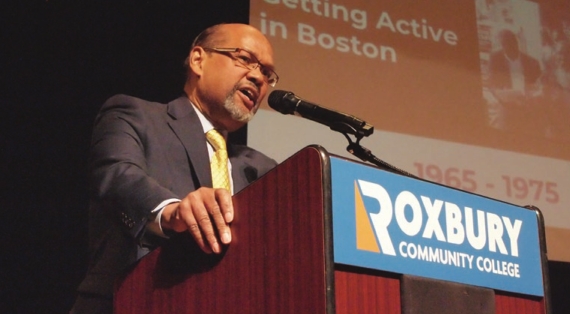
Former City Councilor Charles Yancey speaks in Roxbury Community College’s Media Arts Center.
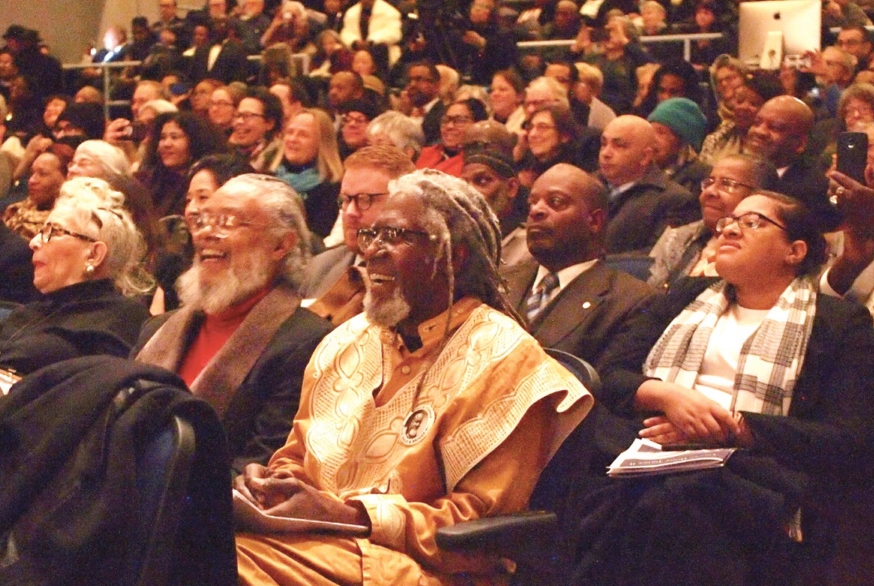
A capacity crowd filled Roxbury Community College’s Media Arts Center.
Speakers recall decades of service
The collection of speakers who turned out Thursday to share their memories of Chuck Turner came from the worlds of politics, organized labor and community activism, each sharing perspectives on how the former city councilor taught, mentored and encouraged them to effect change in Boston.
A crowd in the hundreds packed into the Roxbury Community College Media Arts Center for a three-hour memorial service for Turner, who died last week at age 79. The auditorium filled to capacity within minutes of opening. An overflow crowd gathered nearby at the Reggie Lewis track facility.
Those gathered at the two venues listened to the testimonials of dozens of Turner’s former mentees, colleagues and collaborators.
Former City Council colleague Charles Yancey recalled how Turner helped him organize his fellow Tufts students to protest a university construction project that he said employed no blacks and no women.
“We shut down the construction site until we could negotiate,” Yancey recalled. “Then we shut down the entire university.”
The
jobs Turner and Yancey negotiated through the action were among
countless jobs Turner advocated for on behalf of people of color, women
and white Boston residents during a time when a majority of construction
jobs were going to white men living outside Boston.
That
work continued as Turner advocated for a policy signed into law by
then-Mayor Raymond Flynn in 1983 — the Boston Residents Jobs Policy —
that mandated that 50 percent of all jobs go to Boston residents, 25
percent to people of color and 10 percent to women.
Veteran labor activist Dick Monks called Turner’s strategy of including white Boston residents “brilliant.”
“Chuck
knew this would take to political fire out of the white political
leaders who were against this,” Monks said. “Their own constituencies
were being blocked from jobs.”
Turner’s
legislative push, which was sponsored by the late Bruce Bolling on the
council, moved the field of battle from protests at construction sites
to the floor of the City Council’s Iannella Chamber.
“Chuck
always understood that you need an inside game and an outside game if
you’re going to create change,” Monks said, using a line that was
repeated during Thursday’s memorial service.
Speaker
after speaker recalled Turner’s commitment to expanding economic
opportunity for those shut out of Boston’s jobs, supporting grassroots
organizing and mentoring young activists.
Former school principal Suzanne Lee, a longtime Chinatown activist, praised Turner for advocating on behalf of all communities.
“He
always included the immigrant community and all people who were left
out of the power structure,” she said, citing his work with the Third
World Jobs Clearinghouse, an initiative he founded. “Chuck Turner is a
hero in our community. He has always stood with us and he will be
greatly missed.”
Among
the groups Turner helped found were the Greater Roxbury Neighborhood
Authority, which gave residents a voice in the city’s planning to
dispose of public land for development, The Roxbury Neighborhood Council
and the Greater Roxbury Industrial Council.
Turner,
who fought cancer for the last year of his life, worked with
community-based organizations right into December, even as he knew he
had possibly just days to live. Monks and Chinatown Community Land Trust
Director Lydia Lowe recalled two different meetings Turner attended on
Dec. 17, just a week before his Dec. 25 passing.
Former
City Councilor Tito Jackson, who succeeded Turner in representing
District 7, spoke with passion about Turner’s work and integrity.
“The
hardest thing about coming into office behind Chuck Turner was finding
out how hard Chuck Turner worked,” Jackson said, recalling the large
volume of constituent requests he fielded while in City Hall. “I paid
light bills. I paid gas bills. I almost lost my own house.”
Jackson echoed the certainty of many in the room that Turner’s 2010 conviction for allegedly taking a bribe was unjust. Turner was convicted after he met with an FBI informant who told him he planned to host a fundraiser for him, then handed him cash.
“Chuck Turner was not a crook,” Jackson said to a standing ovation.
Jackson
said Turner paid for a Dudley Square district office out of his own
salary and that he had loaned his own campaign more than $100,000.
“What they accused him of taking wouldn’t pay for one month’s rent for his district office,” he said.
Jackson elicited another standing ovation when he suggested the city name a street after Turner.
Among
those in attendance were Mayor Martin Walsh, former Mayor Raymond
Flynn, former state Sen. Linda Dorcena Forry, Sheriff Steve Tompkins and
a number of city councilors and legislators.
“Councilor
Turner dedicated his life to fighting for economic and social justice
for our communities of color, and his work leaves a long lasting legacy
that expands equity on jobs and access to opportunities in our city. He
will be greatly missed,” City Councilor Ed Flynn told the Banner.
In
addition to the testimonials of activists and officials, community
members recited poems and sang songs. Elementary school students from
Paige Academy gave a drumming performance.
In
a particularly poignant moment, former state Rep. Mel King read a poem
he wrote about Turner, concluding by remembering him as “a great human
being who was a model of the power of love.”


