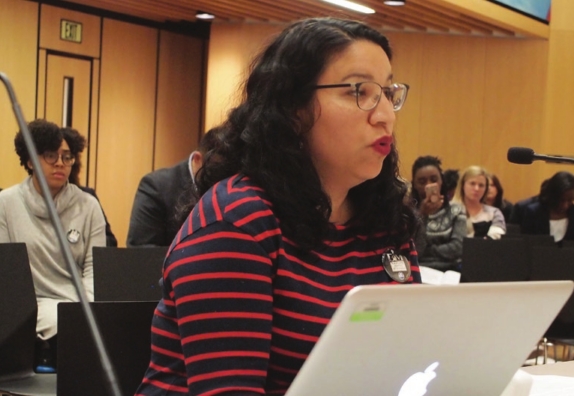
Boston Education Justice Alliance Executive Director Ruby Reyes testifies in front of the School Committee.
School communities wrestle with deficits
Boston Public Schools officials last week announced a $1.39 billion budget and highlighted targeted investments in science instruction, supports for schools facing budget reductions and inclass administration of the ISEE exam the district uses for admission to its three exam high schools.
Interim Superintendent Laura Perille characterized the allocation, a 2.4 percent increase over last year’s sum, as the “largest budget in the history of the Boston Public Schools,” repeating a claim BPS officials have made during the past two budget cycles. While the school system, like the City of Boston and Commonwealth of Massachusetts, routinely increases spending yearly as the costs of salaries, benefits, and goods and services rise with inflation, parent activists and teachers at last Wednesday’s School Committee meeting testified that allocations for many schools are still not enough to cover basic necessities.
“Due to the low enrollment projections, our budget cut seems to be in the $276,000 range,” testified Antonietta Brownell, a member of the Curtis Guild school’s parent council group. “We believe this is the fourth consecutive year that our school faces cuts over $100,000.”
Under the BPS system’s weighted student funding formula, funding for individual schools is determined by the number of students enrolled and their needs.
When the number of students enrolled
in a school declines, the school loses the per-pupil funding for each
seat that remains unfilled. Because the cost of paying for staff such as
teachers, programming and paraprofessionals often remains the same
regardless of enrollment numbers, school communities are often forced to
cut programs and positions. Those cuts are usually announced in
December or January, before the following year’s BPS budget is released.
School
site councils reporting budget cuts for Fiscal Year 2020 on a parent
activist Facebook page include Mather Elementary, with a $400,000 cut
expected; Nathan Hale Elementary, where the parent council recently
launched a GoFundMe campaign to save a computer science teacher position
in the face of a $130,000 cut; the BTU Pilot K-8, which is anticipating
a $168,000 cut and the Henderson K-12 Inclusion School, said to be
facing a $400,000 cut.
BPS officials have not yet released a full list of schools receiving budget reductions under the weighted student formula.
Kristin
Johnson, the parent of a BTU Pilot student, said the school’s budget
deficit would likely force the layoff of a middle school math and
science teacher and a paraprofessional and result in one less day of art
instruction per week.
“As
a result, next year our sixth-, seventh- and eighth-graders at BTU will
share one math teacher, one science teacher and two teachers
instructing both ELA and social studies,” Johnson said during the Feb. 6
School Committee meeting. “Students and teachers across the district
will once again be asked to do more with less.”
The
weighted student funding system has sparked controversy in recent
budget cycles as critics have decried what some describe as a “Hunger
Games” competition for funding.
“In
the current system, when one school wins, another experiences a cut
that is the first step to school closure. This creates a culture where
surviving becomes winning at another school’s expense,” said Ruby Reyes,
executive director of the Boston Education Justice Alliance, testifying
during the meeting. “Every student should have an educational
experience in which they feel safe, cared for and have access to quality
learning environments. They should not have an apocalyptic-style
culture of destroying the basic needs of those who underperform.”
Last
year, parent advocates from schools receiving cuts decried the loss of
school nurses, psychologists, social workers, librarians and libraries.
During last week’s meeting, Boston Teachers Union Political Director
Johnny McInnis noted that there 1,348 students for every one guidance
counselor in the Boston schools, whereas nationally the average is
482-to-1.
Perille told
reporters BPS has made additional investments in nurses, psychologists
and social workers. This year, each school now has at least a half-time
nurse.
“We continue to
aspire to build those investments, and that is part of our ongoing
dialogue with school communities,” she said. “There is not a flat
investment as yet in this budget.”
Perille
also said BPS has invested in Naviance, a software system that helps
students with college planning and career assessments. The software will
be available in all high schools next year.
New and expanded funding in the next school year’s budget includes:
• $3.8 million in new funding to expand the number of K1 seats in community-based programs
• $750,000 to facilitate improved outcomes for schools identified as needing support
•
$500,000 for the BPS Office of Engagement to support family engagement
in schools and for BPS Welcome Centers, which help families enroll
students in the system
• $375,000 for expanded science instruction
•
$364 for schools to host the ISEE, the test students must take to gain
entrance to one of the city’s three exam schools. Students in each
sixth-grade class will be able to opt in and take the test in class.
State funding
BPS
officials cited declining state aid and a flow of funds from district
to charter schools, which receive state funding earmarked for school
districts in a system similar to the BPS student weighted funding. While
state Chapter 70 funding accounted for 20 percent of the Boston
district’s funding in 2010, it now accounts for just 4 percent,
according to BPS figures.
Perille
said BPS officials would be actively involved in efforts to increase
state funding. Mayor Martin Walsh is supporting the PROMISE Act,
legislation filed by state Sen. Sonia Chang-Diaz that would increase
state funding by more than $1 billion over a seven-year period to
provide adequate funding for school districts across the state.
“The
state funding has to be part of the conversation,” Perille said. “We
think it is important, even as we debate here in the Boston Public
Schools how will we allocate the resources we have in the pie this year.
There is no question that that pie needs to be larger. Especially when
you look at the extremely high-needs base of our student population.”


