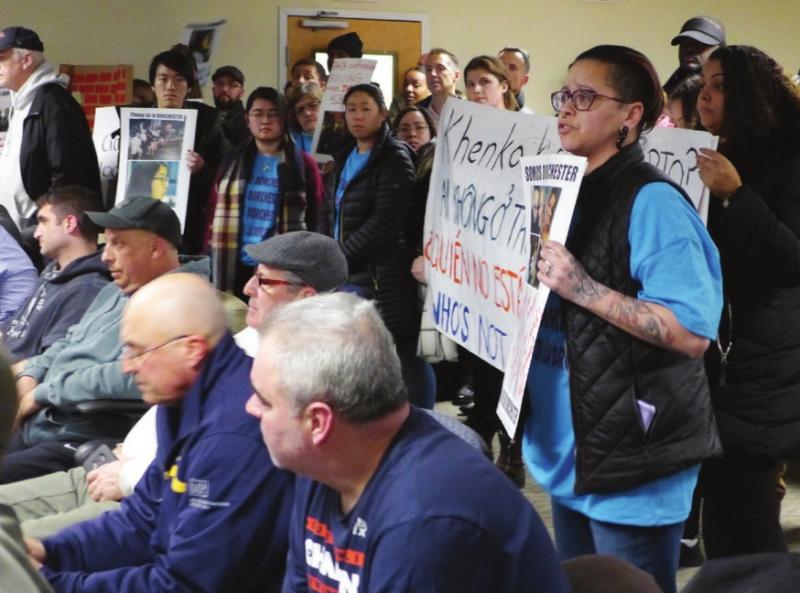
Mimi Ramos and other members of the group Dorchester Not For Sale spoke out against plans for a 488-unit development near Fields Corner.
Building trades voice support, abutters are divided
Developers of one of the largest residential complexes planned for Dorchester squared off against affordable housing activists at a meeting Monday, defending the Dot Block project against charges that it will drive up rents in the area and force longtime residents out of the city.
The back-and-forth between supporters and opponents of the project got testy at times, with members of the group Dorchester Not For Sale predicting displacement and some abutters complaining about traffic, while representatives of nearby neighborhood groups and building trade union members spoke in favor.
“This is not for us,” said Mimi Ramos, who wore a blue T-shirt with the words “We are Dorchester” written in English, Spanish, Cape Verdean Kriolu and Vietnamese. “You are basically telling the community that you don’t want us here.”
The development project, which sits on land bordered by Dorchester Avenue, Hancock Street, Pleasant Street and Greenmount
Street, received approval from the Boston Planning and Development
board in 2016 for 362 units of housing, a fivestory parking garage and
37,000 square feet of retail.
More units
In
January, developer Wintergold LLC and Samuels & Associates filed
for a project change that would increase the number of units to 488,
relocate the parking under the buildings and reduce the commercial space
to 23,000 square feet. Included in the new figure are 66 affordable
units — half a percentage point over the city’s minimum requirement of
13 percent of the total.
Menzin
noted that three of the units would be affordable to families earning
up to 45 percent of the Area Median Income, 12 would be available to
families earning up to 50 percent and 10 to families earning up to 63
percent. He added that the affordability for those units is deeper than
the 70 percent AMI required by the city’s Inclusionary Development
Policy (IDP).
“We’ve heard that traditional affordable housing units don’t work for people in this neighborhood,” he said.
Menzin also said the 66 proposed affordable units would boost overall affordable numbers for the neighborhood.
“Sixty-six units is about equivalent to what’s been built in Dorchester in the last three years with IDP money,” he said.
Speaking in favor of the development, Michael Keaty told the audience he felt very positive about the project.
“Change is hard,” he said. “There’s a lot of concern and a lot of fear. Just try to be positive, folks”.
Dorchester
resident Erica Schwarz praised the project, telling the development
team she would want to live there, but raised concerns about
affordability.
“What are the proposed rents for the market-rate units?” she asked.
Abe Menzin of Samuels and Associates said the firm has not yet settled on numbers.
“I know you have numbers,” Schwarz pressed. “I work in real estate.”
When Menzin said the units would fetch $4 per square foot, Schwarz shot back.
“So a 1,000 square-foot apartment would be $4,000?” Menzin said the apartments would not be that large.
Schwarz echoed the concerns of many in the room, questioning whether the developers could make the rents more affordable.
“This is going to kick off another huge wave of displacement,” she said. “This has to be way more affordable.”
Traffic
Others spoke about the project’s impact on traffic, which backs up significantly on Dorchester Avenue during the afternoon.
Local
business owner Stuart Schrier questioned the traffic impact of the
project, noting that the developers’ decision not to include a
supermarket would induce residents of the 488 units to shop elsewhere.
“Four
hundred eighty-eight families are going to be leaving the site to drive
down to Morrissey Boulevard,” he said. “We can’t take that traffic.”
Affordable
housing activists also complained that the meeting had no translation
services and asked BPDA officials present to schedule another. BPDA
planner Aisling Kerr did not commit to holding another meeting.
The
public comment period for the review of the Dot Block project ends on
Friday, March 1. Comments can be submitted on the BPDA website: www.bostonplans.org/projects/development-projects/dot-block


