Legislators send final bill to governor
Beacon Hill lawmakers have passed a major reform bill that addresses racial disparities in the criminal justice system by repealing some mandatory minimum sentences on non-violent drug charges, reducing or waiving legal fees for low-income offenders, and lowering the number of years that criminal records are sealed from employers. All they are waiting for next is Governor Charlie Baker’s final approval.
Advocacy groups, legislators and formerly incarcerated individuals have been pushing for these changes in Beacon Hill for the past four years.
“This bill is a massive and joyful turning point for our state. It finally honors the needs of communities that experience the most crime and who are too often ignored,” said Sen. Sonia Chang- Diaz who was one of the lead sponsors of the key bills that made it into the final version. “It includes serious evidence-based reforms that will make our criminal justice system, from start to finish, more effective and efficient.”
A spokesperson for the Jobs NOT Jail Coalition, Lewis Finfer, said in a statement, “It [the bill] will have a serious positive impact on the major problems of mass incarceration, recidivism, great racial disparities in who is sentenced to prison, and too many with substance use disorder going to prison instead of to drug treatment.”
Key changes to the criminal justice system include:
- Raising the threshold for felony theft from $250 to $1,200.
- Decreasing
the number of years after which criminal records are sealed from
employers from 10 years for felonies to 7 years, and from 5 years for
misdemeanors to 3 years.
- Requiring district
attorneys to create pre-arraignment diversion programs for individuals
with substance abuse or mental illness.
- Authorizing expungement of certain juvenile and criminal records for individuals ages 18–21.
- Limiting and regulating solitary confinement.
- Repealing and limiting mandatory minimum sentences for non-opiate, non-weight retail drug offenses.
- Strengthening mandatory minimum sentences for opiate trafficking.
Calvin
Feliciano, political director for labor union SEIU 509 and criminal
justice reform advocate called the bill “a good compromise,” but said it
didn’t go far enough.
“I
feel disheartened that although the bill is more fair towards opioid
drug addicts, they’re getting a lot harsher with drug dealers,” he said.
“It’s all these white addicts buying in urban cities from black and
brown petty dealers and now those petty dealers are going to get
mandatory minimums.”
However, Feliciano said he was excited about the raise in the felony theft threshold and the CORI reform.
“It’s huge in terms of getting people back to work,” he said.
Earlier
in the week, a group of NFL football players, in partnership with the
American Civil Liberties Union of Massachusetts, visited the State House
to talk to legislators and press about their advocacy work with the
Players Coalition, a nonprofit organization that addresses racial
disparities in the education and justice system.
New
England Patriots player Devin McCourty, former Patriot Troy Brown and
former Pittsburgh Steeler Ulish Booker, leaders of the Players
Coalition, met with House Speaker Robert DeLeo, Senate President
Harriette Chandler, Governor Charlie Baker’s staff and criminal justice
reform advocates.
“It’s
been great to be a part of this community for me in my ninth year and
seeing [that] Massachusetts does want to advance, create change and do
different things,” said McCourty at the press conference.
Among
the policies McCourty and his group support are raising the juvenile
age from 18 to 19, not allowing children as young as age 7 to be tried
in a juvenile court, eradicating mandatory minimum sentences and
ensuring more equitable education funding across the state.
In
reference to the former juvenile offenders he was able to meet with
that day, McCourty said, “These are kids being brought straight from
elementary or middle schools, tried as adults.”
McCourty
said that after hearing about their trauma and how they were made to
feel like criminals, he understood how later as adults, they continued
to stay in the criminal system.
Carol
Rose, executive director of ACLU Massachusetts, told the Banner that
the players “have had a warm welcome here and it shows that in
Massachusetts everyone has an opportunity and obligation to use whatever
platform they have, including famous NFL players, to urge freedom and
justice for all people.”
When
asked to respond to those who say athletes shouldn’t have any voice in
politics and social justice, McCourty told the Banner, “They’re probably
doing a little hiding right now, because I think you’re seeing more
athletes using their platform, not just to hear our stories and our
opinions but so you can hear stories of people, [that] without us
sitting on a platform talking about it, no one would want to listen to.”
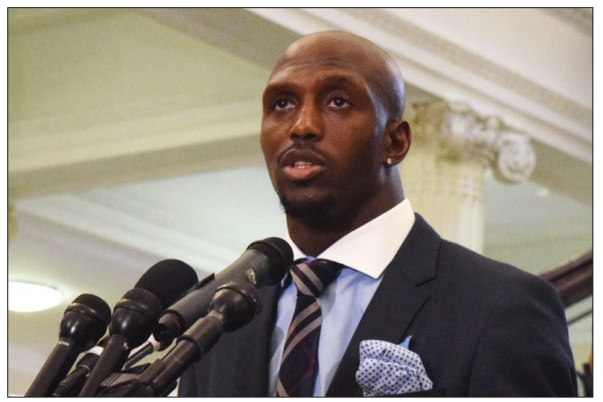
New
England Patriots player Devin McCourty makes an appearance at the State
House last week to advocate for criminal justice reform.


