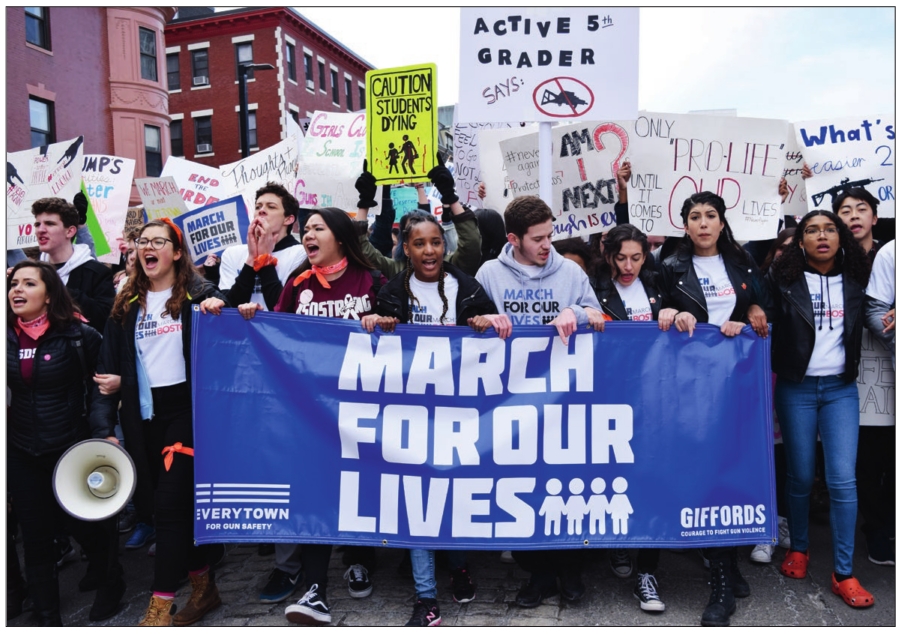
Local student organizers leading the two-mile March for Our Lives that began in Roxbury and ended at the Boston Common.
The event was part of national student-led movement
More
than 50,000 people of all ages and from all over New England joined the
March for Our Lives Boston event on Saturday spearheaded by local youth
who are demanding policy action to prevent gun violence and mass
shootings.
The march
was spurred by the Feb. 14 mass shooting at Marjory Stoneman Douglas
High school in Parkland, Florida that claimed the lives of 17 and left
17 others wounded.
Since then, young people have been at the forefront of the movement for stricter gun control laws.
The
march, which began in Roxbury at Madison Park High School and proceeded
for two miles, ending at the Boston Common, was one of more than 800
demonstrations that occurred across the nation over the weekend.
At
the Common, people spilled onto the surrounding streets to hear from
the student organizers and their allies speaking from a stage.
“My
school will always be remembered for what took place on February 14,
2018,” said Leslie Chiu, a Northeastern student and graduate of Stoneman
Douglas High.
“But it
will also be known to people across the country that is a school that
started the movement that we are a part of today,” Chiu roared into the
microphone, her voice breaking with emotion. “We will take it upon
ourselves, to make sure that we are the last ones in this environment of
daily shootings, we will tell them that we are here and we are angry and we are strong.”
Becca
Munoz, who is a sophomore at Northeastern University, went on stage
with her younger sister Leonor, a current student at Douglas High in
Parkland, FL. “These are our lives at stake,” she said. “We shouldn’t
have to fight for our lives — but we will, and we are.”
“Not one more,” they chanted, as the crowd at the Common joined in unison.
The
student organizers of Boston’s march highlighted not only mass
shootings in suburban high schools that were previously deemed to be
“safe communities” but in cities where young people of color face the
dangers of gun violence and police brutality.
“Because
the thing that sets Parkland apart is our wealth and color of our
skin,” said Munoz. “We cannot be complacent of a system that designates
certain areas safe while communities of color continue to be neglected
and disproportionately affected by gun violence.”
The
sisters spoke of Tarek Mroue, a black man killed in a road rage
incident in Roxbury and Stephon Clark, an unarmed black man who was shot
20 times in his backyard by Sacramento Police in California.
“There cannot be one more,” they repeated.
Graciela
Mohamedi, a physics teacher at Rockland High School, also spoke at the
rally, recalling the moment when she served for the U.S. Marine Corps
and she understood that her rifle was a weapon of war, with the singular
purpose of killing enemy combatants as quickly as possible.
Mohamedi said that as a teacher and veteran, she does not want to be armed.
“If
you want to arm teachers, arm us with science equipment ... with books
that aren’t missing pages ... arm us with equitable funding throughout
all school districts,” she said.
Bolaji
Olagbegi, a Boston University student from Texas, joined the march at
Madison Park, making her way down Tremont Street with the crowd.
“I
think it’s a really important cause that affects a lot of us and it’s a
problem that should have been fixed by now,” she said.
“More guns aren’t going to fix the problem,” she added.
“This
is my first march, I’m from Jamaica, so it’s nice for me to be able to
be here and do this,” said Jordan Richards, a senior at Johnson &
Wales University. “I don’t think anyone should have guns, personally.”
Massachusetts
already has strict gun laws with background checks required for private
sales, registration required for all gun owners, and the prohibition of
assault weapons and magazines of over 10 rounds capacity. However, the
students of March for Our Lives Boston hope that their state’s common
sense laws can carry over to other states and cities.
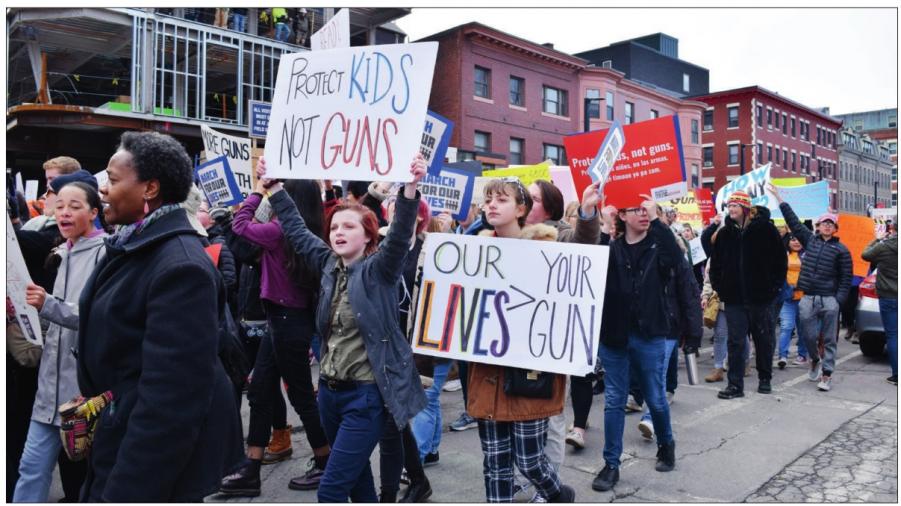
March For Our Lives participants make their way through lower Roxbury to the Boston Common.


