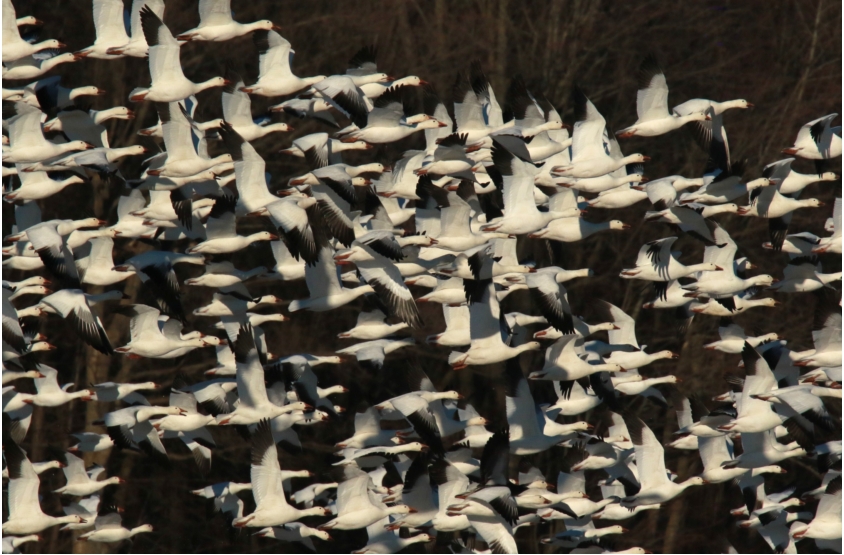
In the last few weeks has been a large amount of staged geese and swans in the Alabama Swamps.
Some of the swans have moved on but the goose numbers continue to climb but they are more scatter than before, now that the snow conditions have deteriorated. However another goose has been moving in, one that we don't see a lot of here until-snow goose.
This goose is a little smaller than our common Canada goose weighing around seven pounds as compare to the Canada of ten pounds. He is of course all white with black tipped wings and pinkish feet and beak. Snows travel in large flocks and move around a lot as with such large flocks they “clean up” farm fields pretty quickly. There are two sub species of the snow goose, the Greater which we see in our area and the Lesser which is more of a western bird. The Lesser is stockier and weighs around five pounds. There is also a Blue goose which is just a color dark morph of the Snow and is much less common. These birds nest in Arctic and we only see them when they are migrating between there and their Southern wintering grounds (which for our Snows is New Jersey, Delaware, and Maryland).
It is estimated a that over 100,000 Snows migrate thru New York State, mostly in the St. Lawrence Valley, the Finger Lakes and Lake Champlain areas but we are seeing more of them in our end of the State now. The Snow goose population has exploded over the last couple of decades or so. There has been concerns about them destroying their breeding grounds for not only themselves but for other wildlife up there. On their southern wintering grounds they have been doing considerable damage to the farm lands. There is also concern about a disease break out of some kind like the Avian Flu and having them getting wiped out completely. In our flyway, the Atlantic Flyway, their population has increased from around 50,000 birds in the mid 1960s to more than one million birds in recent years.
In 2008, after traditional management programs were unsuccessful in reducing their over abundance, Federal and state regulations were amended to allow additional harvest of snow geese in. At present a special Snow goose hunting season runs from January 16 through April 15.
Methods of taking are less restricted for this season with extended shooting hours, use of electrical game callers, the use of shotguns capable of holding more than three shells and high daily bag limits of 25 per day.
Although there has been a big effort to control the Snow goose populations they continue to grow. Here in New York most of the hunting for them is in the St. Lawrence Valley, the upper Hudson and Champlain Valley regions. At present their numbers in our area are not plentiful or frequent enough to provide good hunting for them. They are difficult birds to hunt because they travel in huge flocks and huge decoy set ups are needed to lure them into shooting range. When they are shot at a large number of birds are “educated” to decoys and they become even more difficult to decoy in the future. This alone could be why we are starting to see more of them in our area, they are being driven from the above mentioned areas by hunting pressure.
So last week it was my good fortune to run into several huge flocks and was able to photograph them. I have seen a few Snows mixed in with our Canada geese flocks in this area but nothing like what was experience these times!
Snow geese are constantly on the move, when on the ground, rooting up the crop fields in search of the spoils from the crop harvest season. If you spend some time watching them you may experience them “jumping” as one big, tight mass to move to another section of the field or one nearby. The sight is something to behold and the noise they make with their calling is deafening.
Our local Alabama Swamps provides great spring wildlife observations but if you really want to see Snow geese in mass the place to go is the area around the Montezuma National Wildlife Refuge. It is a hour and half drive (100 miles) from Medina but well worth the trip in the spring. They have a four mile drive that is very nice for folks who have handicaps but that doesn't open until the start of April. However there are many areas with great wildlife viewing if you take the time and scout them out. This is a major migration corridor for waterfowl and Snows gather there by tens of thousands. The place to go is what they call The Mud Flats. This refuge and the near by NYS DEC Northern Montezuma Wildlife Management Area are great areas to visit to in the spring as migrating birds pass thru.


