Producer Ty Yost’s National Team Roping Tour is gaining momentum across the American West, thanks to a formula that serves the roper first.
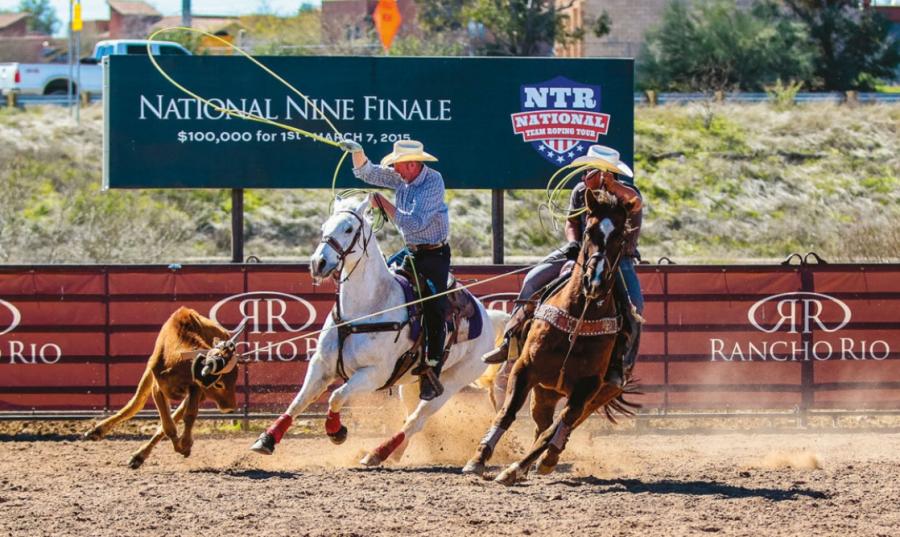
The National Team Roping Tour relies on a simple formula: low entry fees, huge payouts and a finale in the most desirable destination a team roper could want in March—Wickenburg, Ariz. With nearly 50 stops throughout its inaugural season in 2014, the NTR offered its 3,500 members $2.2 million in cash and $800,000 in prizes including five trucks and 250 trophy saddles at NTR qualifiers across nine states.
Like many great ideas though, the journey to this simple system was a complicated one for founder Ty Yost. The NTR came about after years of ingenuity, relationship building and a whole lot of jackpotting. While one NTR roping might feature a National Nine qualifier, as well as an Open down to a #6, another might just have a National 8 down to a #6. For Yost, the ability to mold each individual roping to each specific roping community in each city and the time of year is the biggest strength of his new organization that’s been years in the making.
STARTING POINTS
Yost, a Montana native who now spends his winters in Wickenburg, grew up watching his parents, mother Karen and father George, along with his sisters Heather, Katie and Kellie produce some of the earliest jackpots in the northwest. By his sophomore year of college at Montana State University, Yost was putting on ropings of his own in his hometown of Billings. Yost was at MSU to college rodeo his way through a business degree, one that he’d put to use shortly after graduating.
“At some point then, I took my focus off rodeoing and I realized I didn’t want it enough,” Yost remembers. “I didn’t seem to me that the rewards that a rodeo career would garner would equal the amount of work and risk necessary to compete at that level. I needed to change my focus and get to work.”
But for Yost, work still meant rodeo.
He started working for Jerome Robinson, who now coordinates the live television for the Professional Bull Riders Built Ford Tough Tour. At the time, Robinson was producing a series of indoor rodeos called the Wrangler ProRodeo Classics. These were PRCA sanctioned rodeos in large urban markets. The markets included NBA coliseums in Sacramento, Calif., Portland, Ore. and Indianapolis, Ind.
“I was amazed at the business model,” Yost says. “I didn’t know it existed really.
I didn’t know you could rent coliseums, do the advertising, sell the tickets, lease the stock and put on a rodeo and make it work. I liked every part of that. Looking back, one of the things I really liked was not knowing what the financial outcome would be. You could spend all year setting up the event and then it might blizzard and no one would show up, and the event would tank and lose money. But on the other end of the spectrum, when everything clicked, the weather, the promotions, the timing, and you sold out of tickets, how sweet that was!” From Robinson, Yost learned how to manage event sponsorship, how to write contracts for personnel and how to manage media coverage, all skills he’s found essential throughout his career.
One of the most impressive skills Yost saw in Robinson was his ability to be calm under pressure, knowing that it was Robinson’s own money at risk.
“I remember times when an event was doing well, maybe making $100,000 and times when the seats where empty and Jerome might have been losing $50,000. That man was so cool, no difference in his outward appearance.”
ADAPTING
Yost went on to learn from watching Booger Barter, Tim Nelson, Ron Treat and especially Denny Gentry over the last two decades in his capacity at Yost Events, Inc. Under that umbrella, Yost put on barrel races, team ropings, cuttings, bull ridings and even concerts at facilities where he’d built lasting relationships.
Yost is quick to give credit for the idea about the progressive pot format, that the National Eight and National Nine use to Denny Gentry. In visits with Yost, Gentry told him about a format that he had been working on and that it had been implemented at RFD TV’s The American and its qualifier events. Yost liked the format, where for a low entry fee you could run at big money.
“A key factor is dates,” Yost explains.
“Dates can make or break a good event. I had all these dates I’d had booked for 10 to 15 years. So when I went to start the National All-Amateur, the predecessor to the National Team Roping Tour, all of those dates fit in naturally and we were able to capitalize.”
Yost had put on USTRC-sanctioned events but went out on his own to kick off the National All-Amateur in 2012, and in 2014 changed the name and format to the National Team Roping Tour, aimed at filling a void for ropers from #3s, #4s and #5s, but maintaining enough big-picture perspective to build innovative formats for higher-numbered ropers, too.
“We are focused on the #3, #4 and #5 roper,” Yost said. “We want to let them rope for the kind of money, and with the kind of excitement, that the higher numbered ropers get to enjoy. But that said, we have an eye to the future in expanding our formats and experimenting with formats to include the higher number roper, too. Many of our weekend productions, and most of our productions throughout the winter in Arizona, have higher number ropings included, and we want to grow those. But the primary focus this year are the National 8 and National 9 Finales that each will pay $100,000 for first.”
“FOR YOUR INITIAL $100 ENTRY FEE AT THE QUALIFIER, YOU ARE ELIGIBLE TO SPLIT $100,000 AT THE FINALE. THAT’S 500 TIMES YOUR INITIAL INVESTMENT. EVEN THE GEORGE STRAIT, THE BIGGEST JACKPOT ROPING IN THE WORLD, DOESN’T HAVE THAT KIND OF MULTIPLE.”
- Ty Yost
QUALITY CONTROL
One key detail of the success of the NTR is the great job the TRIAD classifications office does. The NTR, like the USTRC and WSTR, relies on TRIAD classifications.
“I can’t express my gratitude enough to the TRIAD and the TRIAD employees,” Yost says. “It seems ropers get more concerned about their classification and others’ classifications, rather than catching their steers. There is one thing I know for certain about roping, it doesn’t matter at all your classification if you don’t catch your steers.”
Yost attends so many of his events with his insistence on carefully monitoring his cattle. Since his family began putting on ropings in 1971, the Yosts have predominantly had their own Mexican cattle for their jackpots. Yost estimates he goes through a couple thousand head of cattle each year, with the bulk of them used in Arizona during the busy winter season. Of the 50 or so NTR events held this year, 90 percent will rely on Yost’s own cattle.
Cattle preparation is key, Yost says, and he makes sure his are ready by first sending them to a cutter to break in. They cut the cattle and use them for fence work, and they rope them, too. Then the cattle generally make their way to the higher-number and Open NTR ropings throughout the year before they’re sufficiently sorted for the #3s, #4s and #5s.
THE DEMAND
For those who qualify to compete in Arizona at Yost’s Rancho Rio in the National 8 and National 9, Yost’s goal is to create the kind of atmosphere that an amateur roper may never get to experience anywhere else.
“First of all, their fees are paid into the #8 and the #9 if they qualify,” Yost says.
“Come rope for free at a roping that pays $100,000—the $1,000 you win at the qualifier can be your gas money to get to Wickenburg. I’ve never seen a happier group of ropers in my life.”
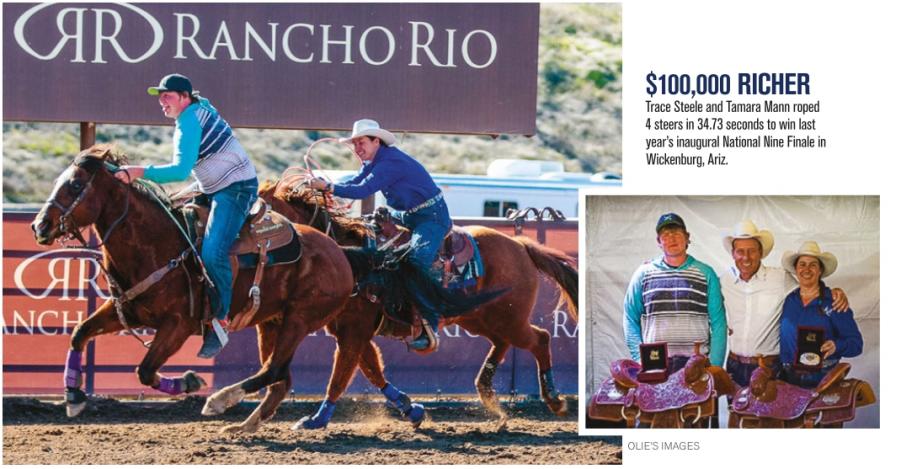
Last year, each team that made the short round in the National 9 Finale won $1,000, with the average paying 35 holes, in addition to consolation rounds and fast time checks.
“Our National format has the best multiple in the industry,” Yost says. “Your risk to enter is the lowest in the industry. For your initial $100 entry fee at the qualifier, you are eligible to split $100,000 at the Finale. That’s 500 times your initial investment. Even the George Strait, the biggest jackpot roping in the world, doesn’t have that kind of multiple.”
Last year, the National Nine Finale paid out $313,000, with the entire NTR Finale paying $516,890 to 2,224 teams over five days.
Held at Rancho Rio, in Wickenburg, the NTR Finale offers way more than just a huge payout. The facility is located minutes from downtown Wickenburg on 55 acres, with two arenas and hundreds of stalls to house the ropers who come to spend the winter in Arizona.
“If you come down here for a week, pretty soon you come down here for two weeks, then a month, then you’re renting a place, then you’re buying a place,” Yost said of life in Arizona in the winter. “It doesn’t get any better.”