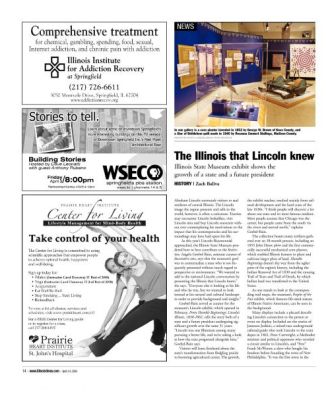
Illinois State Museum exhibit shows the growth of a state and a future president Illinois State Museum exhibit shows the growth of a state and a future president Abraham Lincoln surrounds visitors to and residents of central Illinois. The Lincoln image the region presents and sells to the world, however, is often a caricature. Tourists may encounter Lincoln lookalikes, visit Lincoln sites and buy Lincoln souvenirs without ever contemplating his motivations or the impact that his contemporaries and his surroundings may have had upon his life. As this year’s Lincoln Bicentennial approached, the Illinois State Museum pondered how to best contribute to the festivities. Angela Goebel-Bain, assistant curator of decorative arts, says that the museum’s goal was to contextualize a man who is too frequently presented without much regard to perspective or environment. “We wanted to add to the national Lincoln conversation by presenting the Illinois that Lincoln knew,” she says. “Everyone else is looking at his life and who he was, but we wanted to look instead at his natural and cultural landscape in order to provide background and insight.”
Goebel-Bain served as curator for the museum’s Lincoln exhibit, which opened in February. From Humble Beginnings: Lincoln’s Illinois, 1830-1861, tells the story both of a state and a future president undergoing significant growth over the same 31 years.
“Lincoln was one Illinoisan among many pursuing a better life, and we’re taking a look at how the state progressed alongside him,” Goebel-Bain says. Visitors will learn firsthand about the state’s transformation from fledgling prairie to booming agricultural center. The growth, the exhibit teaches, resulted mainly from railroad development and the land craze of the late 1830s. “I think people will discover a lot about our state and its most famous resident.
Most people assume that Chicago was the center, but people came from the south via the rivers and moved north,” explains Goebel-Bain.
The collection boasts many artifacts gathered over an 18-month process, including an 1855 John Deere plow and the first commercially successful mechanical corn planter, which enabled Illinois farmers to plant and cultivate larger plots of land. Humble Beginnings doesn’t shy way from the uglier parts of the region’s history, including the Indian Removal Act of 1830 and the ensuing Trail of Tears and Trail of Death, by which Indian land was transferred to the United States.
As one stands to look at the corresponding trail maps, the museum’s Peoples of the Past exhibit, which features life-sized statues of Illinois Native Americans, can be seen in the background.
Many displays include a placard describing Lincoln’s connection to the person or event on display. Included are the stories of Jameson Jenkins, a mixed-race underground railroad guide who took Lincoln to the train depot in 1861, Peter Cartwright, a Methodist minister and political opponent who traveled a circuit similar to Lincoln’s, and “Free” Frank McWorter, a slave who bought his freedom before founding the town of New Philadelphia. “It was the first town in |