Page 15 Loading... Tips: Click on articles from page |
 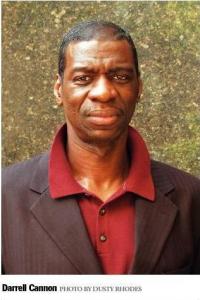 Darrell Cannon paused just long enough to have his picture taken for this paper outside the Rainbow PUSH headquarters in Chicago. He had just wrapped up an hour-long television interview with an Indiana station, and was trying to return phone calls before heading off to a radio appearance with the Rev. Jesse Jackson. Cannon, one of the first inmates incarcerated at Tamms, doesn’t miss any opportunity to educate the public about the prison.
“It’s a hellhole,” he says, during a late-night phone interview, squeezed in after his shift as an outreach worker for a gang intervention program called Ceasefire. “It’s a place designed to break you mentally, spiritually and physically, and if you’re not strong enough, it happens.”
Cannon sums up his criminal history this way: "I've never been an angel, nor have I been a monster." He can't discuss details due to a pending and hard-won suppression hearing that could set a precedent for scores of other men who had the misfortune to encounter officers from Chicago Police Department's notorious Area Two violent crimes unit, led by Lt. Jon Burge. Cannon's encounter came in November 1983, when he was on parole and two of Burge's officers picked Cannon up to question him about a shooting. At his trial in 1984, Cannon told the judge that the officers drove him to a remote area, showed him what appeared to be a loaded shotgun, put it in his mouth and pulled the trigger, three times. Then they stretched him across the back seat of a squad car, pulled down his pants, applied a cattle prod to his testicles, and soon obtained a confession.
Years later, Cannon’s tale of torture and scores of others much like it were confirmed by investigators and acknowledged by judges. Burge was fired, and the city of Chicago paid more than $20 million to settle claims from his victims. Cleared for release in April 2007, Cannon was given one weekend of lockup in Stateville to transition between nine years of solitary at Tamms and the city of Chicago.
“I have tons of frustration, anger, hatred, all those things built up in me. It’s a wonder that I don’t have a bleeding ulcer,” Cannon says. But asked if he knows anyone who deserves incarceration at Tamms, Cannon is adamant that his answer is no. “There are people who deserve to be in prison, but no one deserves to be in Tamms. Not even an animal,” he says. “They’ve created some monsters that are sitting dormant. Sooner or later they’re going to get out. Politicians better do something. They better give these men some light of day.” Like Cannon, Michael Johnson was also brutalized by the Burge crew. Johnson’s mother, Mary L. Johnson, blames herself: she filed a complaint against officers back in 1970, when she says Michael and his friends were approached by CPD in the park, and Michael was beaten up. He was 16 at the time. Soon after his 17th birthday (when he was old enough be charged as an adult), he became a target of police, arrested 17 times within six months and charged with petty infractions like loitering or disturbing the peace. When he wore a hat with a pin in it, he was charged with possession of a deadly weapon, Mary says.
She admits that her son wasn’t a saint. “He was really into gangs when he was a young person. He found out the police respected gangs more than they respected me,” she says. Michael’s 56 now; when he was a child, the Blackstone Rangers ruled his neighborhood, using a federal grant to hand out summer jobs for kids. The Rangers’ founder, Jeff Fort, was treated like a community organizer, and was even invited to the inauguration of President Richard Nixon.
At age 17, Michael was sent to prison on a shooting charge. Mary believes he was innocent of that charge (he was working as a porter at the Palmer House Hotel at the time), but she says he came out of prison at age 19 using drugs and primed for a life of crime. He returned to prison after his brilliant scheme to hold up a drug house went awry. Within a few months of his arrival at Pontiac, Superintendent Taylor was killed. Mary has reams of detailed documents that she believes prove that Michael was framed for the Taylor murder. He refused four plea bargains, from 15 years down to 10 and finally, “is there any number of years that you would accept in your case?” Mary says Michael responded that he wouldn’t accept a plea bargain for 15 minutes if it meant confessing to something he didn’t do. At trial, he was given a life sentence.
Yet despite her staunch belief in her son’s actual innocence, and in the face of his probable life sentence in Tamms, she says Michael may be better off there than in a general population joint where he could be “set up” like he was with the Taylor murder.
“My son is not the poster boy for Tamms,” she says. “It’s so cruel for other people. But my son can spend the rest of his time there — if they would just let him come out periodically and hug me and his children.”
She’s a smart woman, and she smiles as she speaks. Somewhere in her soul, though, Mary L. Johnson knows that as long as her son is incarcerated at Tamms, he will never be allowed to hug her or his children. Contact Dusty Rhodes at [email protected] |


