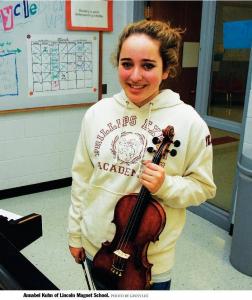

Future musicians? Maybe so, maybe not
Since 2002, program cuts have made it much more difficult for students to begin, continue and master instrumental music performance.
That year, when voters turned down a property tax increase set to help fund Springfield schools, school board members began looking for budget cuts and, District 186 Fine Arts Facilitator Lynn Gilmore speculates, noticed that three full-time beginning band instructors were preparing to retire at the end of the year. That was the first opportunity to cut band programs.
Sure enough. For the 2002-2003 school year, the only beginning band instruction at the elementary level would be at Iles and Feitshans. Even the grassroots Save the Bands campaign in 2003 couldn’t persuade the board to restore fifth-grade band in the rest of the elementary schools.
That same year, middle school principals redoubled efforts to meet achievement standards of the No Child Left Behind Act which, Gilmore explains, mandates that schools make “adequate yearly progress” in academic achievement and close the achievement gap between races, economic groups, students with individualized education plans and other subgroups.
Illinois schools that fail to demonstrate adequate yearly progress are placed on warning lists, as measured by the Illinois Standards Achievement Test (ISAT) and so, despite the well-established link between music studies and academic achievement, local middle school principals focused compliance strategies on increasing language arts and math enrichment — at the expense of arts instruction.
They cut band staff hours and beginning band sections and assigned trained music educators to teach health, physical education and reading classes to fill out their schedules.
And now, on top of district budget cuts and federal yearly progress mandates, there is also the matter of the master school schedule. Each of Springfield’s five middle schools autonomously sets the number of class periods each day, class length, and whether classes meet every day, every other day, or on odd/even days. Kingsley Keys, Franklin Middle School director of bands, sees grade-level bands two or three times per week, except when holidays, onsite professional development meetings, school pictures, assemblies and testing don’t replace band. There are a lot of missed band periods, says Keys. “It’s worse because band doesn’t meet every day. During this year’s ISAT week, there were no electives, and we had Casimir Pulaski Day in there, too — all right before the district’s solo and ensemble contest.” Some students missed nearly two weeks of band classes.
The schedules at Jefferson and Washington are among the most restrictive for electives. Class periods are arranged in blocks, meaning classes meet for longer periods, but less often.
So, illness, holidays, and various other conflicts routinely cause students to go nearly a week between classes. And at Washington, band students only meet for half a block — half as often, for half as long as classes in other schools.
In addition, Gilmore says, students’ elective selection may be restricted by other organizational limitations, including guidance deans who override band requests in order to double up on academic enrichment sessions.
It is a troubling lack of consistency, and just as problematic as lack of funds. “I would love to get to the point where we’re concerned about money,” says Gage. “I have so many students who would like to take band, but they’re not able to because of the scheduling.
“That saddens me more than anything else. If a student wants to play music, but can’t afford an instrument, there are ways to provide for that student. But if they weren’t permitted to take band because of schedule conflicts, there’s no way around that. They don’t really have a choice.”
Springfield High School director of bands Kelly Goldberg sees the ripple effect. “In schools with just 30 minutes of instruction time every other day,” she says, “there’s no way they can accomplish what the other kids can do. As ninth-graders, these students aren’t as far along in their playing skills as they used to be. This affects the dropout rate. When they can’t play as well, they can’t get caught up.”
What to do, and why
The first thing to do is restore fifth-grade beginning band to the rest of Springfield’s elementary schools, say teachers, musicians and Illinois Music Educators Association District 4 President Kim Webster.
“At the fifth-grade level, they’re learning the basics,” says Webster, how to hold an instrument, how to read notes on a page. Starting them in sixth grade, she says, puts the teachers, the beginners and more advanced students at a disadvantage.
“You can’t throw them in with more experienced kids at middle school and expect them to keep up ... and it’s going to follow that progression for years.” By the time they reach high school, Webster says, they’re one to two years behind students who started in fifth grade. They’re less likely to compete successfully at the state level, and less likely to get music scholarships to college.”
And they may not start at all. “By middle school,” says Gilmore, “students have a lot more options than at the elementary level. The world of middle school is so huge for them, there are so many new things; when we start them early, they have more chance to catch that ‘aha!’ experience and carry it into sixth grade.”
Don Udey, retired Chatham bands director, sees many benefits of music performance, and the earlier the better. “The experiences you have performing music make you more relaxed down the road, more confident,” says Udey, including the solo and ensemble contest at Springfield High School he recently judged.
“Arts encourage intelligence and structured thinking. Starting band in sixth grade is slighting the students. They can’t begin to play at the level they used to in the middle and higher levels. And when it comes to competing with other schools, our kids are at a definite disadvantage.
“But it’s not just about competing at All State. It’s about what goes on later in life,” he says — employment opportunities, public service, advances in science and culture and the ability to work in a team. “There is a visible difference in the brain of musicians, in the size of the corpus callosum that connects the
continued on page 14


